 Posted by
Position: 44°34’28″N 121°37’10″W
Back in late August 2003, lightning struck near Mount Jefferson in central Oregon – twice. Both strikes ignited fires that over a period of two weeks consumed some 90,000 acres of forest. More than 2,000 crew fought the blazes which eventually united into a single inferno. Total costs ran close to $40 million. Then President Bush, who visited the nearby town of Redmond, OR, described the fire as, “…the Holocaust; it’s devastating.”
Nature cleans her forest home with fire, burning out messy undergrowth and reducing highly destructive fuel. But man had a better idea: that every fire is an enemy to the forest and must be extinguished. Of course, without nature’s housecleaning deadfall and brush accumulates and accumulates. Once lightning hit and started the B&B Complex fire, dry weather and high winds ignited all the extra fuel and proved once again that humans aren’t smarter than Mother Nature. The blaze was so big it even created its own weather. Several huge fires around the same time shifted fire containment policy to allow more clearing out.
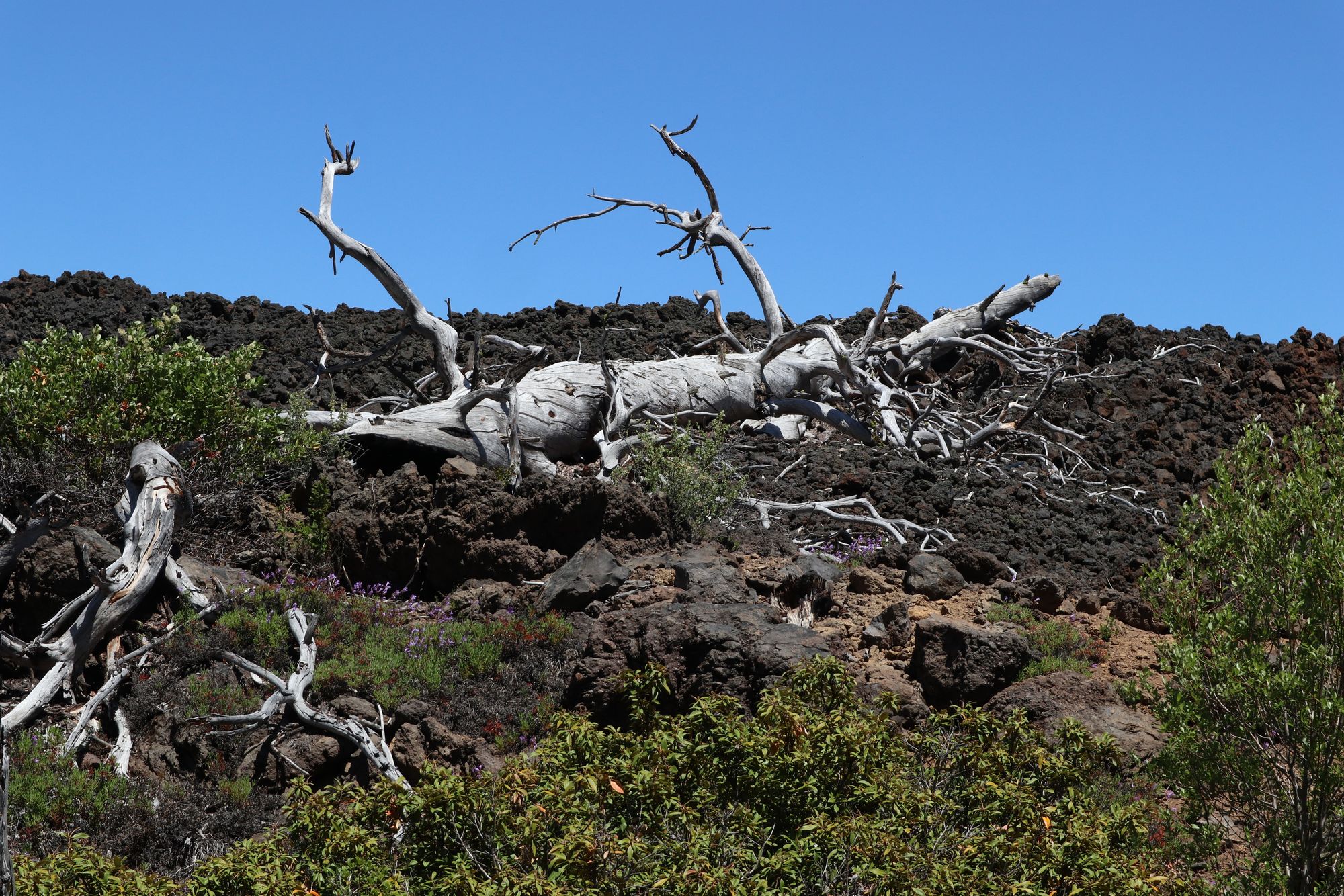
Today the foothills of the Mt. Jefferson Wilderness has precious few tall trees, but plenty of burnt trunks. Yet, an abundance of verdant ground cover demonstrates nature’s resiliency. With our daughters Tai and Ava, along with doggos Marlon and Spencer, we walked through this renewing countryside on a hot, cloudless day last week. The hills swept up and away to our left. To our right ancient lava flows hemmed us in, forming the northern border of the park. The dusty, exposed trail took its toll on the dogs, however, and after a couple of miles we turned back for shadier paths.
A River Runs Through It
In 2020 Oregon experienced some of the most devastating fires in a century. Drier, hotter weather in the region resulting in part from climate change has created a long-term trend. Fortunately, the Metolius River near Sisters, OR, makes a beautifully serene natural firebreak.
Campgrounds these days are booked online. The problem is their prices are still low enough that should the weather turn iffy people don’t bother showing up. That leads to plenty of empty sites that may or may not get occupied. But the further from running water and showers you get the more readily available sites become. And when you’re that far away from civilization, dispersed camping becomes a viable option.
One of the river’s big attractions is the Wizard fish hatchery near the Metolius’s source. Among the fish raised are rainbow trout, steelhead and spring chinook salmon. Come June the hatchery releases the fish and draws fly fisherfolk in like, well, flies. The upper part of the river is posted catch and release only. Bait and hook fishermen can go elsewhere, they’re not welcome.
Norman Maclean
I’m not a fly fisherman, although I have successfully made a side cast in a crosswind on a tricky stretch of the Carson River in Northern California, much to the astonishment of Matt, my riding buddy and instructor. I guess I didn’t know enough to know it was difficult.
But I am a huge fan of Norman Maclean’s work, not least because he was a friend and colleague of my dad’s. Over a tumbler of scotch Norman once told me the story of his first manuscript for ‘A River Runs Through It’. An early reviewer said to him, Norman, it’s interesting, but where’s the poetry? He undertook a complete rewrite and the rest as they say is (art) history.
Links: An excerpt from A River Runs Through It and Young Men and Fire
The following photos were taken on our two trips to the Metolius area this month.


The Metolius is one of my favorite places on earth! It’s serene and takes one back to a different, more simple and rugged time. I’m happy you got to experience it but am disappointed you didn’t get a chance to use the side cast into the wind we worked so hard on! 😉. Tight lines !!!
Completely agree! It’s really beautiful and happily empty right now. I recall tight hamstrings for most of our riding career, but that’s another story.
Beautiful photos
Thanks Ginger!