 Posted by
Position: 37°08’54″N 38°47’20″E
Hiking down Rose Canyon just outside Göreme took us along its arroyo’s tortured course to an open plain five kilometres distant. In a heavy rainstorm it would be deadly. Water must cascade over the huge boulders then course through the narrow slots and roar through the curving tunnels. But with bright sunshine, blue skies, and nothing but frozen puddles to navigate, we felt pretty safe. High above our heads we got our first look at a mystery that wasn’t solved for a full week.
I’m sure if we’d hired a guide that first day, we’d have learned what the little arrays of square and sometimes rounded indentations were. They were everywhere, most at least 25 feet off the ground. Checked grids with 5-10 squares per axis. People lived in the cliffs and caves of Kapadokya right up until 1954 when they were finally rousted out for safety (or social) reasons. That made us wonder if the carvings had something to do with food storage or preparation.


Mardin
A week later, deep in Southern Anatolia, we found the next clue in the puzzle. The city of Mardin sits on a wide bluff 500 metres above the plains of Mesopotamia and 21km from the Syrian border. With all the riches of the Fertile Crescent at its feet, the city went through the region’s routine exchanges by Hittite, Assyrian, Hellenistic, Roman, Byzantine, Seljuk, Ottoman, British, and French forces until it finally embraced an independent Turkey in 1923. If you want your community to remain occupied down through the centuries, remember, it’s all about location, location, location.
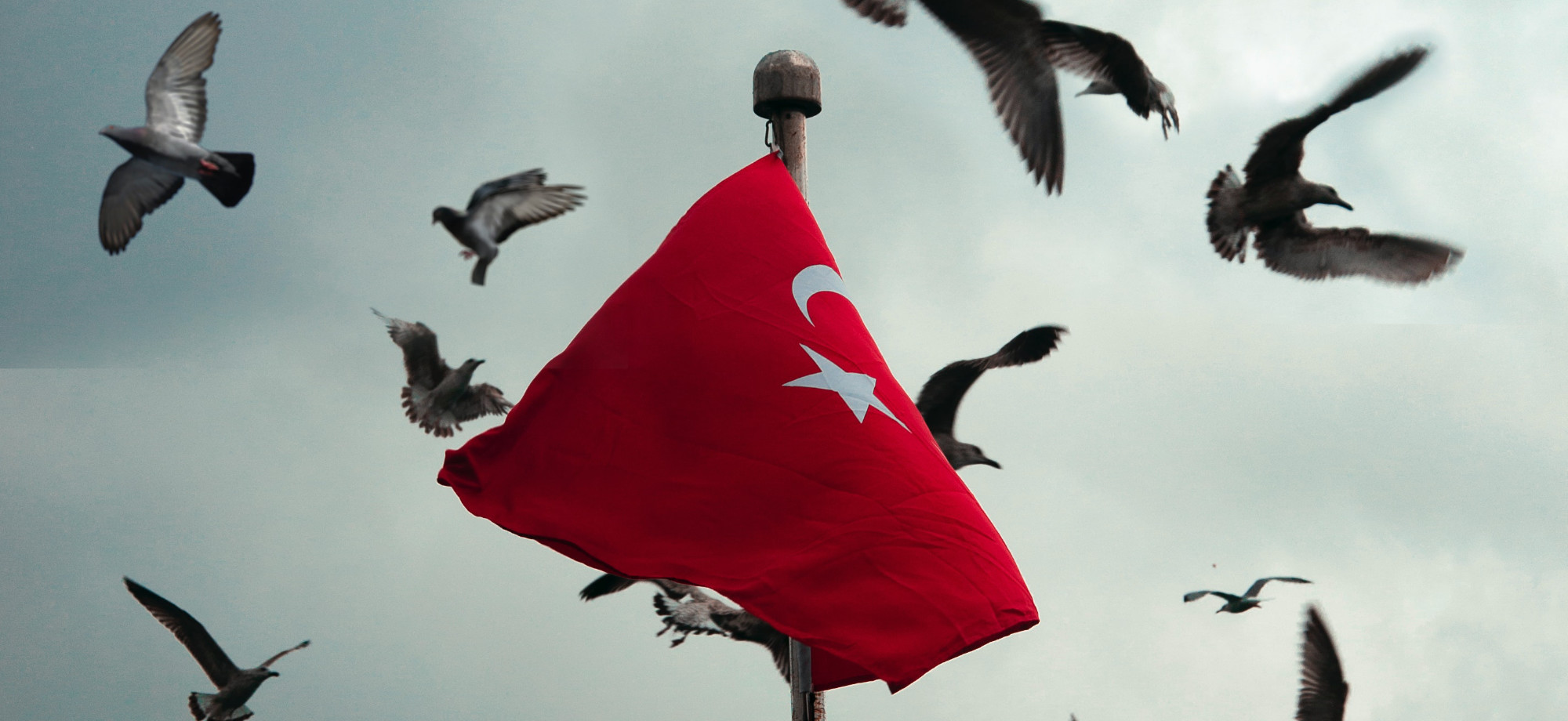
Mardin is quaint. With a castle at the top still in use by the Turkish army, the town lurches down the steep hills one boxy stone mansion teetering on top of another. Looking uphill, if you substituted towers and steeples for the minarets, you might be in a Mediterranean coastal town. Turning the corner during our long afternoon walk criss-crossing the narrow lanes, we paused to watch a man pacing a rooftop while purposefully fluttering a tea towel atop a six-foot pole and whistling. Above his head a flock of pigeons circled and dived to his commands. Occasionally, one would land to take a breather, only to be shooed aloft again by the man.
Earlier in the day Carol had commented on how loudly the pigeons flapped their wings. Sure enough, among the soaring pigeons, several white and black birds would periodically stop with a loud snap of their wings. Dead in the air, they’d tumble, somersault until, spreading their wings again, they sailed off in an orthogonal direction. Neither Carol nor I are peepers or pigeon fanciers. We like dogs, and some cats. But the spectacle before us was fascinating enough that we had to know more. Our hotelier, Zahit, himself a native of Mardin, got very excited when we told him what we’d seen and had answers to our questions.


Poo

Pigeons were the first domesticated bird. Their relationship with humans began in the cradle of civilization arching from modern Israel to the Persian Gulf. It didn’t take Neolithic farmers long to realise that they were a gift from the gods. Guano makes wonderful fertilizer, but far from the sea pigeon poo is the best. It wasn’t long before cavemen began making dovecotes. Carved out of solid rock high above the ground to flummox stalking and slithering predators, roosts eventually moved outdoors and made poo gathering much simpler. This is what we had seen in Kapadokya. Elsewhere, Assyrians (and others) built pigeon towers containing 1,000 roosts producing 12 tons of valuable manure annually. The birds were themselves a source of food and provided their owners meat year-round.
Today pigeons aren’t as popular on menus. While still tasty, pigeon-based dishes are expensive. Instead, they are bred for racing. A good racer may sell for thousands of dollars. The record, however, was set in Belgium in 2020. A Chinese industrialist bidding under the name of “Hitman’’ bought New Kim, a Belgian-bred bird, for a coo-coo-cool $1.9 million.
War

In bigger Anatolian cities like Sanliurfa, hundreds of breeders train and race thousands of birds. At around dusk each day, when the weather is good, all the pigeons may be released at the same time. Their owners having trained them well expect them home in 30 minutes. The faithful return, while the errant are (hopefully) sent back by their finder. We went to Sanliurfa specifically to see a release of pigeons, but a dreary mist blanketed the city and we were told an evening flight wasn’t in the cards.
On special days, by agreement, there are wars. From what I’ve gleaned, it’s a bit like a game of marbles where the winner takes all. As soon as the birds are released, everyone, including young boys, tries to capture the pigeons with nets, or socks (don’t ask me how). For purists, the goal is to get your flock to convince your neighbour’s flock to come home and roost with them. If you capture a bird, it’s yours to keep, until you sell it at auction. Then the bird’s original owner has the right of first bid. Although, I gather that with birds costing thousands it’s less common to hoard prizes than in the past.
And what about the flappy ones, you ask? Originally bred to dodge and weave to avoid raptors, today Tumblers show off for appreciative crowds. These acrobats are venerated and their displays impressive, but account for only about 20% of the total stock.
Also impressive are the gold necklaces and anklets owners adorn their birds with. The pigeons take it all in their stride.
The Miracle of the Pigeons and the Spider and the Cave,
A charming story every Muslim child learns:
Stones, trees, the moon and sun all know the Prophet Muhammad (PBUH) and in this same way so do the all the animals of the world. Once up a time the Holy Prophet Muhammad (PBUH) and his loyal friend Hazrat Abu Bakr (RA) took shelter in a cave to escape persecution by Quraysh polytheists from Mecca. While they sheltered, two pigeons laid eggs and stood watch carefully outside, while a spider spun a thick web over the cave’s entrance.
The polytheists searched and sensing they had found their quarry stopped outside the very cave where the Holy Prophet (PBUH) and his loyal friend had hidden. “Let’s enter the cave,” prompted one of the pursuers. The leader, Ubay ibn Khalaf, replied, “How can we enter? I see a web that looks as if it was made before the birth of the Prophet Muhammad. There are two pigeons standing there. If there was somebody in there, would they not fly away?”
At that time the Holy Prophet Muhammad (PBUH) was standing in prayer and while Abu Bakr (RA) watched and waited breathlessly. Abu Bakr (RA) then said to the Holy Prophet (PBUH), “Those people are searching for you. It’s not for myself I am sad, but because something terrible might happen to you”. The prophet replied, “Abu Bakr don’t be afraid, God is with us”. The people from Mecca then left without causing harm to the Holy Prophet (PBUH) or Abu Bakr (RA).
And that is how pigeons weaved their way into the spirit of every child of Islam.


Looks like Canyon deChelly or others in the Southwest. Amazing the folks lived there until 1954!
Then the marketing guys came in and the local hotels all rent caves. The circle of commerce…
I lived in Turkey for four years. And once went to gourmet. I also raised homing pigeons when I lived in Ankara. Your story was wonderful delightful and brought back great memories. We’re jealous of your journey. Carry-on for us. Steven Lorna
Wow! We had no idea! It’s time you brought West Linn into 3rd century and started keeping pigeons again! Anything we can’t miss while we’re here?
Love it!
In today’s society, with our limited sensibilities, and non-acid resistant urban art and architecture, pigeons are scorned, unless they can hire a PR firm and be labeled dove. But in wiser ancient times, no such subterfuge was necessary – as they were valued for their contribution to the fertility of the land.
Praise be unto them, indeed!
Touché! Well said!