 Posted by
Position: 36°12’41″N 36°10’25″E

Cordoned off by the police, the crowd hung back behind makeshift barricades at our hotel’s entrance. A big red and gold tour bus was the focus of most people’s attention, including the cops. That allowed us to slip past them, mostly unnoticed. The revolving door to our hotel opened directly onto a metal detector. Emptying our pockets and looking touristy was enough to gain access. At the check-in counter, we asked our concierge what was going on outside? She looked at us thoughtfully. Then she looked down for a moment and finally turned to her manager and asked for his input. He sidled over and told us, tonight there is a Super League football match. Our local team is playing Istanbul. That’s their bus outside.
Our hopes that The Boss had stopped over for a night on his way to a gig dashed, we went upstairs to our room. The balcony looked out directly over the team bus and the gathered, braying crowd. Given their demeanour, I assumed they were Istanbul fans and not local hecklers. We unpacked and decided to head downstairs to watch the game over bar snacks. Hatayspor Antakya beat Galatasaray Istanbul 4-2. At least the hotel was quiet that night.
Museum Hotel

Antakya, formerly Antioch and now officially Hatay, has a complicated history, and a complicated present. Sandwiched in a valley with Syria to the east and the Mediterranean just over the hills to the west, both Turkish and Arabic are still widely spoken. Opting for the Museum Hotel was something of an indulgence. But for the price of a Motel 6 in California, we had the best room in town in a building straddling the world’s largest intact Roman floor mosaic.
After breaking ground in 2009, the hotel’s developers discovered the 1,050 square metre (11,300 sq. ft.) mosaic, along with a richness of artifacts and buried buildings. The project was stopped and an entirely new design respecting the finds called for. Ten years and $120 million later the hotel, complete with suspended, prefabricated rooms, covered the entire site, protecting it and giving guests something truly unique to marvel over during cocktails.


Bubbles
With heavy weather coming in, we decided to extend our stay and rest our road weary bums. Part of our recovery included a Turkish bath and massage. The Hamam ceremony, or Turkish bath, kicks off with a restful sauna and relaxing cold plunge. Softened up, the assisted bathing starts by laying supine on a heated stone. Modern sensibilities call for some kind of loin cloth, and the paper ones handed out by the staff are, in truth, only ceremonial. Once relaxed, your attendant douses you with several buckets of warm water and begins scrubbing you with a loofah from head to toe. Sufficiently exfoliated, another dousing follows, and the process is repeated on your dorsal side.
Next comes bubbles. Lots of bubbles. Piled high. In some hamams, piled so high the weight of the foam can impair your breathing. Much scrubbing ensues, more dousing, and eventually you are declared clean enough for the masseuse. Historically, hamams descended from Roman thermae and serve the dual purpose of cleanliness and social intercourse. Politics and business were common topics for men, while prospective mothers-in-law would inspect potential brides during ladies’ hours. Modern plumbing has reduced most public bathing in Turkey to a spa day. But in the east, some traditions haven’t entirely disappeared.

By the time the storm blew out on the second night, we awoke to the first snow anyone at the front desk could remember. Grey chimney smoke, tinged yellow with sulphur, rose languidly in the morning air, while snow on the rooftops gave the entire place an L.S. Lowry / Pictures of Matchstick Men atmosphere. The distinctive smell of burning coal hangs heavily over Turkish cities in the winter. It sent me back to Britain in the 1960s, before it turned to natural gas for heating. I’d almost forgotten what that was like.
Archaeology Museum

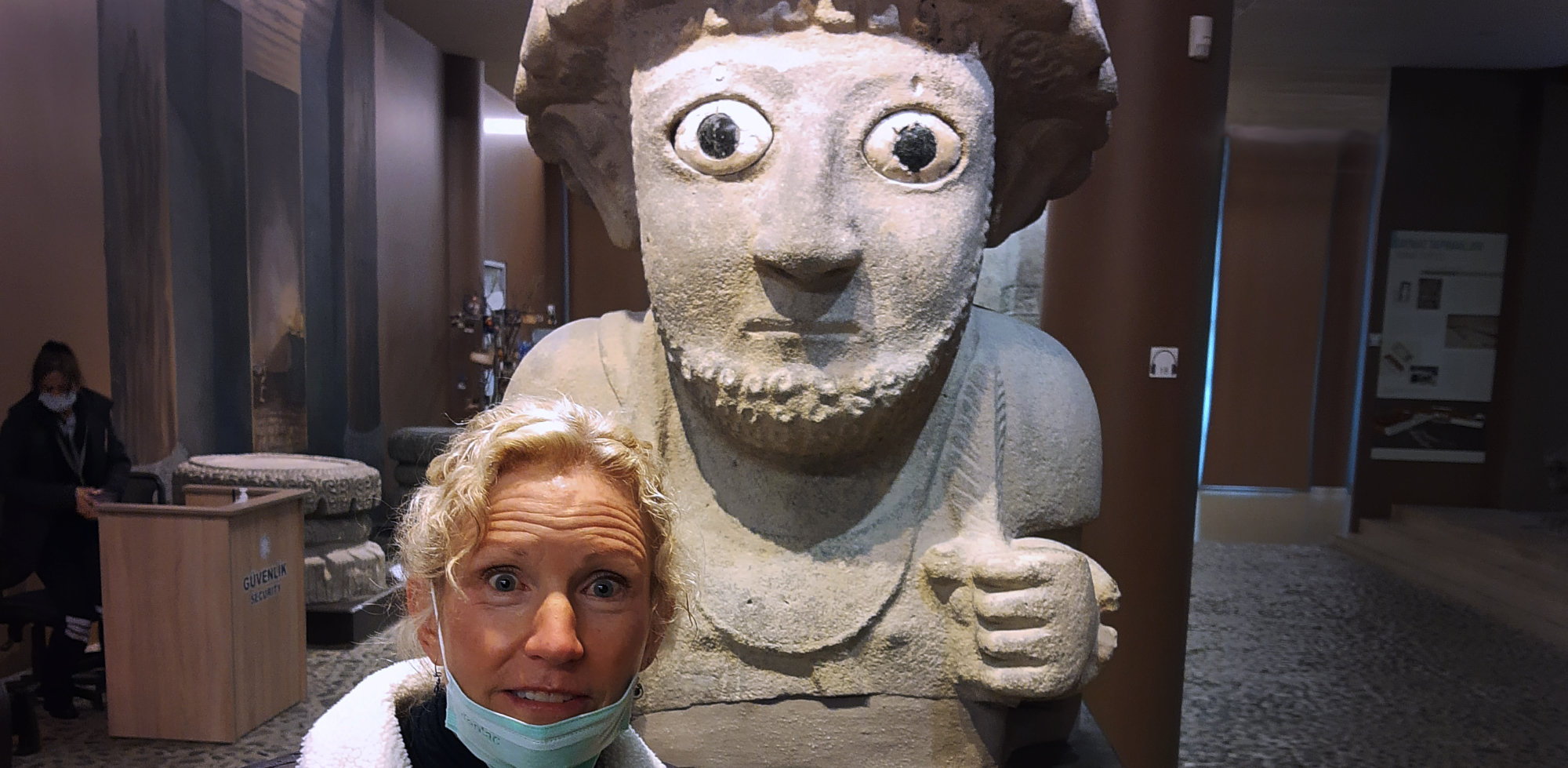
Having read so much about the Hatay Archaeology Museum we pulled in for a visit on our way out of town. Our brains stuffed with new historical knowledge from the past three weeks, we didn’t hold much hope of absorbing anything. A routine tour through prehistory to the Hellenistic period passed mostly unremarkably when the museum’s true riches presented themselves: wonderful mosaics in all sizes and stunning colours.
Among the more recent finds is the now notorious image of a skeleton lying recumbent, seemingly the worse for wine. Originally laid on the floor of a dining room, the inscription invites the reader to, ‘be cheerful and live your life’. Given my weakness for mementos mori, this was a favourite.
Our hotel’s basement, as remarkable as it was, was only an overture to this symphony of tiled art that lays testimony to the wealth and importance of Antioch for the Roman Empire. If you study visual art, or just care for it a bit, treat yourself to a visit to this modestly fabulous collection.


Note: Before you ask, we left Hatay two weeks ago. Had we known what was going on just over the mountains we might have missed it completely. That would have been a shame.


Looks like a great and fascinating experience.
We’ve put a lot of kilometres on the car already! She’s going to need an oil change soon.