 Posted by
Position: 41°41’17″N 44°48’15″E
There is an abandoned railway line that runs alongside the road between Tbilisi and Telavi. The gantries that carried the electric power are still there. Some are broken, their big glass resistors dangling low over the middle of the track. The copper wire has long since gone. The two-inch-thick conductor made scavengers wealthier by the meter.
Thirty years ago, freight trains heading for the marshalling yards at Rostov-na-Donau passed this way with goods bound to and from the Soviet Union and its satellites, Georgia, Azerbaijan, and Armenia. Today the journey is made by truck, slowly struggling over the Caucasus mountains, sometimes delayed for days by snow.
ASPIRATIONS
It is hard to imagine what Georgia was like when the Soviet Union disintegrated in 1992. With almost no warning, the system of indenture and cronyism ended. Central planning that directed programs, jobs, and resources to Georgian workers vanished. Craftsman stepped away from their state-owned tools and watched them get hauled away for scrap. If you wanted a Soviet Army Kalashnikov and had $100US in your pocket it was yours – with two full magazines. The chaos surrounding the collapse of an empire favors the crafty and the brutal. Gangsters ruled the day and they either got rich or dead.
For Georgia, democracy was the aspiration. To express a newly found freedom by electing your leaders was a fantasy made real. Almost. It didn’t take Moscow long to send in a puppet, a Georgian by birth and someone familiar with the west: Eduard Shevardnadze. But it was a start. A messy start to something like a more positive future.
SLAVES

Burly, with salt and pepper hair, our driver, David, has the careworn lines of a middle-aged man who’s ambitions are being fulfilled through his children. Coming of age at the height of US Soviet brinkmanship, his compulsory two years army service came just as Russia pulled out of Afghanistan.
‘You know,’ he said, ‘Russian soldiers are slaves. And you cannot trust them. If I went drinking in a village near my army base, a Georgian or Ukrainian would tell an officer that I was working on the other side of camp. A Russian, though, a Russian would report me immediately. That’s how they think. They just want to get the better of you. I’m very worried about Georgia. I can’t see a future here. I tell my children, get the best education you can and get out. All our smart people are leaving. The politicians all look to Moscow and are millionaires. They make money for themselves. They don’t care about the people. How can you have a government that doesn’t support its people?’
He wasn’t alone in these thoughts. Chatting with staff in hotels and pubs, we found similar despondency and skepticism about the future. Many would leave if they could. Most would head to America.
Strong Ties

The links between Ukraine and Georgia are heavy and strong. The two countries share DNA. Before the war, families and politicians moved back and forth seamlessly. Both experienced life under the thumb of communism, and each looks to the other in times of stress. Russia invaded Georgia in 2008 and annexed lands in the northwest corner and central mountains. Taking note, Ukraine began beefing up its defenses.
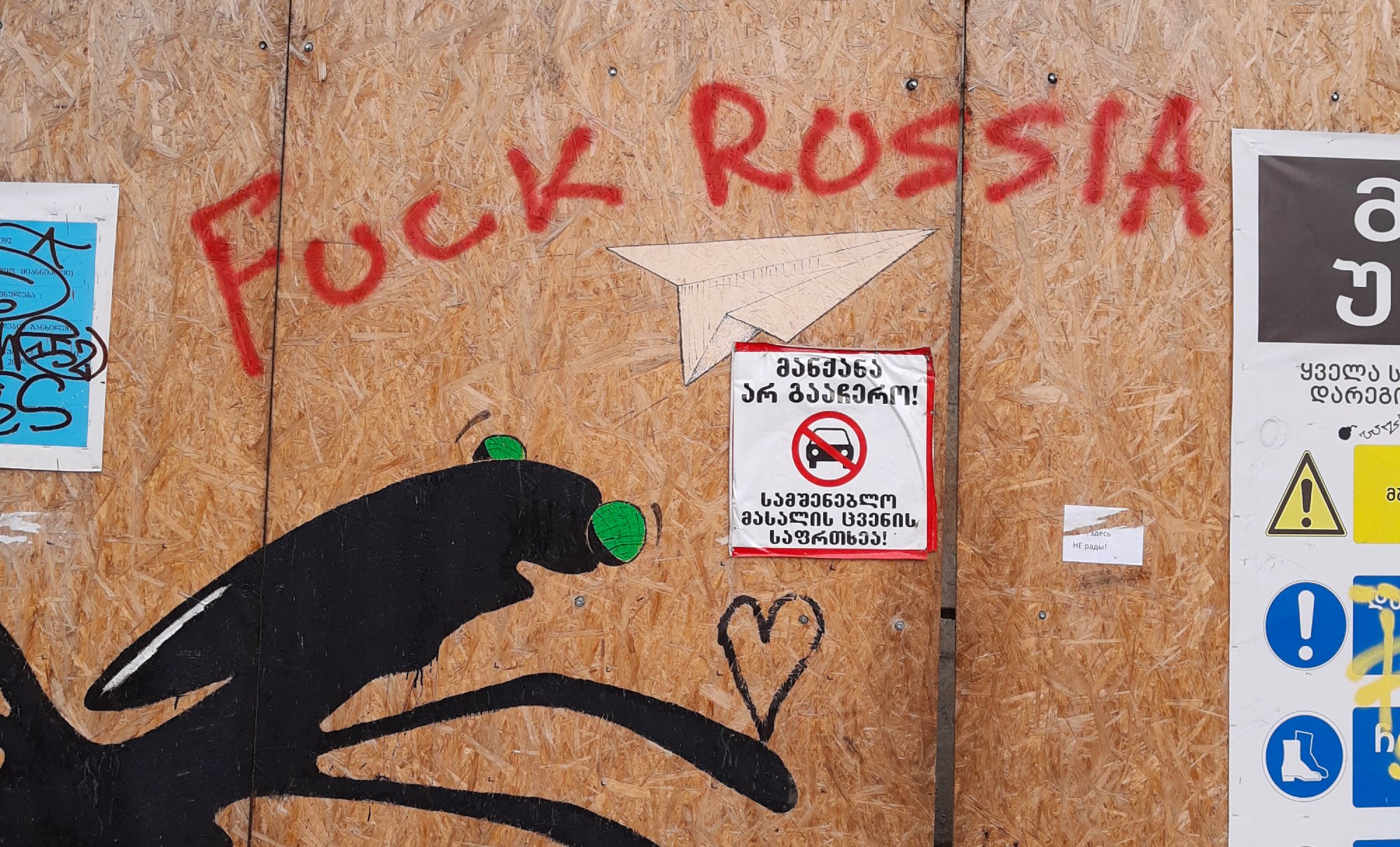
When, two years before Crimea capitulated to Putin in 2014, Georgia’s parliament embraced a pro-Russian oligarch. For many old hands a grim resignation started settling in. Now, four weeks into the war on Ukraine, Russians have started arriving in droves. At least 30,000 at last count. Most claim they are refugees, but locals are convinced that many are spies, political operatives and money launderers. In one day last week over 500 new companies registered for business. Russia is barred from SWIFT banking transactions, but money still comes in and out of Georgia and makes its way around sanctions from there. Somewhere near Tbilisi stand huge wind turbines that feed electricity to one of the world’s largest crypto mining operations.
Defiance

Yet, despite the Georgian government’s reluctance to impose sanctions, the distinctive blue and yellow horizontal lines of the Ukrainian flag are everywhere (blue representing the sky and yellow the vast fields of wheat). Everywhere we went we found defiance and the resolute belief the Ukraine will win. One young woman we met had even painted her fingernails blue and yellow. Hotels in Tbilisi have banded together to host thousands of displaced Ukrainians. We asked our hotel’s staff what they thought Americans could do. Two things, they immediately replied. The first is to enforce a no-fly zone, the second is to keep coming to Georgia and visiting. We need tourists, and we need your support.
Georgian Humour
‘Do you know how Georgia became the best place in the world to live?’ David asked. ‘No.’ I replied shaking my head. “After seven days God admired his work and considered it complete. Just then a voice piped up and asked, What about us? The Georgians? I can’t help you, said God. I’ve parceled out all the land. Besides why should I care? Just go someplace. But, God, we are the Georgians. We make the best wine, the best food, and worship you with all our hearts. I’ll tell you what, said God. I have a strip of land that I use for summer holidays. You can settle there. Thank you, Lord! cried the Georgians, Only, does it have to be next to Russia?”


Great Blog!
Thanks Robin! Please tell Bob we discovered Chacha – Georgian grappa – and thought of him.