 Posted by
Position: 37°57’14″N 22°57’20″E

For centuries one tyrant after another envisioned a canal uniting the Gulf of Corinth and the Aegean Sea. Seeking a shortcut to the long, risky voyage around the Peloponnese peninsula has always made economic sense. One of the first attempts was by Periander around 600BCE. High costs and a lack of labour made him settle for a portage road instead. The Diolkos allowed ships to be towed overland on wheeled carriages and is one of the earliest examples of intermodal logistics*. Pretty cool tech for the time, but still not a canal.
A stark lack of hydrologic science led to rumours the Aegean would inundate the Gulf of Corinth should the two bodies of water ever connect. That bit of bad data helped delay projects for centuries. Julius Caesar thought about having a go, but the Ides of March intervened. Caligula commissioned a study, but he too wound up with the worms before the consultants made their final report. Nero got as far as personally breaking ground with a pickaxe in 67CE. With the help of several thousand slaves, he hollowed out a couple of trenches. But the effort proved too much for his weak constitution and he too shuffled off the mortal coil. Work halted soon after his death.
Sixteen hundred years later the Venetians, having conquered the Peloponnese and built a few nifty castles, considered the project, but then thought the better of it. In 1830, with the help of Lord Byron, the Greeks booted out the Ottomans and under its newly constituted government commissioned yet another study. This time undertaken by the French. When the price tag came back at 40 million francs, the project was once again shelved. (If you’re familiar with the history of I-5’s Interstate Bridge near Portland this will sound depressingly familiar. – ed.)
Enter the French

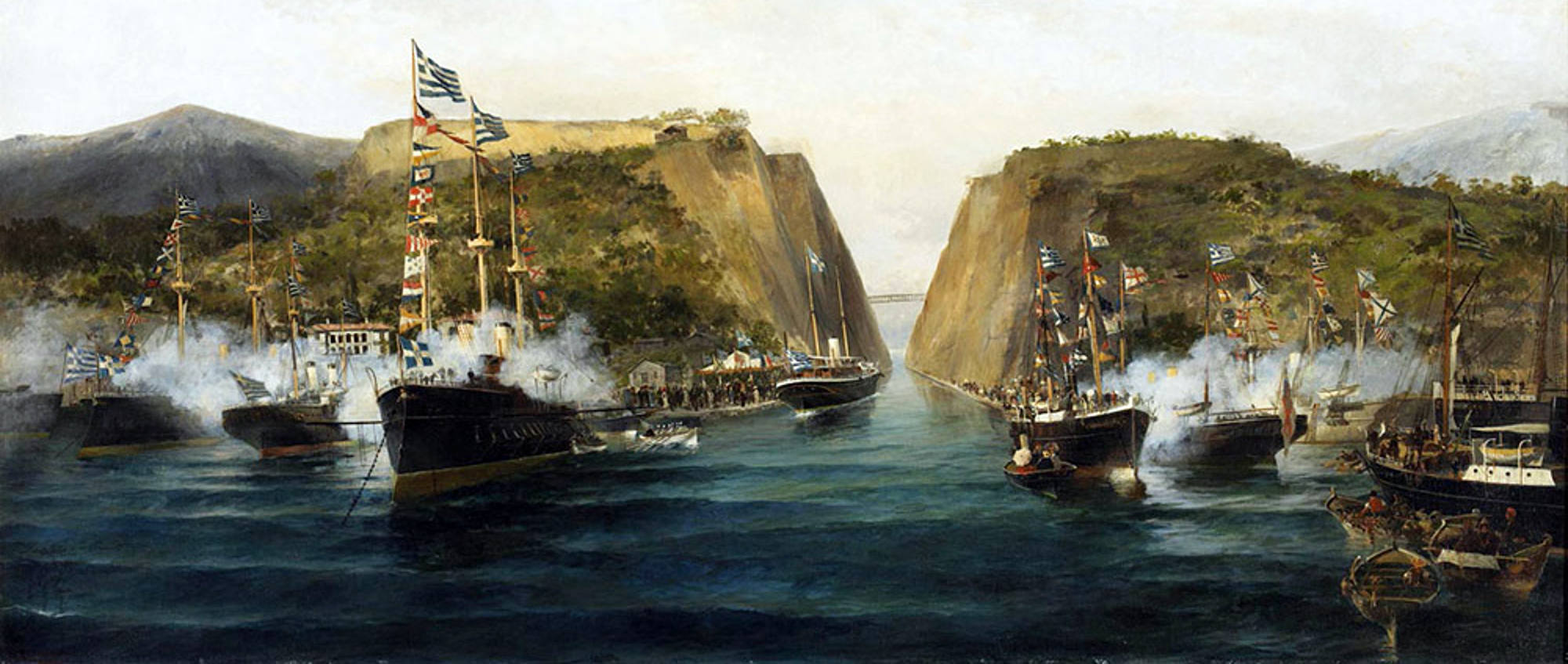
The French went on to build the Suez Canal, at the cost of some 120,000 lives, and opened it in 1869. With a strong case of FOMO, the Greeks passed a law authorising the building of the Corinth Canal the following year. It took 12 years to figure out the financing. Finally, in 1882 work started in earnest, led by a French company, the Société Internationale du Canal Maritime de Corinthe. Construction continued for eight years until the money ran out and bankruptcies ensued. Thanks to new financing and the formation of a new Greek company, the canal was completed on July 25, 1893.
Success was brief. Immediately after opening landslides delayed traffic for a year. Winds and tidal currents discouraged ship owners from using the canal and revenues fell significantly below expectations. Then World War I happened, and traffic declined even further. German bombs in World War II initiated landslides that were cleared by the US Army Corps of Engineers, who reopened the canal to traffic in 1947.
At just under 25 metres wide, useful cargo ships soon became too large to squeeze through the canal’s rickety 90-metre-high limestone walls. Today it is mostly a tourist attraction. Of the 11,000 ships passing through annually, most are small cruise ships and private yachts. It’s not cheap. Our bill came to €249. Still, less expensive than motoring around the far end, I guess.
Enter Aleta
In 2021 another landslide closed the canal and it only reopened on July 5 this year. Of course, Covid has put the kybosh on tourism and it hasn’t recovered. The quiet streets of Corinth saw many bars and restaurants shuttered. The smaller boutiques that were open had sales on. Tough for the local economy, but easy for us to find a mooring along the town’s harbour wall.


Video: Transiting the Corinth Canal
The 6.34-kilometre journey takes about 35 minutes. We pulled up around noon and by 1PM we got the go ahead and led the little flotilla westwards. We started modestly, but when the controller told us to step on it we complied as best we could. Fighting current and headwinds we eked out a steady 5.9-ish knots at 2,300 rpm. This short video shows the entire trip in just under 3 minutes, or what it would be like if Aleta could sail at 80 knots.
You can visit the canal’s official site here: Corinth Canal, SA
*Clearly, I spent too long in supply chain operations.


Hmm. Fenders deployed port and starboard throughout the passage, eh? That’s a narrow canal, with perhaps winds that don’t always stay neatly aligned with the canal’s centerline? Anyway–excellent video!
Indeed! We take every precaution! More importantly, the fenders were primed and ready for docking at the other end.
Very cool. Everything is so shipshape
Haha! If only!
We 3 students slept on the deck of a sooty Greek coastal steamer on a trip from Piraeus, Athens to Corfu in 1964. A couple of days there then ferry to Igoumenitsa and loud bouzouki music on a rickety bus across northern Greece to a work camp in a remote mountain village near Ioannina. A month there then on to Thessaloniki and a train back across Europe and so home. I would love to revisit.
So enjoyed your 3 minute trip through that pristine and empty Corinth canal and reading it’s history. Have a good summer
Sounds like quite the formative experience! I wonder how many kids travel the slow routes these days? Both in transport and in life.
Daughter Jo introduced me to TV series ‘Race around the world’ this week. Contestants had to travel from UK to Singapore by
any means other than flying and spending only the amount of a flight, as specified by the organisers. 4 teams of two were filmed going to do many interesting and beautiful places en route. eg Kazakhstan, Cambodia, Thailand. You two are stacking up so many good( some bad) experiences. Long may you have the energy to continue.
That sounds fun. It’s not as easy to get to Singapore overland these days. So many countries are reluctant to allow tourists in.
How novel! And narrow! So short yet it took so long to build, how does the timing compare to the Panama Canal I wonder. . . .
Turns out the original Panama canal took a year less, was 10m wider and more than 10x as long. American ingenuity and money, at work, I dare say. But the French had started work 30 years earlier and went bankrupt in their attempt. A pattern?
Thank you Mike. Always an education! Have you done the Panama Canal already?
No. Have you? We’re hoping to in a couple of years. Unless the Straits of Magellan prove too attractive.
Oh wow! That would be very intrepid! We only went through as line handlers, great experience !
Beautifully scored! Were you going east to west or vice versa?
Thanks Anne! Yes, east to west and Idomeneo seemed appropriate enough.