 Posted by
Position: 45°54’58.9″N 6°51’19.9″E
Saturday

Pulling up outside our turn of this century chalet flanked by steep mountains on either side of Chamonix’s narrow valley, we were glad that we had driven. Our house guests, a motley amalgam of relatives, friends and extended family had variously lost luggage, missed flights, or otherwise fallen victim to staff shortages and faulty airline automation. Undaunted, we shared a single goal: get to know Chamonix. Our journey started with the purchase of a five-day lift ticket. Because in Chamonix ski lifts run all year round and there is even more going on up the mountains than down in town.
Sunday

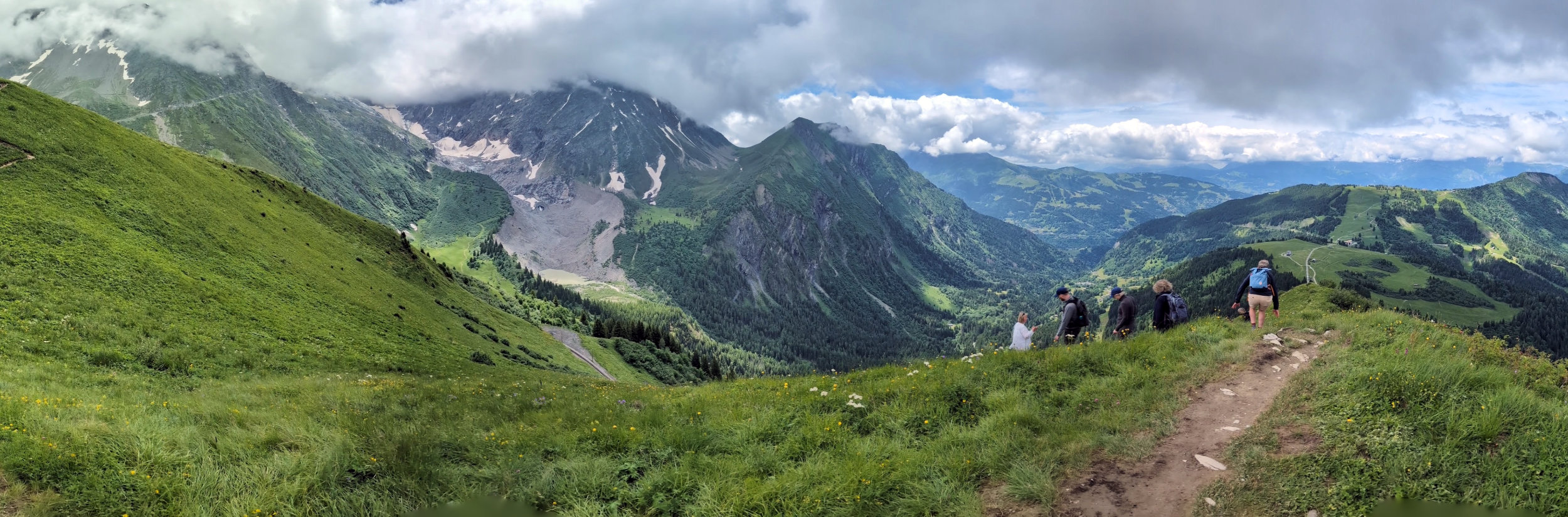
Cold rain fell gently from the swirling clouds making for slick footing on the rocky scrabble trail between the Flegere lift and the Planpraz telecabine. A brief trip to the top on the open chairlift convinced us we should start lower down, at the midpoint. The treacherous footing was accentuated by an unending stream of mountain racers participating in the Mont Blanc Marathon. An annual event for runners with a peculiar sense of masochism and a desire for accelerated knee replacements. Having run a couple of marathons myself, I can attest to how hard trail running is on your knees. In training the beauty and solitude of the woods is a welcome distraction – until you head downhill. Crappy knees is one of the reasons I took up cycling.
Our merry band of walkers included Emma, Tai, Carol, me and Chris. Chris is a birder and natural resources manager by trade, and a photographer by avocation. With his help we identified many species of plants and birds, thoroughly enriching our experience. After a couple of miles, the runners finally peeled off and headed downhill towards their finish line. Carrying along the face of the mountain, we gained enough vert (mountaineering speak for height above sea level) that we once again had our heads in the clouds. Tramping across the remains of winter’s wet, slushy snow we were glad to have on hiking boots and our poles with us.
The fog lifted just long enough that we saw the little restaurant where we would meet the rest of our party for lunch. By the time we got there, though, the maitre d’ rudely pushed the doors shut, saying the kitchen was closed. Coffee or ice cream only, he muttered through the glass, hoping we would go away. Undeterred, we pushed open the door and greeted our chalet mates. They regaled us of their bountiful repast while we rubbed our sore flexors and sought out the salles de bain.
At least the gondola dropped us near the centre of town. Grabbing a late lunch, we watched runners hobble past with bandaged shins and shoulders to lean on. My running days long behind me, I still miss the simplicity of the sport. Grab a pair of shoes and head out the door. Running is hell on your knees, but after the first seven or eight miles you pass the point of caring about things like that and live in the moment.


Monday

3,842 metres above Chamonix stands the Aiguille du Midi, a narrow pinnacle of rock that for decades has served as the starting point for some of the most extreme sports humanity has yet to devise. In the old days, nutters had to climb the mountain before jumping off it. Since 1961 a cable car has saved them the trouble. A series of buildings are seemingly lashed to the rocks and the view from their connecting bridges awesomely vertiginous.
Clouds and clammy fog swirled around us, clearing briefly to reveal the sharp stand of rocks holding us up. Wide bands of steel bolted in place help prevent the peak splitting apart in the seasonal freeze/thaw cycles. It wasn’t very reassuring. With temperatures in the high teens (F), the freezing fog led us straight towards the café and a Viennois (hot chocolate with lots of whipped cream). Carol and Tai meanwhile had peeled off for a 10-mile honest-to-god Kemble death march (it’s a family tradition) down the mountainside from the mid-station. Such foolishness would have only delayed my hot chocolate and not enhanced my enjoyment of it.

There is a glass booth where you can stand over the precipice. Despite his terror of heights, Bryan not only braved the cable car, but gamely had his photo taken while clinging to the wall. The trip back down was swift and efficient. We soon dropped out of the clouds into the sun dappled valley below.
For centuries, Chamonix’s glaciers hung over the town like the foggy grey cat that hugs San Francisco in the summer. The threat of the massive wall of snow and ice crashing downwards taking everything in its path never happened. Mostly because that’s not how glaciers work. They are big moving walls of frozen water, something that is only apparent with long timelapse images. Ireland sized chunks don’t calve off like they do in the Antarctic Ocean. They quietly melt and trickle into the river to nourish farms miles downstream.
Glacial melting has accelerated dramatically in the past five years. Soon there will be nothing at all but a scree field and rivulets that fill when the rains come. To save the farms and the region from becoming a high desert, I expect the French government will dam the higher reaches if it can. It is the sort of massive engineering challenge that Europeans love.
Katie and Aron were originally due to arrive Sunday, but their flight got cancelled. Rebooked out of London, their plane arrived too late for budget ground transportation, so I volunteered to fetch them from Geneva airport, an hour and 10 minutes away.
Tuesday

The clouds parted and teased us with what life must be like here in good weather. Damn pleasant by the looks of things. Emma’s informed knowledge of the area beckoned the entire chalet’s contingent down the valley to the Tramway du Mont Blanc in Saint-Gervais. The tram’s tech is similar to that of the Montenvers cog railway mentioned last week. A big cog sits in the middle of the track and keeps the tram going up and down the steep slopes. It isn’t fast, but if you love trains, it has all the romance you can imagine. It clanks and groans and wends its way slowly uphill past tall pines and rolling green meadows.
Cowbells, big thunderous ones, clank in the distance drawing your eye away from the steep, snowy peak of Mont Blanc. Nature buzzes around the wildflowers and you carry on this way until you can go no further. Unless, that is, you are an extreme sports enthusiast. As long as you are French or Italian, male, and have no more than 5% body fat, you can continue on up the mountain to the Refuge du Nid d’Aigle.
Disembarking at Mont LaChat we took the short hike down to the Bellvue station, working up an appetite. After a baguette and well-turned local IPA at Le Chalette, we climbed aboard the train for our return journey. All that fresh air makes you feel like you’ve done some real exercise, which of course you have not. In the winter you can ski from restaurant to restaurant and make an excuse for every beer you drink. Not that any of those things explains the ladies’ fascination with face masks.


Wednesday

Having observed the highest point in the valley, it was time to get wet in its lowest. Yep – the morning’s exercise was whitewater rafting in glacial meltwater. Har! Har! Rafting the Arve! Shiver me shivers! (Say it with a pirate’s voice. It’s funnier.) Given the icy conditions, wetsuits, complete with a post-float skin rash, were mandatory.
The River Arve is shallow at the best of times, its level determined by rains and temperature. Higher temperatures mean more meltwaters. More rain – do I really need to explain rain’s effect on a river’s water level? I don’t. And even if I did, I won’t. The river makes up for its shallowness with its speed and currents. Our guide Jean-Michele decided he would teach us as much as he could about rafting in 50 minutes. We steered across currents, repelled boarders, snagged men overboard, conducted self-rescues, and floated briefly on our backs while the chilly waters seeped in through our collars. Slipping downstream over the rocks in the sandy grey water I wondered momentarily if I would ever wash out to sea from there? Then I stood up and let the freezing waters rush around my ankles and forgot all about that idea.
Chalet life, meanwhile, had settled into a form of easy-going communal living. This being a band of experienced parents, children and adventurers, duties and household chores became a matter of self-organization. If something needed doing, someone got on and did it. Should someone have proposed a roster of duties it would have failed miserably. Each according to their abilities, n’est pas? Seeing as we had the only rental car, for the first half of the week Carol and I took on shopping duties. A kitty was anted up and we ventured forth to spend as much of it as we could.
Given the diversity of tastes and dietary requirements, we were stunned that no one was allergic to shellfish. Excellent! Jamie Oliver’s fish pie with cod and shrimp for all. Given we were feeding a small regiment, the fish pie scaled up nicely (pun intended). Accompanied by a competent and fabulously well-priced Crement d’Alsace (bubbly wine made in the manner of Champagne) the pie was a hit with everyone. Phew! No leftovers to worry about.
Thursday
Temperatures rose as the clouds cleared and warm air flooded up the valley. Tourists poured into the streets and queued en masse for the Aiguille du Midi cable car. Abandoning our idea of seeing the view from the top in clear skies, Carol, Tai and I instead turned away from the crowds and headed up the north side of the valley where we had hiked on Sunday. This time we would reverse the route, heading east towards Switzerland.
Rising above the Planpraz gondola is the Brévent cable car that takes you up another 1,200 metres to 2,525 metres. That is about 1,300 metres lower than the Aiguille du Midi, but high enough you can watch clouds swirl and form from the little wisps of moisture dancing around you at eye level. Brilliant snow spread out beneath us, and we reasoned this would be a good starting point for the day’s walk. Ten minutes on the slippery slopes was enough to change our minds and take the cable car back down to the mid-station.
Wildflowers in yellows, magentas, and blues spread everywhere, all enjoying the warm sun as much as we were. The hike is about six kilometres and we reached Flegere in time to skip lunch and head down the gondola for the pleasant riverside walk back into Chamonix. Jealous that we’d missed lunch at Chamonix’s hippest hotdog joint Cool Cats the day before, we stopped by for a ludicrously yummy round of veggie and meaty sausages. Generously sized dogs, drenched in your choice of sauce and fried onion crisps, it is the sort of indulgent fast food that can sell well anywhere. Especially if you own a food truck outside one of Portland’s better microbreweries. The only thing missing was Marlon.


Friday
Our lift tickets expired, Friday began nice and sunny – just right for a wander around town. Then it turned rainy, cool, and well-suited for the afternoon’s wedding rehearsal. More guests and friends arrived just in time to help devour a hundred pizzas. It gave us time to meet the wedding party and to reunite with Emma’s best friend from high school, Laura. Laura and Emma shared a similar competitive spirit, and both played racquetball to the highest standards in school. I’m not sure that Emma ever beat Laura at a game, but their rivalry made them both better players. Forcing your strongest opponent to play their best game and constantly improve is the kind of thing that best friends do best.


Sunday
The very last item on our list was a visit into the depths of the Mer de Glace. The ‘Sea of Ice’ flows down past the Montenvers Hotel and into the top end of Chamonix. When I skied Courmayeur in the 1980s a trip down the Mer was deemed a rite of passage for any intermediate skier. Nervous about my abilities and the costs of a guide, I never took the run. Now I’m kicking myself. Fifty years ago the glacier was 300 metres thick. Today it is a third of that.
When Carol expressed indifference to visiting the ice caves bored into the base of the glacier, I pointed out we might never have another chance. She relented. I’m glad we did. Walking into the cool, cerulean blues pitted with air bubbles 500 years old you get an appreciation for the cycles of nature you can’t get any other way. That the caves are rebuilt every few years also gives you an idea of the fragility of this incredible ecosystem.


Thank you for the adventure. I will never go white water rafting, but I feel like this video is the next best thing. Were the folks in the river tossed out or did they jump out willingly?
Everyone should white water raft at least once! There was much jumping in the river voluntarily and some involuntary keel hauling. I think the French have different insurance companies than the Americans.