 Posted by
Position: 50°10’32.9″N 5°31’19.3″E

Rather than flog a dead horse, here’s what happened with the propellor. It’s been removed and we are patientily waiting for its replacement. As someone said, “If you use things they break.” And in this case, our poor MaxProp was used to death. Partly as a result of (ahem!) poor maintenance, but mostly as a result of propelling Aleta around the world a couple of times. Once again on the hard, we decided to postpone our long list of sh*t-we-have-to-do-while-Aleta’s-out-of-the-water and explore Belgium, Luxembourg and Northern France instead.
Carol asked me if there was anything specific I wanted to see. I said, “I think we should go explore the Ardennes. I think your dad would appreciate that.” Coincidentally, a couple of days earlier I ran across Bob’s letter to his kids describing his experiences fighting the Battle of the Bulge. Thus, I encourage you to read his first-hand account as context for this post. You can find it here: Recollections: The Battle of the Bulge
Not So Low Country

Driving across Belgium is a bit like driving across Kansas. Both are as flat as a pancake. Only, Kansas doesn’t have stunning 900-year-old cities to distract you from the tedium of its corn fields. Belgium isn’t a big country, Kansas is seven times larger, so it’s a bit of a surprise when hills appear and the landscape changes to valleys and thick forests. Such changes in topography at the border of any country isn’t surprising. After all, anything that slows down your neighbours’ ability to charge in and grab your land can serve as a natural barrier. After three weeks at sea and moored in the low countries, the hills came as a welcome relief.
Until I read Bob’s essay, everything I knew about the Battle of the Bulge was either from the movie ‘Patton’ or ancient TV ads for low calorie foods. That’s the great benefit of intentional travel and the vast resources of the internet. Thirty years ago, you either had to take Rick Steves’ word for it or go to the library and study. Now you can go all the way down the research rabbit hole and only surface when your battery runs out.
Yet, third party references only take you so far. If you want to get a real sense of the past, you need to go to where it happened and walk in the footsteps of those who went before you. Gettysburg and Antietam were my first visceral experiences of history. Devil’s Den in Gettysburg and Bloody Lane in Antietam both gave me shivers. So many men had died in such small areas it wasn’t possible all their ghosts had left for good.
Nuts!

After the Allies’ success of D-Day and their rapid push through France, Hitler came up with a desperate plan for a counterattack. Starting from the Ardennes, he intended to split the Allied lines by cutting across Belgium in a few days. The challenging terrain was key to Hitler’s plan. The Allies would not expect an attack from that direction, he reasoned. Indeed, the American First Army maintained only a thin line of defence in the area.
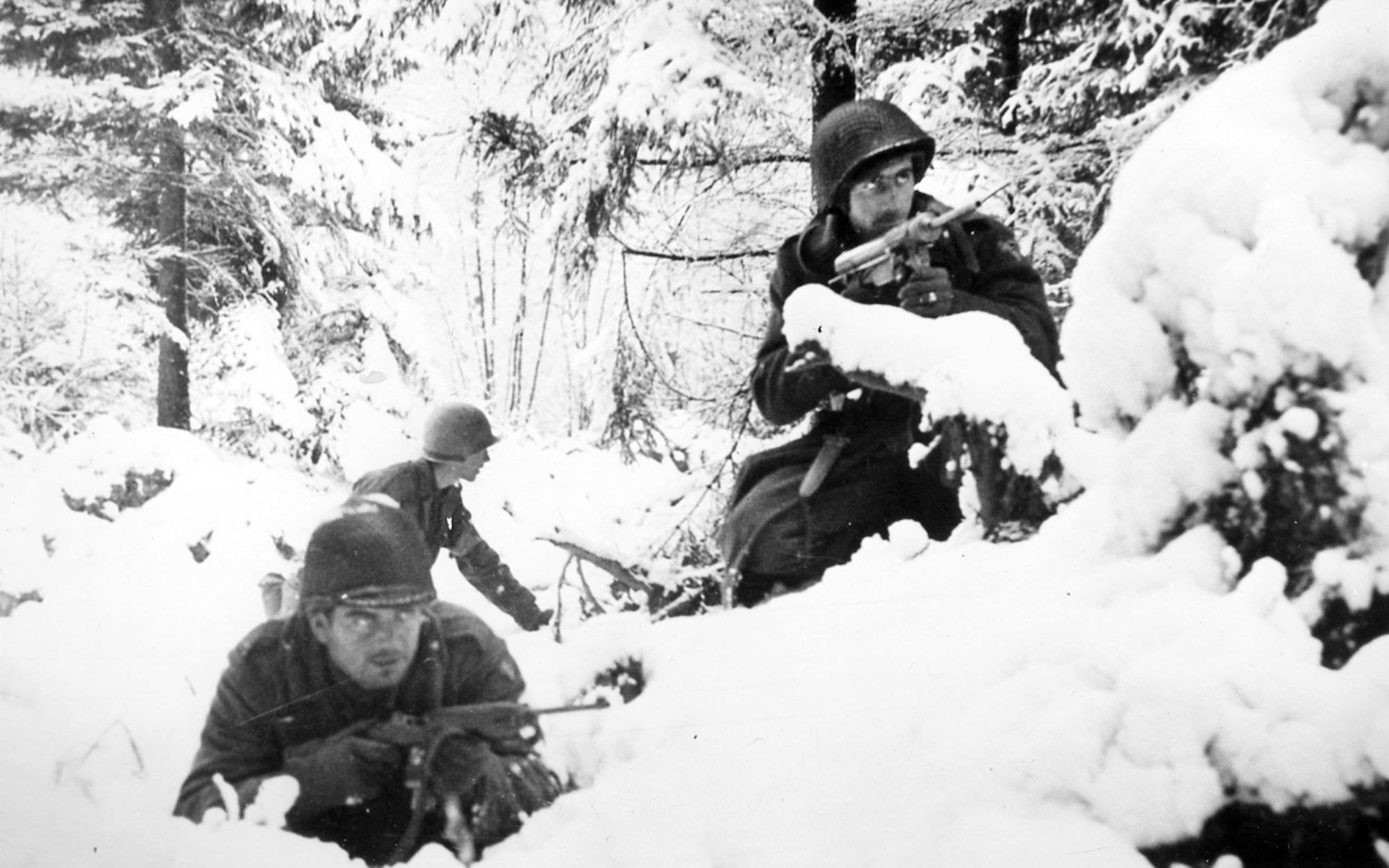
Hard in the grip of one of the century’s coldest winters the Germans mustered infantry and tanks throughout the dense forests and hills. Eisenhower and his generals suspected something was going on in the region but were still unprepared for the attack that began early on December 16, 1944.
Having fractured his pelvis in a parachute drop during Operation Market Garden, Bob recovered in England for a couple of months. He was then posted to the 505st Airborne Infantry just south of Reims, France. On December 17, orders came to move out for Bastogne, 175kms away, and join the 101st Airborne headquartered there. Two days later with air cover grounded by bad weather, American forces resorted to harrying the Germans on the ground.
Following in Father’s FOOTSTEPS

Petite Halleux is an enclave of about twenty houses and farms about 30 kilometres northwest of Bastogne. Seventy metres above a sluggish, meandering creek bed there are rolling fields of wheat and corn and a few cows. Looking southeast across the narrow valley, conifers stood in neat rows flanked by fields of barley. It probably didn’t look much different 80 years ago.
Leaving Clarice the electric Citroen at the village crossroads, we followed the clearly marked trail towards the bluff that led down to the stream. Walking in Bob’s footsteps, it wasn’t hard to imagine the hills covered in snow and small groups of olive clad GIs darting through the trees. Crossing the creek and walking up the steep slope on the other side, the road cut directly through the cultivated forest. Ordered rows of trees with long, almost bare trunks stretched high up into the dense canopy above. Perfect cover for moving troops.
Recalling Bob’s words and with a bend of my head I could almost see the shadows of German soldiers making their forward way as silently as possible. Then I could hear the clatter of tank tracks and smell the diesel fumes trapped in the pine tops. Eighty years on, no signs of the war remained.
From the moment we set foot on the farm track, Carol was almost overwhelmed with emotion. Walking where her dad had fought as a 19-year-old was, for her, nothing short of surreal. Having heard Bob’s stories of the war all her life, she now understood their meaning for him in an entirely new way. And not being able to share her feelings with her dad was especially poignant.


Rough Terrain

By December 24, the Germans had advanced to within four miles of Dinant, Belgium. That was as far west as they got. Hodges and the First Army along with Montgomery and his British troops had pinned them down in the north. Patton and the 3rd Army rapidly advanced from the south. McAuliffe’s 969th and 101st divisions besieged in Bastogne on December 23 were relieved three days later. Seeing their supply lines weakened and encirclement a real possibility, the Germans made an orderly and hasty retreat. Five months later Hitler was dead and the war in Europe was over.
Heading back across the river, we picked up a narrow footpath running alongside the creek. Mapy.cz (my go-to app for hiking in Europe) showed it as a minor trail that linked two official national ones. Spring rains had swollen the creek and flooded marshy areas making for soft going in places. Lingering cool nights meant black flies and mosquitoes remained mostly dormant. A few muddy areas weren’t enough to make me wish for the convenience of hard frozen winter ground, however.
Turning uphill towards Petite Halleux, the trail became difficult. Steepness aside, someone had felled a bunch of trees and left awkward patches of deadfall strewn across our path. The muddy swamp we’d just left was comparatively easy going. Then it started raining and the climb got a little slippery. Scrambling up the last 20 metres, the trees cleared out and we looked out over the rugged forest valley to the north. The Ardennes is a beautiful corner of the world.
Until recently, battles were (mostly) fought by young, fit men. Our walk through the woods of the Ardennes made that logic clear. I don’t care how fit you are, a bunch of geriatrics running up and down steep snow-covered hills in the depths of winter is not how you win a war. You need young volunteers convinced of the morality of their mission. Men like Bob Kemble. It was fitting, then, that our short hike took place on Memorial Day.


beautiful story, thank you for sharing.
Thanks Patti!
An amazing post – much appreciated! I could feel that bone deep cold of the December snowy woods experienced by the troops. The link to Gavin and Kemble’s words enriched the tale! History made part of this morning’s experience.
Thanks Carmelita!
Most interesting thanks. My father took over command of his battalion on the beach on D-Day, when his commanding officer was killed, fighting on for three weeks until he got shrapnel wounds and was evacuated to home to UK. I have only retraced the steps of family who were killed in the first world war, which was very moving.
Thanks Jenny – your Dad was a brave and fortunate man. My dad landed in Normandy in July of 1944, so avoided most of the fighting. We have been to Ypres, the Somme and the Marne in the past couple of weeks, too. So much history here.
Thank you Mike for your poignant and well-written account of following in Carol’s father’s footsteps through Belgium. I especially appreciate the reminder of how young the soldiers were that fought Nazis during that war. We owe them all so much.
Best of luck with the prop repair!
Thanks for the props Michael!I agree, I think our generation has somehow forgotten how young our parents were when they went to war or started families. Living longer allows for a slower start to life, no?