 Posted by
Position: 34°01’33.7″N 6°50’15.3″W

Truth be told I’ve never been big into discos. Sure after a few Rusty Nails and a plate of pasta at the ski lodge I might make my way downstairs in some forgettable nearby Italian hotel and oscillate to the beat, but never for more than a couple of nights a year and never for more than a couple of hours. Besides, European disco music hasn’t changed in 45 years. Not a bit.
The driving beats echoing across the marina each night after we arrived in Tangiers sounded just like the crap I danced to back in the 1980s. Only louder. Much louder. That meant it was already past time for a road trip.
Tiny Cars

Knowing how narrow the roads in Tangiers’ old city are, we chose the smallest car we could find – a Kia Picanto. Over the years we’ve grown to appreciate small cars for the flexibility they provide in countries foreign to us. America’s big wide right-angled streets were designed for its big wide cars. The rest of the world built roads based on footpaths and cow droves. Unsure how many of Morocco’s cities would emulate Tangiers’ medina, opting for a tiny car seemed prudent.
Turns out the roads in Morocco are pretty darned good. A Euro-style tollway links up the big coastal cities of Tangier, Rabat and Casablana. All the major side roads are in the throes of getting repaved and often widened. In fact, most of Morocco’s infrastructure was getting upgraded in anticipation of the country hosting the 2030 World Cup. Hosting the World Cup is a bit like hosting the Olympics – expensive. Very expensive. But it also galvanizes governments into action. In Morocco that means lots of roadworks, new football stadia and lots of jobs.
Underground
Given all the improvements, driving in Morocco only gets challenging when you’re parking. Negotiating underground garages can get especially spicy. Narrow entrances open onto streets crowded with people and parked cars. Ramps pitch down at angles of -30 degrees and more.
The dominant construction material is reinforced concrete. Thus, the spans between pillars in the basement are alarmingly short. That makes parking about as much fun as driving from your living room into your kitchen. Only, everything has sharp concrete edges that will scrape the paint off your rental if you even think about getting too close. But with a tiny Picanto-sized car, you could not only drive through your kitchen, you could pull into your loo and still have room to open the boot.
Asilah
Morocco’s history reads like a colonialist’s dog pile. The Portuguese, Spanish, and French have all had a go in the past few hundred years. Each left behind a bit of architecture, mostly castles, barracks, harbours, and other military memorabilia.
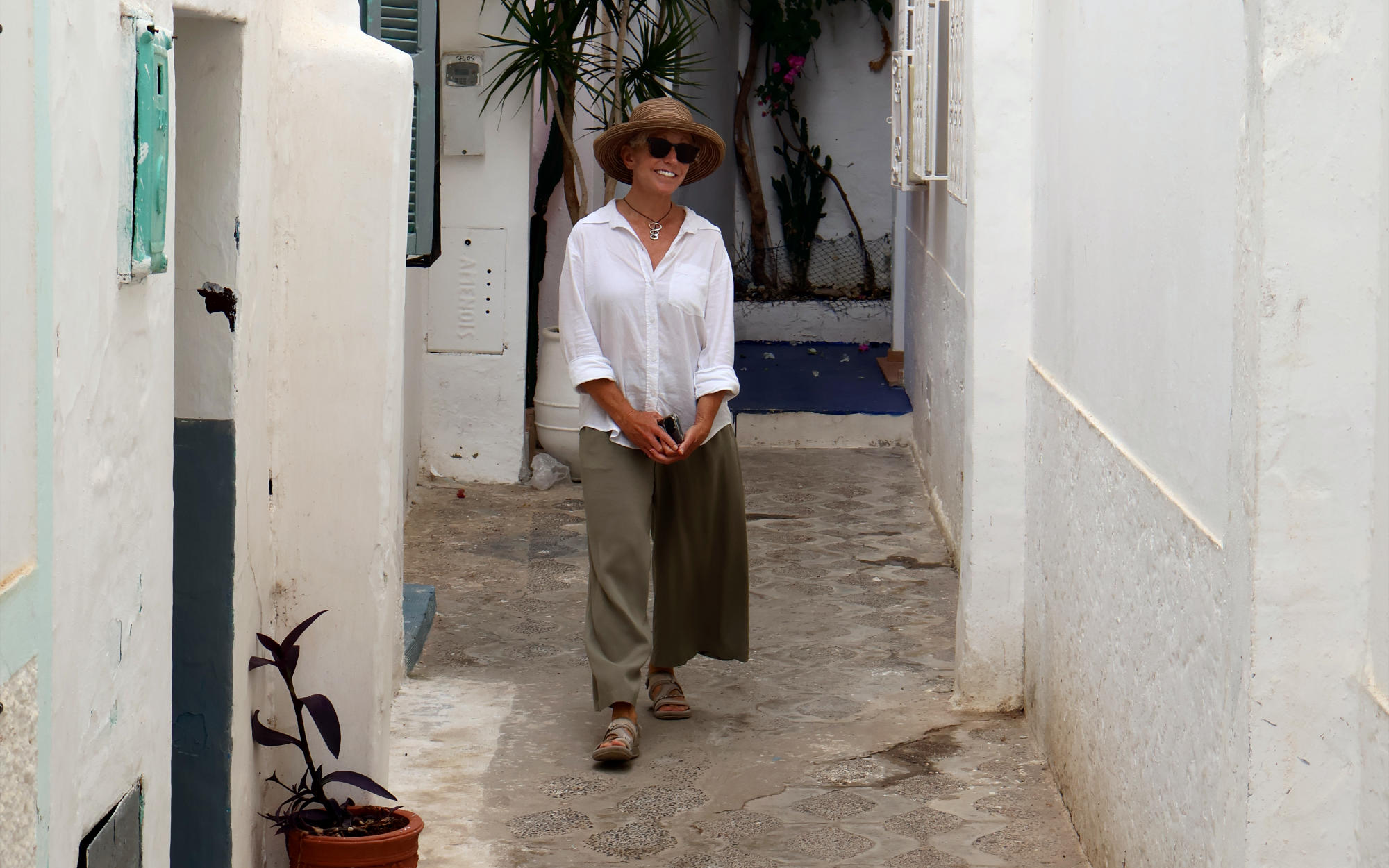
The Portuguese hung out in the city of Asilah long enough to build a big fort, a church, and a huge harbour that needs dredging if ever Aleta were to try and pull in there. While the town feels like a backwater, there are some serious efforts at increasing the tourist trade. The medina is attractively quiet, and home to painters and sculptors and an art school. Several galleries give this funky little town a bit of creative verisimilitude.


Lixus
The Phoenician Empire stretched across North Africa from as far east as the Levant to its westernmost city Lixus. Built around 800BCE, the city was occupied for the next two thousand years. Tenants included Phoenicians, Carthaginians, Romans, Amazigh (Berber) and finally Islamists. Around 1200CE the site was abandoned. What remains today doesn’t seem like much on the surface.
For Phoenicians Lixus was a place of myth and wonder. It was at the far end of their world, but at the crossroads of sea trade between Africa and Europe. At the top of the hill you can see the ocean across a broad, fertile estuary. Once again, the ancients and their ability to spot the best real estate paid off.


Jockey Shorts
Leaving early for Rabat, we headed south in search of an on-ramp and got momentarily lost. Executing a perfect u-turn on a broad, empty road, my only error was not spotting the motorcycle cop coming down the hill. After chastising us in French for a full ten minutes for a (debatable in my book) infraction, he let me off with a warning then asked if we needed directions. We drove away charmed and within a couple of hours arrived at the outskirts of Rabat. The seat of the King.
A smooth two-lane carriageway flanked by palm trees and separated by a lush green median strip drew us towards town. A long line of black Range Rovers appeared on our right at about the same time as a high yellow wall. Armed police and soldiers in fatigues stood in sentry boxes every 100 metres. They searched around meaningfully. This tableau continued for a kilometre or more until we finally saw the signs of the Royal Moroccan Jockey Club and everything was revealed. The international horsey crew was in town for a competition. We toyed with the idea of watching one of the show-jumping events but decided instead to take a walk.
Bou Regreg
Rabat was by far the most modern city we visited. Parks with dense trees and manicured walkways dot the city, offering shade from the searing heat of summer. The Bou Regreg River runs through the city’s centre and pours out into the Atlantic, making Rabat one of four places in the country offering moorage for private yachts. Which, given Morocco’s long coastline and many existing (if a bit rough) harbours, seems like an opportunity. Every yacht attempting to cross the Atlantic sails down Morocco on its way to the Canary Islands, so there’s a ready market.
Our snazzy Airbnb in Rabat was big and airy and only a couple of hundred metres from the medina. A quick exploration led us to a stand selling excellent olives. Our selection of which was guided by a young hipster who clearly knew his pimentos from his harissa.
The next morning, after suffering through a couple of cups of Carrefour’s finest roast, we found a legit torrefactor (coffee roaster) deep in the labyrinth of the medina. Fridays are holy days in Morocco. Most stores are closed for at least half the day. Fortunately, OKFE was open for business. At eight euros a kilo I was a little sceptical and then pleasantly surprised at how good their coffee was. Perhaps the cure for inflation at home is to spend more time abroad with independent torrefactors.


The Invisible Handjob
Which brings me to another question: how do the market sellers in any of Morocco’s medinas make any money? My guess is they don’t make much at all. Mostly just enough to eke out a living. Capitalists would see only inefficiencies in this model. Dozens of vendors selling the same thing from separate shops represent a clear opportunity for consolidation and efficiency making.
The downside of capitalism is soon everyone is an employee in debt to The Man. In Morocco’s case that would take all the life out of the medina. All the buzz, the hubbub, the shouts of bartering, the performative sales pitches, the rituals and deep cultural roots of buying and selling would disappear. Poof!
You only need walk across the boulevard to find brand-named air-conditioned shopping. Even bargain brands like Zara and H&M are marketed as luxuries. Prices are double those in Spain to prove it. But in the medina you can find really, really inexpensive things if you take your time and know where to look. That’s where and how the majority of Moroccans shop.
If you’re a tourist, it is easy to ignore the quotidian needs of the locals. After all, your daily bread is, usually, already catered for. Bargaining for bananas or rice cookers isn’t something you should worry about. But occasionally it’s worth stopping and casually watching as the world around you gets on with its life. Take a moment and hang around a store that opens onto the street and is stuffed floor to ceiling with dry goods. There you might catch a glimpse of how folks in other countries live, or how we used to live in ours decades ago.


Great blog as always
I always learned something when I read your stuff Mike thank you
Thanks Mark! We wandered through a fishing tackle store yesterday and thought of you! I remember when you got us kitted out for boat fishing.
agree, i too always learn a couple of new words! all the best !
Thanks Steve! It’s way past time for us to catch up! Hope you’re doing well!
Love the bright blue and white color schemes and graphic art on the buildings. Noticed how clean the streets are as is typical in any posts I see from Europe. Great hat , Carol!
Hi Carmelita – for the most part the cities were very tidy. A few rural places had problems with plastic bags and trash, but I suspect rubbish collection will also improve over the next few years.