 Posted by
Position: 54°57’51″N 2°52’38″W

It’s not really a secret that I like motorcycles. Since my first turn around the Loudon’s orchard in Wantage on a 50cc moped back in 1972 I was hooked. The little bike, probably a Puch or Honda, had wide pedals like my old single speed coaster on Cape Cod. It rode like my old bike, too: solid, slow and bright red. Best of all, when I wanted to go uphill all I had to do was spin the pedals. The two-stroke, single cylinder engine coughed into life and I’d zoom off without effort. When I reached the top, I turned around and puttered down, brushing between the low branches of the apple trees.
Back at the paddock I would turn around and do it again. I only skidded out once or twice and learned how easily rubber slips on wet grass (a lesson I repeated many years later). If you remember wrestling with your big heavy Schwinn as a child, then you’ll appreciate that my first experience of motorized cycling felt almost luxurious. As though someone else was doing the hard work and all I had to do was go along for the ride.
Dodgy Mechanics

A few years later, inspired by my elder sister’s purchase of a Honda 125, I decided it was time to hang up my ‘treader’ (push-bike) for a motorcycle. My colleague George, also an American, offered to teach me some of the fundamentals. Nervously, I swung my leg over his bike in the crowded car park.
After some mumbled instructions, I switched on the engine, pinned the throttle and stood up in terror. Thanks to George’s dodgy mechanics, the little motorcycle shot out from under me and crashed into a Hillman Imp a hundred feet away. The Imp got a dented fender and George’s handlebars took a twist. It was another 35 years before I tried motorcycling again.
It was probably as well I waited. Most of my English friends had either crashed a motorcycle and spent time in the orthopaedic ward, or knew someone who had. That said, the magical blend of male youth and high speed two wheeling probably reached it’s peak in the UK around the same time Punk flamed out and became New Wave (1978). A couple of years later many of us could afford a car of some vintage and motorcycling began its inexorable slide from quotidian transportation to, “Something I do at weekends when the Mrs. lets me.”
Spandex

When my dormant motorcycling bug reawakened, I was already back on two wheels. For five years I’d been bicycling with some seriousness, covering about 25,000 miles in all kinds of conditions. Part of my logic for taking up motorcycling was that it couldn’t possibly be more dangerous than what I’d been doing. After all, I descended steep hills at 50mph in a pair of brightly coloured, skin-tight Spandex shorts. At least, I reasoned, with a motorcycle you have a fighting chance of getting out of the way of traffic.
I’d spent enough time in management to know I needed training. Fortunately, the insurance industry demanded mandatory basic rider training as a criterion for getting a motorcycle endorsement. Then my friend Scott convinced me to buy a small starter bike. In my case a Yamaha WRX250 that I rode for about a year. Scott also convinced me to take an off-road riding course. I only dumped my bike once on the wet grass.
The following summer I traded in my 250 for Lily, my Triumph Tiger 800XC. In the meantime I read everything I could about riding technique, on and off-road, and the relatively short, but very crowded history of the machine.
I learned more about the lunacy of the global event they call the Isle of Man TT. This annual race is really as set of time trials held on the island’s streets and byways. There is none of the safety found on a modern racetrack. Hairpin turns at 130mph around dry stone walls demand focus and an excellent memory of every bump and divot on the course. Contestants have reproductive organs forged from high tensile steel.
The craziest, in my humble opinion, are the motorcycle and sidecar riders. Anything other than precise teamwork ends in disaster. And teamwork, of course, is based on trust. Given the insane speeds they reach, something as small as a rabbit dashing across the road can easily flip the rig and kill the riders. It is a sport worthy of a Roman coliseum. Perhaps that’s the fascination for spectators. It is time to introduce Mike Barry.
Somewhere North

England’s border country is for most Brits a place you drive through on your way north to Scotland or south to Manchester. As you speed past the gently rolling hills dotted with grazing sheep and cows, you can be forgiven for thinking the area doesn’t have much to offer. You would be wrong.
The countryside is open. Well, at least as open as dry stone walls and rambler’s gates allow. Footpaths are plentiful and, provided you are prepared for the weather, walking is joyful. A bright morning often gives way to clouds roiling in from the Irish Sea. Grey and heavy, they lash down rain in the afternoon. Then the weather breaks and sunset pokes through the scattered clouds, themselves highlighted in brilliant purples and pinks. Take in the air, now clear and fresh, and redolent of the farmyard. Ahh!
History meanders through this region. Ancient conflicts between imperial armies and guttural tribes have long since settled into today’s political boundaries between the two countries. Hadrian’s wall reminds visitors of the financial strength of the Roman Empire and the fierce will of the Caledonian peoples. Warm, kind-hearted, and capable are the four words I would use to describe the spirit of life here. Travellers are made welcome with a cup of tea and story. My cousin Sarah and her partner Simon, a keen motorcyclist himself, are naturally at home in the Borders. They live on the Scottish side.
Petrol Heads

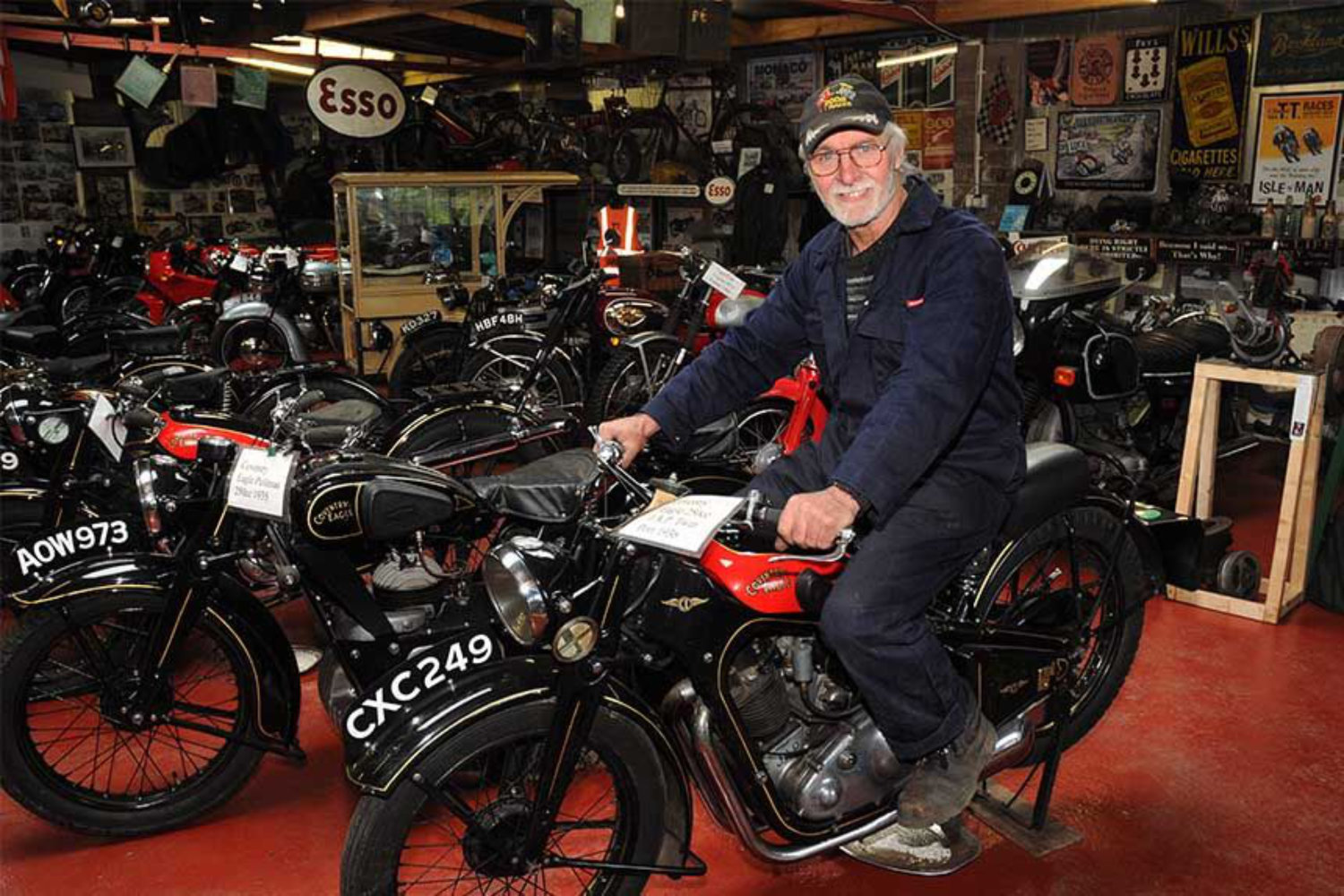
To the south, outside Carlisle in England, lives Mike Barry – TT racer, mechanic and owner of one of the finest motorcycle museums in the UK, if not Europe. I found Mike’s place after searching for ‘museums’ on Google maps. Vintage and motorbike are two of my favourite words. Toss in museum and we immediately dialled in directions.
Turning into a small lane not far from the motorway, we pulled up outside a low garage decorated with flags. Three happily barking golden retrievers bounded out to greet us. Mike soon followed and, inviting us in, assured us the museum was open. A couple of neck rubs settled the dogs down and we wound our way past an old Commer van under restoration into the exhibition hall.
Jammed with motorbikes and lined with TT memorabilia, Mike entertained us with stories of his racing days and his passion for restoring old bikes. One year at the TT his sidecar racing partner didn’t show up, leaving him in a bit of a pickle. Walking into a pub he announced he needed someone to ride with him the next day. A young man raised his hand and a new team was formed. They came second in their class. This was back when you could wander into a random pub, ask for help, and almost always solve your problem.
Like many riders of his generation, Mike tuned his motorcycles himself, painstakingly eking out every additional mile per hour. If he didn’t have spare parts he’d make them. Still does. He even has an English wheel for bodywork repairs on the vintage cars he restores. But perhaps most endearing for us is Mike’s love of dogs. All his dogs are rescues. One, his eldest, was so severely abused that he teared up just thinking about how poorly treated the pup had been when they found him.
Photo Tour
These photos mostly speak for themselves. Enjoy the tour! And if you are zooming by Carlisle on the motorway, get off at exit 44 and visit Mike. It’s well worth the side trip.


Sailing and riding bikes. Both give you a great sense freedom. Merry Christmas
Thanks Mark! They do and Merry Christmas to you, too!