 Posted by
 Position: 46°10’41″N 123°58’51″W
What Oregon’s coast lacks in hospitality it makes up for in beauty. Its bluff, jagged shoreline offers sailors little respite from the wide expanse of the north Pacific Ocean. Deep canyons lie mere miles offshore and cold water wells up from the vasty deeps. What little sanctuary there is often sits, tantalizingly, behind rip currents, tidal races, and huge standing waves. Steady winds blow from the west and roar out of the south during frequent winter lows. Fog and driving rain blend together making navigation challenging to nigh on impossible.
Cry Foul!
James Cook, an English sea captain and early victim of cancellation for cultural (mis)appropriation, explored this area during the winter and spring of 1778. Cook made landfall at Cape Foulweather, about halfway up modern Oregon. A spot he named for good reason: the weather was foul. Going on to map most of the coast north of there for the first time, he built on the work of Spain’s cartographers to the south and completed a picture European explorers had attempted to draw for centuries.
Journey’s End
During the bicentennial of Lewis and Clark’s exploration of North America I briefly wondered how Meriwether Lewis knew they had reached the end of their journey. Arriving as they did in November, 1805, the weather was dismal. Their campground in the salt marshes at the mouth of the Columbia River was damp and cold. A worthy place to move on from. Having relied on native intelligence for most of the journey, I realized Lewis, a skilled navigator, would have committed Cook’s coastal latitude and longitude fixes to memory. On the first fine day he must have grabbed his sextant, looked over the vast grey sea and confirmed the long beach at Clatsop Spit was indeed the continent’s western edge. From that point forward destiny became manifest and soon millions of rapacious Anglo-Saxon colonists pressed relentlessly westwards.
Flotsam
Many things wash up on the beaches. After a tsunami struck Japan in 2011, all manner of boats, gear, building materials, and other floaty things found their way across the Pacific. This was nothing new. The northwest’s indigenous peoples routinely ran across items of value on the shore from unseen, distant lands. Ages before white men showed up, they knew they weren’t alone.
The Graveyard
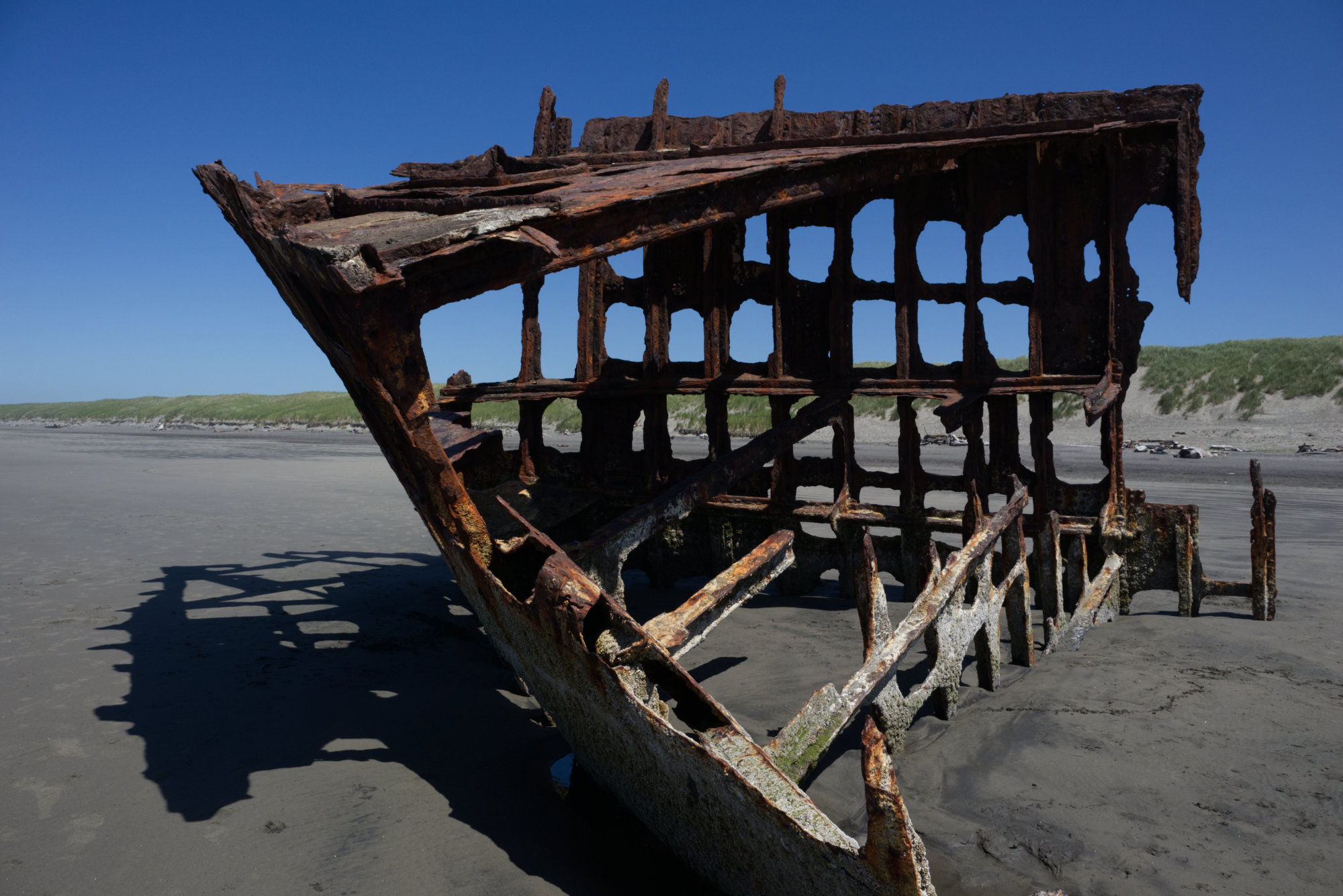
Shipwrecks were common enough that the coast between Tillamook Bay and the top of Vancouver Island is informally known as the Graveyard of the Pacific. One of the most accessible wrecks is the late four masted steel barque Peter Iredale. Run aground in October 1906 just south of Clatsop Spit, the bow and a few keel members are all that remain today. No lives were lost in the accident, the ship remaining almost intact. The salvage rights were eventually sold, but the ship remained stuck in the sand, slowly fading away as her captain predicted. “May God bless you, and may your bones bleach in the sands,” he said. Here are a few pics from our visit earlier this week.


Flying Blubber
Whales also wash ashore occasionally. Most notoriously at Florence in 1970. At the time Oregon wasn’t famous for much more than its two main cash crops, timber and reefer. As soon as the 45’ sperm whale showed up it began rotting. And smelling. A situation the local State Highway Division said was best fixed with dynamite. Lots of dynamite!
Their idea was to blow the suppurating carcass to smithereens, then let the gulls do the rest. Only, no local had ever blown a whale to smithereens before. “The humor of the entire situation suddenly gave way to a run for survival as huge chunks of whale blubber fell everywhere.” As you may know, the story grew legs and has all the hallmarks of an epic Darwin Award in the making. Here is the original news report:


Mike,
Thanks for the history lesson, and for sharing the most famous exploding whale story of all time. It is so instructive that it is shown in US Army and DoE explosives classes.
I’m glad you and Carol are enjoying your travels over here.
That poor whale is so famous, they designated a town memorial for it! We are starting to get out more, second jabs on Sunday!
Loved watching the blubber blast. Enjoy your visit, see you late July, early August.
It’s a classic Oregon moment. Looking forward to catching up!