 Posted by

Several people, well at least one, have asked, “How can I track you?” Unlike most things boaty, the answer is simpler than it might be with other endeavors. Knowing where ships are in all weathers and conditions and to avoid collisions has long been an objective of most maritime regulatory bodies around the world. It took the combined inventions of VHF radio, Global Positioning Systems and electronic marine charting to make Automatic Identification Systems a reality.
These days, all commercial vessels over 300 gross tonnes and all passenger ships are required by international law to carry an AIS transponder. Regulated by the International Maritime Organization (a useful part of the United Nations) under the International Convention for the Safety of Life at Sea (SOLAS).
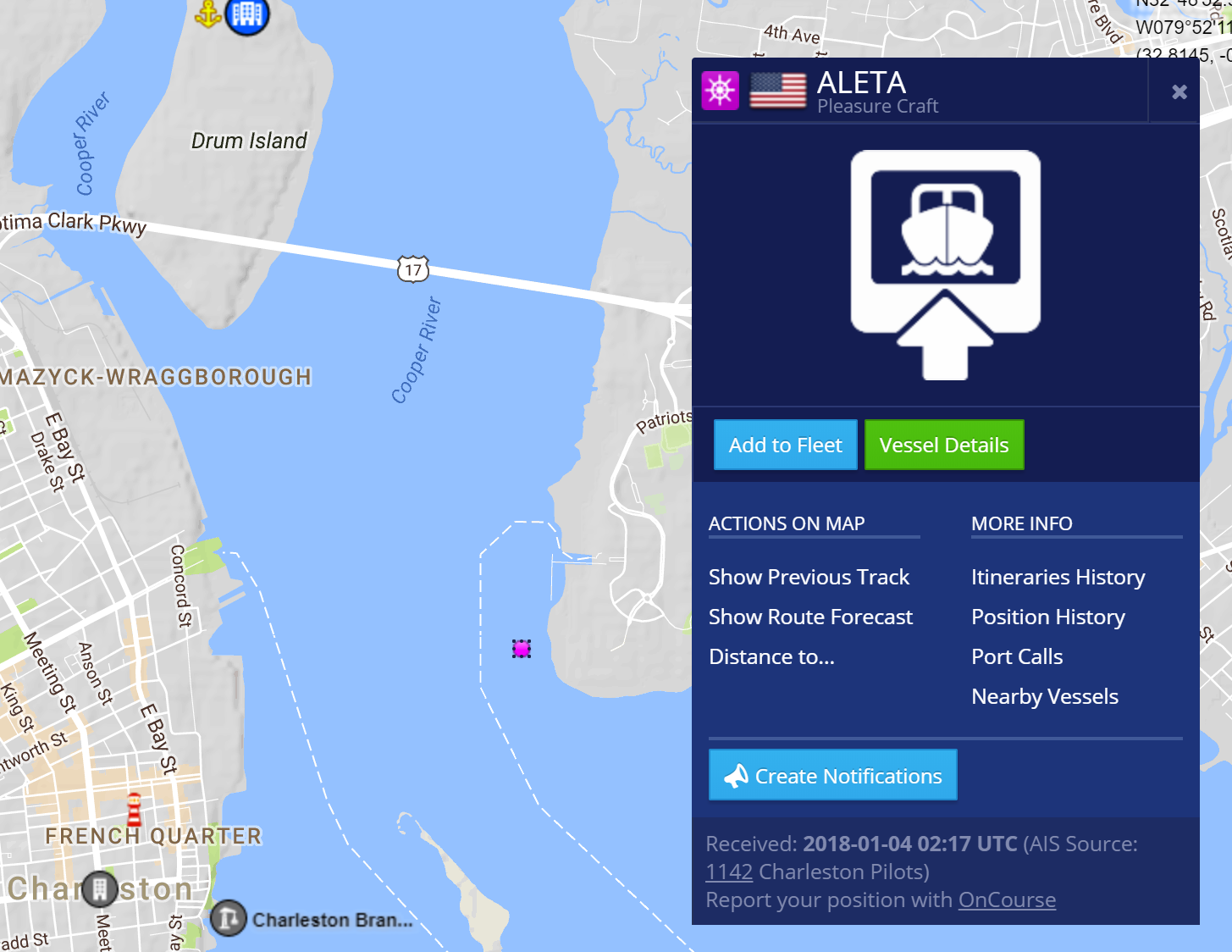
AIS information can be viewed on most modern chart plotters within the reliable distance of VHF radio broadcasts, that’s about 10-20 miles. And for those who enjoy a bit of trainspotting there’s always the Internet. There you can access near real-time AIS data on several sites including www.marinetraffic.com. You can also find ships using Android or iOS apps like FindShip (see also: www.findship.co).
To locate any vessel you’ll need her name, her call sign, and or her MMSI (Maritime Mobile Service Identity).
Here are Aleta’s specifics:
Name: Aleta
AIS vessel type: Pleasure Craft
Call sign: WDJ8033
MMSI: 367520170
MMSI numbers serve as a unique identifier for ships, their radios and positioning beacons in the case of emergency. Agencies like the Coast Guard, and others around the world, can quickly identify your vessel, its type, size and approximately how many people may be on board. In the United States a ship’s radio station license and call sign is regulated and managed by the FCC. The MMSI falls under the auspices of the International Telecommunications Union (another useful UN department).
In addition to government registration, once a ship has been broadcasting its AIS location for a bit the data gets picked up and shared by tracking websites. In Aleta’s case it took about four days before we were Google-able.
Now, if you want to find us just Google our MMSI number or search for it on an AIS tracking site. There are no secrets on the water!
As a side note, there are other means for tracking wayward adults, including the Spot tracking system (www.findmespot.com). I’ve used Spot in the past and liked it, but its annual subscription has gone up to $200. Meanwhile a (class B) AIS system costs around $600-$800 without any annual fees (installation extra). Plus with AIS you get much more real-time information about other boats while you’re out on the water. Since we had AIS already, renewing my existing Spot tracker simply wasn’t worth the money.


