 Posted by
 Position: 37° 52′ 45” N 4° 46′ 47” W
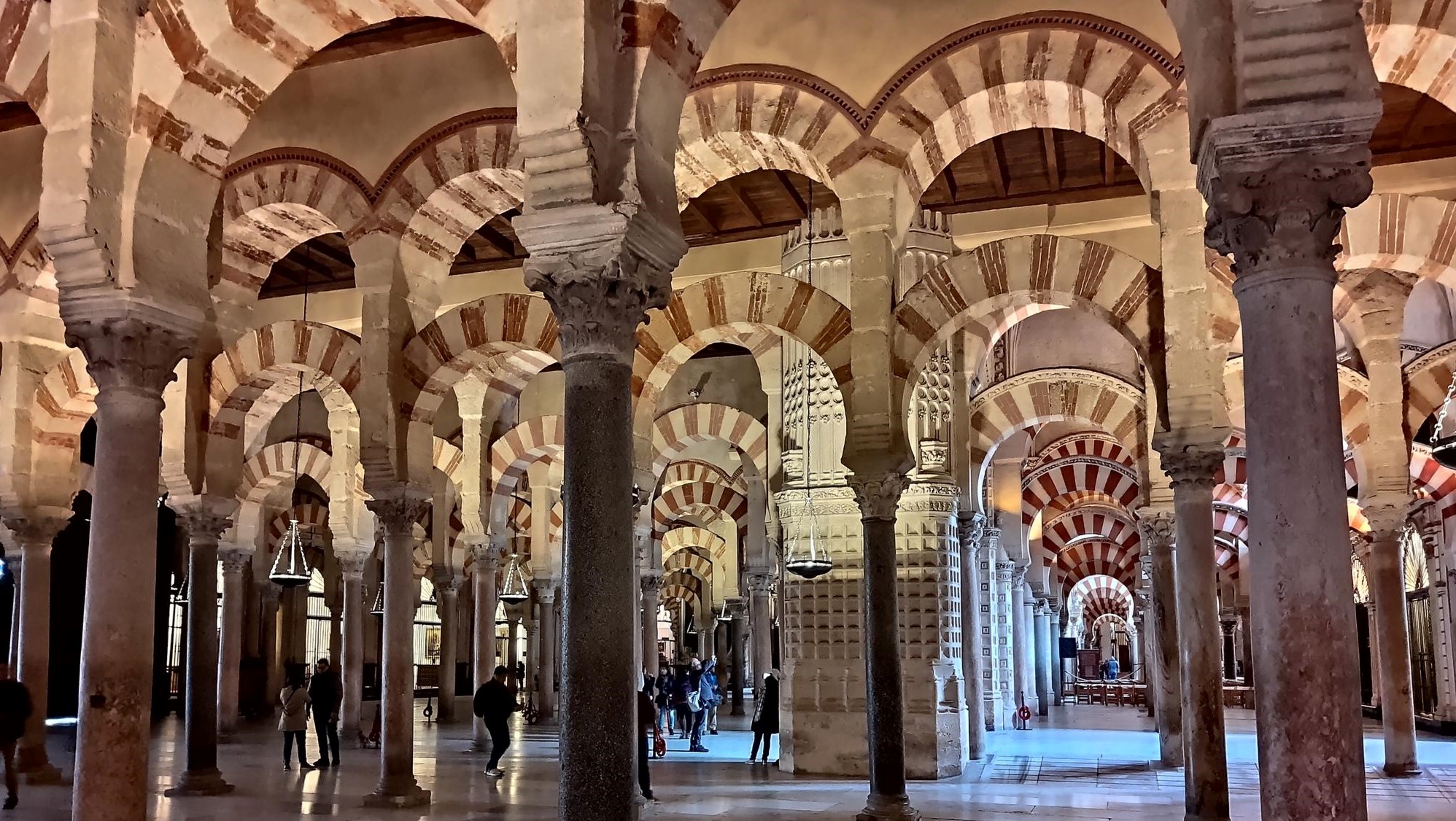
My instinctual response upon entering Córdoba’s stunning mosque-cathedral was an overwhelming sense of peace. It is late November and the tourists have thinned out to where I easily found a modicum of solitude. Walking past the ticket collector, into the broad spaces sectioned by endless rows of arches, I claimed my spot and closed my eyes. I took a breath and gently exhaled. Now I imagined the mosque’s busy, agora-like past. As the cultural center of the city it was the primary gathering place. Worshippers and potentates in flowing robes and headdresses came and went, making deals, arguing politics, discussing faith, or finding out how the wife and kids are.
Arches
 Work on the mosque began in 784 and continued for over 200 years. Today, 856 arches support the building. Each arch stands roughly 30 feet high and 10 feet wide. Those wedge-shaped doohickeys at the top of arches are voussoirs. (I know you knew that, but it was news to me.) In the mosque, the voussoirs alternate red and white giving it its famous trademark look. Columns, some originally pillaged from Roman buildings in the area, are lavishly decorated with crowns of palm leaves. Natural themes abound in the details, here.
Standing in one place, you can rock to one side and watch the arches fall in an out of line through forced parallax. Rock on your other foot and you’re in a hall of mirrors with arches disappearing into infinity.
Extensive use of onyx, jaspar and marble allude to the wealth and ambition of Abd al-Rahman I, the mosque’s original sponsor. Al-Rahman established the Emirate of Córdoba and proved both a tolerant and effective ruler. Thus began 300 years of Muslim rule in Iberia, or al-Andalus as it was known. Córdoba was at the center of scientific research, education, arts, culture, and theology. Muslims, Christians and Jews lived and worked together under the auspices of the Caliphate.
Breaking my reverie and walking further into the mosque, things changed. Incongruously, chapels appeared along the west wall with all the gilt trappings (and guilt trappings) of the high Catholic church. I had crossed into the mosque-catherdral’s next chapter in history.
Icons

Chased all the way up to the north coast of Iberia in the 8th century by the Muslims, the Christian kings bided their time. For years the Reconquista was mostly Catholic-led raiding parties having marginal success. By the 13th century, though, they had gotten their act together and made steady progress towards reclaiming the southern territories. It helped that the Caliphate of Córdoba spent a great deal of time defending itself from regional in-fighting and fending off Berber raids, and pretty much self-destructed. Thus in 1236 the Christians returned victoriously to Córdoba and began converting the mosque into a house of Christ.
In the center, I found myself in a fully realized Catholic cathedral. Big crosses. Big effigies. Big icons. Big paintings. Big organ pipes. All lit by soaring clerestory windows. Daylight reflected off a ceiling as ornate and baroque as can be. Replete with vines and bas relief figures, the ceiling, and all it covered, is the utter antithesis of the mosque’s quietly understated surroundings. King Charles V of Spain authorized the building of the cathedral, yet was appalled with the result. “You have destroyed something unique to build something commonplace,” he famously said.
Turns out that the Reconquistadors weren’t as tolerant as the Caliphs, either. Over the next couple of hundred years, Muslims and Jews who refused to convert to Christianity were expelled from Iberia en masse. Those found guilty of practicing Islam or Judaism were imprisoned, exiled, or put to death. It was the basis of a foreign policy that indigenous ‘Americans’ soon suffered firsthand.
Sacred
I’m not sure how the mosque survived, but I’m very glad it did. Like many things of great beauty, it has been handed down and cared for by successive generations. History isn’t kind to destructive victors, rather, she favors those who adapt to local norms. The mosque-cathedral at Córdoba embodies the pasts of two great cultures who, in their diversity, produced a fabulous work of monumental sacred art.


