 Posted by
Position: 36° 44′ 26”N 5° 9′ 57”W
“You have to see Ronda,” Carol said. “When Tai and I were here a few years ago, we fell in love with the place.” Driving into the city from the east it was hard to see what she meant. All white boxes and modern Spanish tower blocks, the place looked better avoided.
Arriving late on a grey, rainy afternoon, we drove around until we found parking in the Old Town. Hungry, we sat down to good tapas at the Taberna, a small bar off one of the main squares. We had to leave Marlon outside, but he scored a bowl of water and tapas of his own. It was chilly. Even in southern Spain there is snow on the mountaintops in November.
Multi-layered
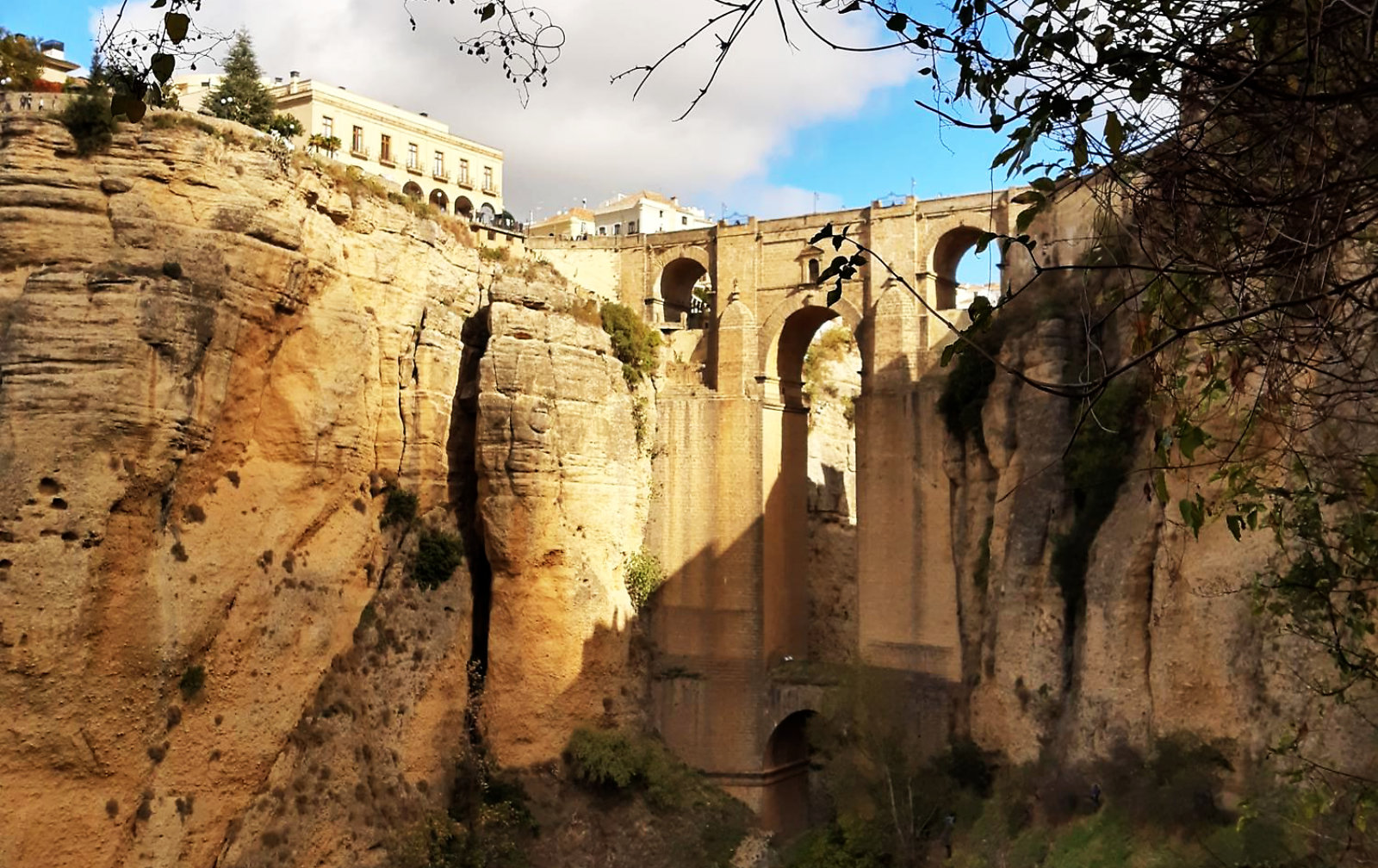
Ronda is another of Andalusia’s astonishing multi-layered historical sites. Set on a dramatic hillside with a canyon running through its heart, the to-and-fro of Roman/Islamic/Christian occupation provides visitors with some of the most spectacular views in the country. Standing on the New Bridge, completed in 1793, from the west side you look down 320’ to the river-falls below you. On the east side, you marvel at the sheer walls and deep pools of the canyon. Keep looking east, cast your gaze slightly upwards and you will see the Old Bridge. Just beyond that lies the original, 2nd century Roman Bridge. The three bridges join the ‘New Town’ to the old one.
After a cold night in our unheated Airbnb, we warmed ourselves with hot coffee and pastries at a local café, Spanish style. Crossing the Old Bridge, we followed a footpath past the Arab (thermal) baths and down to the river running along the eastern edge of the city. Turning up, we entered the Gate of Amocábar. The gate’s solid stone, thirty-foot walls defend the nearby church’s sanctity, as well as the far end of town.
Clinging to its narrow ledge, the Old Town’s streets wind through its residences, churches, and plazas. Sidewalks are cobbled with smooth river rocks, set narrow side up in elaborate black and white patterns. Still, at only a half mile end to end and a quarter mile side to side, the place is tiny. Getting lost would be challenging.
Steep
Just before you leave Old Town, there is a viewpoint above a steep path running downhill, along the town’s western edge. Take the path and almost immediately the New Bridge hoves into view. The scene is your reward for the detour. From below, the bridge is as wonderful as the views are from the top. Stone pillars 200 feet high spring from the sides of the canyon and reach up, confidently supporting the road above. It is a solid structure. Birds soaring below you as you looked down earlier, now flitter above your head. The murmur of the falls grows louder as you step under the shadow of the span, and drowns out all other noise.
Steep roads crawl up the canyon’s sides to the modern central shopping area in New Town. Tabernas and restaurants cram in alongside hotels and souvenir stores. Tourism has been big business here for a long, long time.
Bulls
Modern bullfighting originated in Ronda and drew American fans of Ernest Hemingway’s Death in the Afternoon to the city for decades. One of those Americans was Orson Welles. While traveling in Spain at the age of 17, Welles studied bullfighting in Seville. He also fell in love with Margarita Carmen Cansino, the daughter of a Sevillian dancer. Margarita was better known as Rita Hayworth, and Welles and Hayworth would later marry. It’s no surprise he too was drawn to Ronda.
Given their passion for Spain, the natural question is, did Welles and Hemingway ever meet? The obvious answer is, of course they did.
Fighting
 In 1937 Welles was narrating The Spanish Earth, a pro-Republican Spanish Civil War documentary with commentary by Hemingway. During the recording, Welles began asking questions about the script and started making suggestions. Unbeknownst to him, Hemingway was in the studio listening to the recording. Declaring he wasn’t going to let “some damn faggot from an art theater [tell] me how to write narration”, Hemingway lumbered into the studio and took a swing at Welles. Welles swung back and the two men brawled in front of the war movie on the projection screen. The lights came up, they paused, looked at each other and burst into laughter. Welles was 22 at the time. Hemingway was 16 years and several acre feet of alcohol his senior. The fight was over, but if I were a betting man, my money would have been on Welles. This was the moment they became great friends.
Ronda’s famous bullring is now a museum, and Orson Welles is buried nearby. Meanwhile, Japanese tourists outnumber Americans 4:1. Such is the timeless attraction of this ancient city perched over a canyon. Like Carol and Tai and Orson, I too fell in love with it.


great history
Happy Holidays
love you both
Thanks Mark! Hope you’re all doing well and getting back to line dancing! Happy Christmas and may Santa NOT come down your chimney in a Speedo!
Wow! Description and photos are both wonderful.
Happy holidays!!!
Thanks Erin! I hope Santa brings lots of happiness your way!