 Posted by
Position: 37° 10′ 35”N 3° 35′ 23”W
Olives!
 Cresting the southern coastal mountains and heading north, olive groves blanket the dry, dusty, and otherwise barren landscape. From a distance, olive trees have all the hallmarks of a cash crop. First, they’re short, to make harvest easier. Second, they’re planted in vast rows that reach for miles across Andalucía’s wide valleys. Third, olive trees are nicely shaped. They are round and cuddly, like big, green cotton candy. Planted farther apart than apple trees in America, Spanish olive farms vaguely resemble giant boards for Chinese Checkers.
Spain may have the fewest beaten tracks of any country in Europe. Motorways are lightly trafficked. Even in the rush half-hours bookending the working day in larger cities, I have yet to find anything like the endless parking lot that is US Highway 101 in the Bay Area.
Getting off the beaten track takes mere minutes. Leave the highway and boom! Instantly you’re in the countryside, pootling down a one-track farm road in search of boutique accommodations. After our chilling AirBnb experience in Ronda, we were determined to find a place with functioning heaters. Settling for nothing less than ‘superior’, we discovered Molino La Nava, a converted olive mill and now a lovely rural hotel in the middle of a working olive farm. We fell in love with the place.
Spain makes almost half of the world’s olive oil. And, like many of its wines, Spanish olive oil is often underappreciated. It is a vast industry with over 2.6 million hectares under cultivation. That’s roughly the same size as the state of Massachusetts. Carol discovered that olive trees are some of the world’s longest living plants, and a couple of them near Catalonia are over 2,000 years old.
After driving all day, Marlon wanted out. So out we went. Long shadows and a cool westerly breeze meant keeping a brisk pace lest golden hour turn to darkness. A pack of farm dogs across the road barked menacingly. But like most Spanish dogs, they cowered at the sound of my best British accent and I barked orders back at them.
The olive trees swayed and rustled in the wind. Their long branches rattled gently, while their thin leaves turned silver side up as they caught the gusts. Heavy with fruit, the trees were close enough to the road that I reached out and plucked an olive. I squeezed it until juice popped out, green and opaque. Releasing a resinous scent, this small berry was, I assumed, a long way from becoming delicious salad oil. Walking on, Marlon and I got as far as the bobcat warning signs and then doubled back. I arrived just in time for sunset, cocktails, and dinner.
Granada
Granada is a big city. Built high on the foothills of the Sierra Nevada, the city’s historic districts are all narrow streets and no parking signs. Much better to tackle things on foot. Carol found us a place in Albaicín, the old Muslim quarter, a stone’s throw and river crossing from the Alhambra Palace.
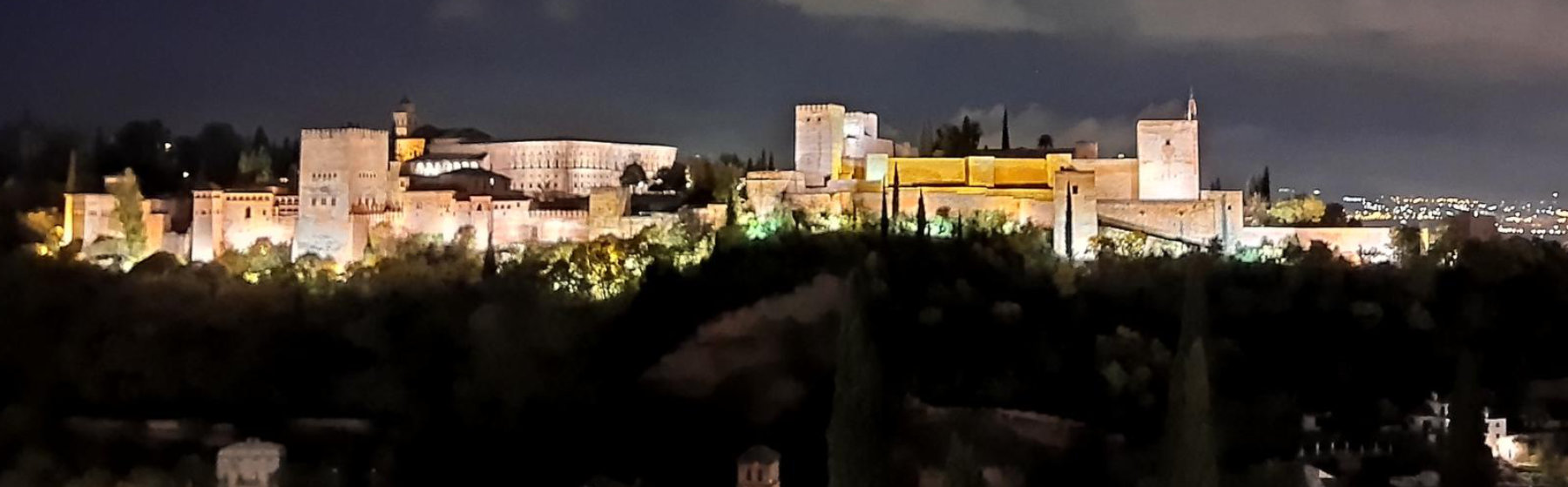
Finding our apartment proved challenging the first time around. The Albaicín district is bound by ancient portcullises barely wide enough for a motorcycle, let alone a car. Augmented by a fiendish one-way system designed by Daedalus himself, there seemed no way in or out. Encouraged by our host, on our second pass we ignored most of the road signs and checked in only 20 minutes late. Tuckered by the stress of the day, I napped while Carol took Marlon for a stroll down the hill. An hour after sunset, we stopped at the church of San Nicolás and marveled at Alhambra, beautifully lit in the clear, cold blue of night. Appropriately, Venus and a sliver of moon hung together over the hills to the south.
Alhambra
Our tour of Andalusia’s coolest historical sites finished with the Alhambra Palace. Looming over Granada, the palace’s origins appear to prove conclusively that the Romans discovered the secret of success in real estate: location, location, location.
Sometime around the middle of the 13th century Mohammed ben Al-Ahmar built the current walls and a palace in traditionally sharp, boxy lines. A hundred years later, further conversions made Alhambra a royal palace for Yusuf I, the Sultan of Grenada. Then, just as in Córdoba, the Reconquistas marched in and took over the site, along with the rest of Al-Andalus. In 1492 Alhambra became King Ferdinand and Queen Isabella’s royal court and expeditionary launchpad. Adventurer Cristóbal Colón (née Cristoforo Columbo), aka Christopher Columbus, received his royal blessing for a westward trip to India at Alhambra. Such are the makings of a small world.
Visiting the monument is an exercise in military timekeeping. Your ticket is valid for entry only at the time stamped on it. Don’t step out of line. Don’t try blagging your way in early. It won’t work! Thank goodness we visited in the off season. It must be hell in the dire infernos of the summer’s tourist onslaught.
Much like Córdoba’s mosque-cathedral, or a gathering of Green activists, Alhambra’s builders over the centuries stuck to the tenets of Reduce, Reuse, and Recycle. Thankfully, rather than destroy the allure and beauty of the Sultan’s original palace, Carlos V commissioned a new one. Yet, the new palace, thought avant-garde at the time, today looks like it was designed by some Hapsburg corporate hack out of Vienna. It is as out of place in Granada as the cathedral is in Córdoba. Worse, in the Sultan’s palace, someone tried papering over the intricate ceiling decorations with hideous, Hapsburgian stone carvings. Fortunately, someone else put a stop to such silliness.
As impressive as it is, Alhambra today is only a shell. Doubtlessly pillaged over the years, without furniture, or tapestries, or paintings on the walls, it’s hard to get a sense of what it must have been like living there five or eight hundred years ago. On a cloudy, wet day in November, with the gardens mostly resting for the winter, the place felt lifeless.
Fortunately, the palace’s Museum of Fine Arts brightened my mood. Free for EU citizens and two euro for everyone else, it contains a number of excellent pieces by Alonso Cano, and the obligatory Picasso print or two. I’d never heard of Cano before. It seems he was as grumpy a bastard as ever held a paintbrush or a chisel. According to the Encyclopedia Britannica, he smashed a statue of a saint rather than sell it for less than his asking price. Back in the 17th century, destroying religious artefacts, even your own handiwork, was a capital offence. Clearly, the death penalty was not a deterrent then, either.
Back to Sea
After five days on the road, we made our way back to Gibraltar and prepared to get underway. We had a rendezvous with our new crewmates and crazy-in-love-newlyweds-on-honeymoon, Karen and Michael.


Not so nice looking kitty
As James Bond would say, Pussy Galore!
It pictures a trip to Spain but Caroline took years ago overlap in many of your sites and wonderful for free.
It’s such a beautiful part of the world everyone should have the chance to see it.