 Posted by
 The cool Wallowa Mountains with its grasslands and sparse lodgepole pines are the final transition from the fertile plateau that is Oregon east of the Cascades. The long, gentle run out takes you past the dusty town of Baker and the last hipster enclave before the state line. Whatever your fancy, nouvelle cuisine paired with local wines or microbrews, mountain sports guides, horse feed, or a beard trim, it can be found in Baker. We blew past it heading east in our borrowed[i] Prius safe in the knowledge we were traveling as greenly as we could.
The broad plain of southern Idaho’s Snake River is flat and hot, not the river’s most flattering side. Those vistas are reserved for its source in the rugged Tetons near Jackson, Wyoming, and deep in the canyons west of Boise where it carves its way through solid earth before joining the Columbia River and heading out to sea. Along I-84, though, the scenery is vast, all dun earth burnished by the hot sun in clear blue skies, brushed only occasionally by wisps of high cirrus clouds.
This backdrop stays the same for miles. With little to distract travellers, Idaho sees fit to expedite your journey with 80mph speed limits. To be clear, the highways, however aspirationally envisioned by Dwight Eisenhower, are not the smooth racetracks of Germany’s autobahns. Wrangling semi-truck turbulence at 90mph in a Dodge pickup on crudely patched roads is a job best left to the locals.
Dinosaurs and Diamonds
Eventually, you turn the corner and head south into Utah where the foothills gently re-emerge. Outside Salt Lake City the jagged frontal range of the Wasatch Mountains spills into the shallow waters of the Great Salt Lake. The thin spit of land that extends from Ogden to Provo along this front has merged into a ribbon of urbanisation that was probably inevitable. Big box stores tangle with billboards and fast-food outlets in a cacophony of advertising that begs the weary off the road to empty their wallets.
Ignoring all the visual noise, we turned left and headed uphill towards Park City and picked up a backroad towards Moab. Our reward was traveling a section of the Dinosaur Diamond Prehistoric Highway up a lonely canyon. Leaving the town of Duchesne behind us, the first two thirds of Route 191 was pockmarked by leased drilling sites on tribal land. Khaki coloured nodding donkeys languidly dipped their heads as the pumpjack drew oil upwards into the vertical storage tanks. I wondered if the owners simply switched the pumps off when the price of oil drops below $50 a barrel. And if there was any risk to Indian Creek, meandering gently down this beautiful valley.
Price is Right
The last third of the drive winds through part of the Ashley National Forest. This is elk hunting country. Wear your high viz vest if you’re out hiking in the dense woods. The road summits at around 9,000 feet (2770m) then drops quickly on the southern side of the pass into rusty desert, reddening deeper in the late afternoon. By the time we reached Price the iconic monumental rock formations so favoured by western artists and movie makers became almost commonplace.
It had been a long day’s drive by the time we pulled up to the River Rock Inn in Green River, the strains of Creedence Clearwater Revival rattling around our heads. It was also too late for the local restaurant. Instead, we made do with chips and homemade guacamole for a second night in a row. The inn is well worth a detour if you’re out that way. Built on the bones of an old motel, our room was modern, cool, and spanking clean. Kitschy western art covered the walls and river rock lined the shower. A yummy, freshly prepared breakfast the next morning meant we could skip lunch the following day.
DREAMS OF YOU AND BLUEY GREEN
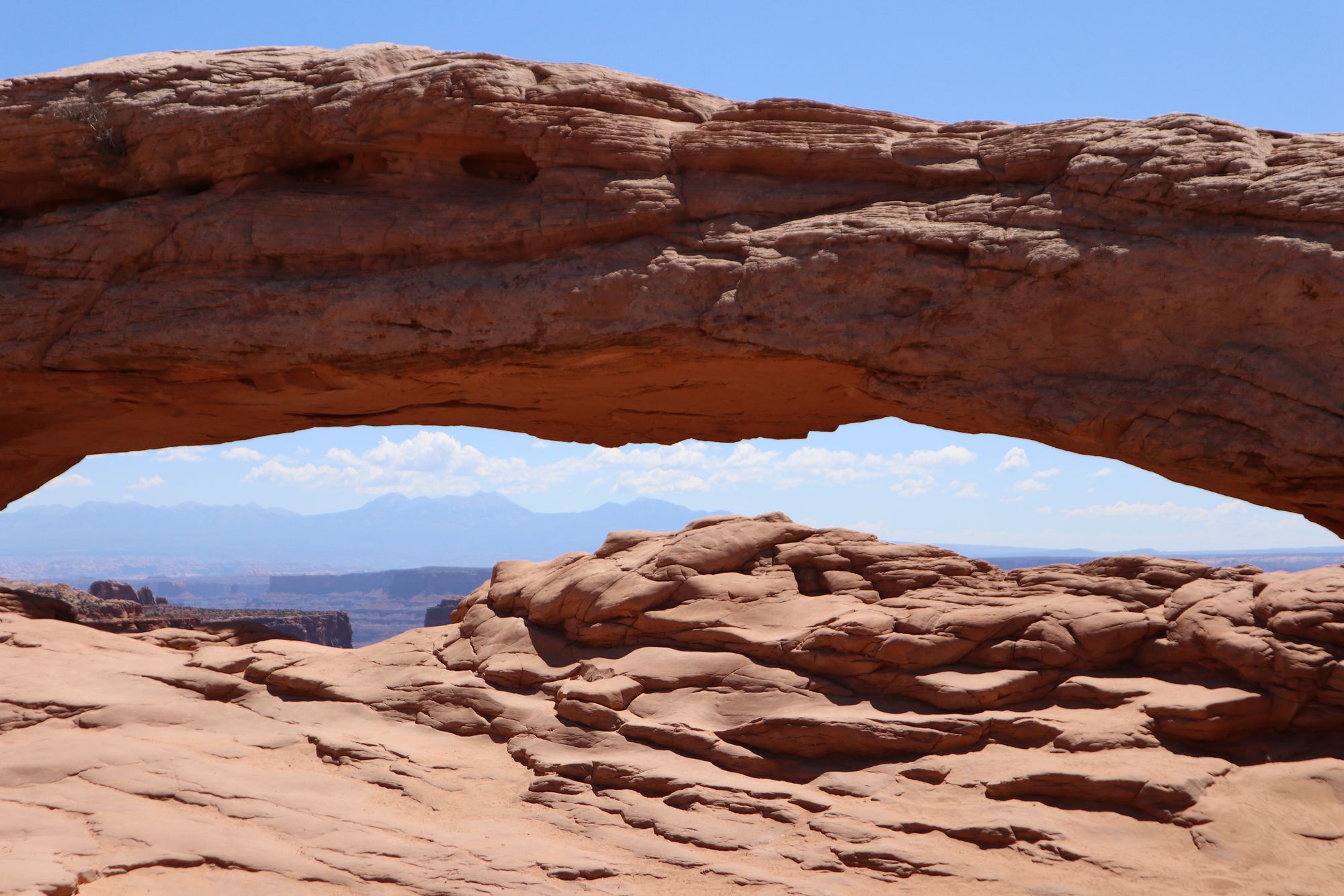
Canyonlands is a Lyndon Johnson era National Park about 30 miles from Moab. Jagged gashes split the wide flat plain leaving tall buttes standing as sentinels. Cliffs along the roadside peer down a thousand feet over the slow-moving, murky waters of the Colorado and Green rivers. Further downstream things get livelier in Cataract Canyon. There the river narrows and draws in rafters and kayakers from all over the world.
The temperature rose to 104F (40C). Undaunted, we drove to the furthest northwest point in the park and hiked in towards Upheaval Dome. It was too hot to consider walking the entire rim of this (possibly) meteorite-stricken spot. So we made do by climbing up the smooth stone trail to the second observation point.
At 8% humidity the land is desiccated, yet alive. Brilliant blue and green swards cover heaps of fallen rocks beneath the cliffs. Not mineral, nor animal or vegetable, cyanobacteria survive the blistering heat and freezing cold of the seasons helping stabilise the soil and bring a colourful respite to the tawny ochre and deep terracotta that otherwise dominates the landscape. They don’t take kindly to being walked on and lots of informative signs warn you off.
In the heat of the day ravens circle and caw in hopes of a handout. Lizards scarper when you get too close, but never very far. They find a new patch of shade and stop, immobile, hoping you never saw them. Insects occasionally buzz, then fall silent. The heat dampening their efforts.
Closing all the car windows when it’s parked is foolishness, but there’s insurance and gear to consider. Leaving the car closed for even a few seconds means throwing open all the doors for at least a minute or two to let the heat out again. If we lived here, we’d have shades on every piece of glass we drove.
Moab
Moab in the 1950s was called the ‘Uranium Capital of the World’ when a rich seam was discovered south of the city. At the dawn of the nuclear age uranium brought in prospectors and miners and an attendant army of camp followers from far and wide. With the population explosion came schools and infrastructure that exists today, even as the economy has shifted to adventure tourism. Radioactive mill tailing remediation (UMTRA) keeps a few well-paid government jobs in town. (If horses sweat and men perspire, then Moab-ites must [surely] glow.) The rest is all sports, entertainment, shopping, bars and cafés.
After watching England make it to the UEFA Cup finals over lunch at the Moab Brewery, we strolled along main street in search of a sun hat for Carol. She is even more sensitive to the sun than I am. I guess all those years of cycling paid off in my instantly reawakened farmer’s tan. Carol’s calves were ominously pink after our hike. Fortunately, her legs had calmed by the next morning. Later that evening we breached the entry to Arches National Park, having been rebuffed earlier in the day.
We breakfasted early and hit the road for Durango, Colorado, home to many fuzzy memories of Carol’s high school years…
Canyonlands and Beyond


[i] Thanks to the unabashed generosity of Lauren and Wade!


