 Posted by
POSITION: 38°22’02″N 20°43’02″E
Dateline – Ithaca. Not that Ithaca. Ithaka the OG island in the Ionian Sea. Birthplace of Odysseus. Home to caves of swineherds and nymphs. That one.

Surrounding an epic natural harbour, the principle town is Vathy. A very pretty place that in the off-season has as much character as you could hope for from a sleepy Greek village. All two-story, flat-fronted buildings with pitched tile roofs. Most are simple, modern designs thanks to a massive earthquake in 1953. Many are painted in sun-washed pastels. Golds, teals and pale blues, offset by natural stone or contrasting lintels. Steep hills, covered in fat olive trees that sit next to skinny cypress trees stretching high above your head, provide an abundance of natural shelter from all but the prevailing northwesterlies. And even those usually die down before nightfall.
Tables line the waterfront and waiters criss-cross the main road with trays of drinks and food. At the height of the season there must be a polyglottal hubbub with a tink of glasses and the appreciative scrape of forks across porcelain. By October the tourists have all left, save for the few remaining charterers on their way back to Lefkas and the big yachting centre there.
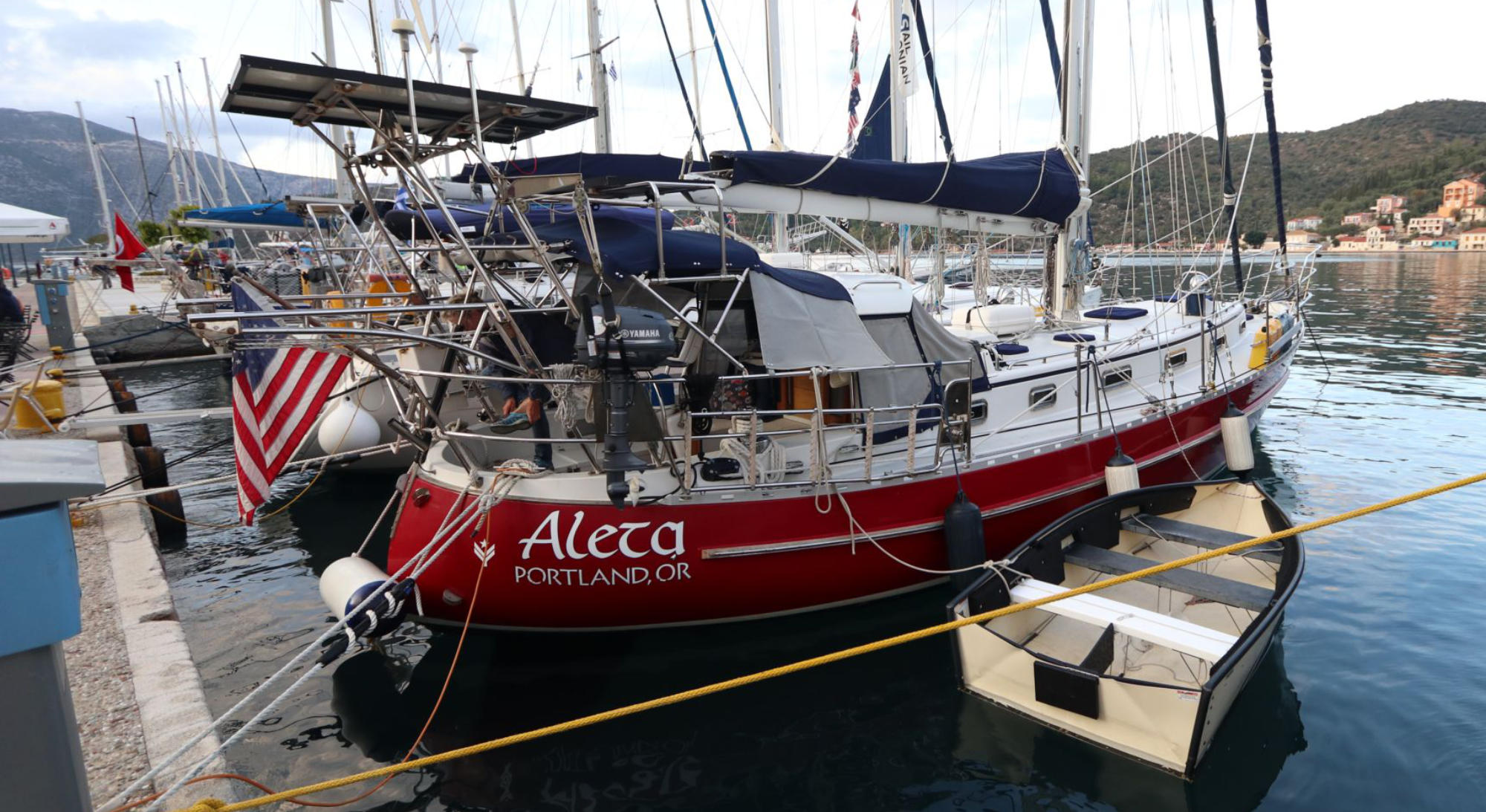
There is plenty of good holding in the harbour which is wide enough to comfortably accommodate a flotilla. There is also plenty of space for tying up at the quayside. Mooring is cheap. Five to ten euros should see you right. You can step off the back of your boat and into the Karamela Yachting Café for breakfast, lunch or dinner. Beaches aren’t far, and several clearly marked hikes start right in town. A couple of big supermarkets and a few fully stocked greengrocers have all you need for provisioning. It’s a terrific spot for a stopover, or to wait out bad weather. We did both.
Beastly
For several days a beastly low-pressure system drew moisture into the lower Adriatic from the west, north and even out of the south. The forecast changed constantly. The weather boffins first thought the centre of the system would head north to Corfu. Then south across the Peloponnese. Until it eventually settled right on top of Ithaka. For three days it bucketed down rain. Each swirling squall announced by gusty 25 and 30 knot winds.
Things really got going the second day when the island’s entire annual rainfall fell in the space of five hours. Water poured down the mountains and into the town threatening to flood businesses and homes close to the harbour. Late in the night, the fire department commandeered a backhoe and smashed the stone seawall to let the floodwaters drain out. Too late to save the local church that had already launched a hundred pews. Nell, our dinghy, filled to her gunnels twice.
Biblical Prelude
Our tactical error was to ride out the storm at the quayside. Having successfully Med moored Aleta the day before, we should have moved ahead of the first rains. Med mooring involves backing your boat to the quay whilst dropping your anchor (to secure your bow), then tying off the stern. You have to haul up on your anchor chain and keep it tight or you’ll have all kinds of issues in the middle of the night. Something generally frowned on in heavy weather as your anchor can slip and your boat sail back into the concrete wall behind you.
The Wee Hours
Leaving your boat unattended in the middle of a biblical rainstorm seems reckless. That didn’t stop the Dutch family next door heading to the pub until the wee hours of the morning. At around 1:00(am) I started Aleta’s engine for safety’s sake and gratefully double checked the midship lines we’d put out hours before as a precaution. Looking right I could see the Dutch boat slewing in the gusts and finally realized her port stern line had broken. Worse, she was yawing into the neighbouring boat, giving the owners kittens as they wrestled with their own lines.
Leaving the engine running and Carol at the wheel, I leapt off with an extra line in hand. With the other captain’s help, we retied the stern line and fitted a midship line to the heeling boat, finally settling her down sufficiently to avoid disaster. At the very moment we’d secured her, the drunken crew reappeared. First with looks of curiosity, then incredulity, and finally gratitude.
Disaster averted, good deed for the night done, Carol and I went below and changed clothes before crawling back in our berth for a few hours sleep. Slowly the storm relented and by sunrise the gusts fell to a manageable 15 knots or less. Our anchor held despite the winds and the waves.
Break and Run
By noon the sun had broken through the clouds and the wind shifted round to the north. In our favour. We hauled anchor (along with a metric tonne of muddy sand), and headed south, sailing before the wind with a following sea. A very civilized end to a miserable few days.


Never a dull moment – even in paradise. Stay safe!
We’ll do our best!