 Posted by
Position: 36°49’11″N 28°18’25″E
Given all their history, it’s easy to forget that Greece and Turkey are a mere discus throw apart. Zooming in on our chart plotter, the red line separating the two countries comes with a note: “This boundary is derived from chart GR45_2007 published by Greece HO”. Navionics, diplomatically, declines to comment further. Crossing that thin red line meant we’d finally arrived on our third continent.
Within two weeks of entering Turkey, it has become clear that its (western) history is so inextricably entangled with the Greeks and Romans that any question of this country being Asian is moot. For most Americans, the notion that any object or building being more than 400 years old is something rare and marvellous. Around here if it’s not 2,000 years old it’s not worthy of a road sign. Our first foray into the countryside brought us to three of the most remarkable historical sites we’ve seen to date.
PAMUKKALE
Pamuk = Cotton, Kale = Castle, viz. Cotton Castle. (Not to be confused with White Castle! – ed.)
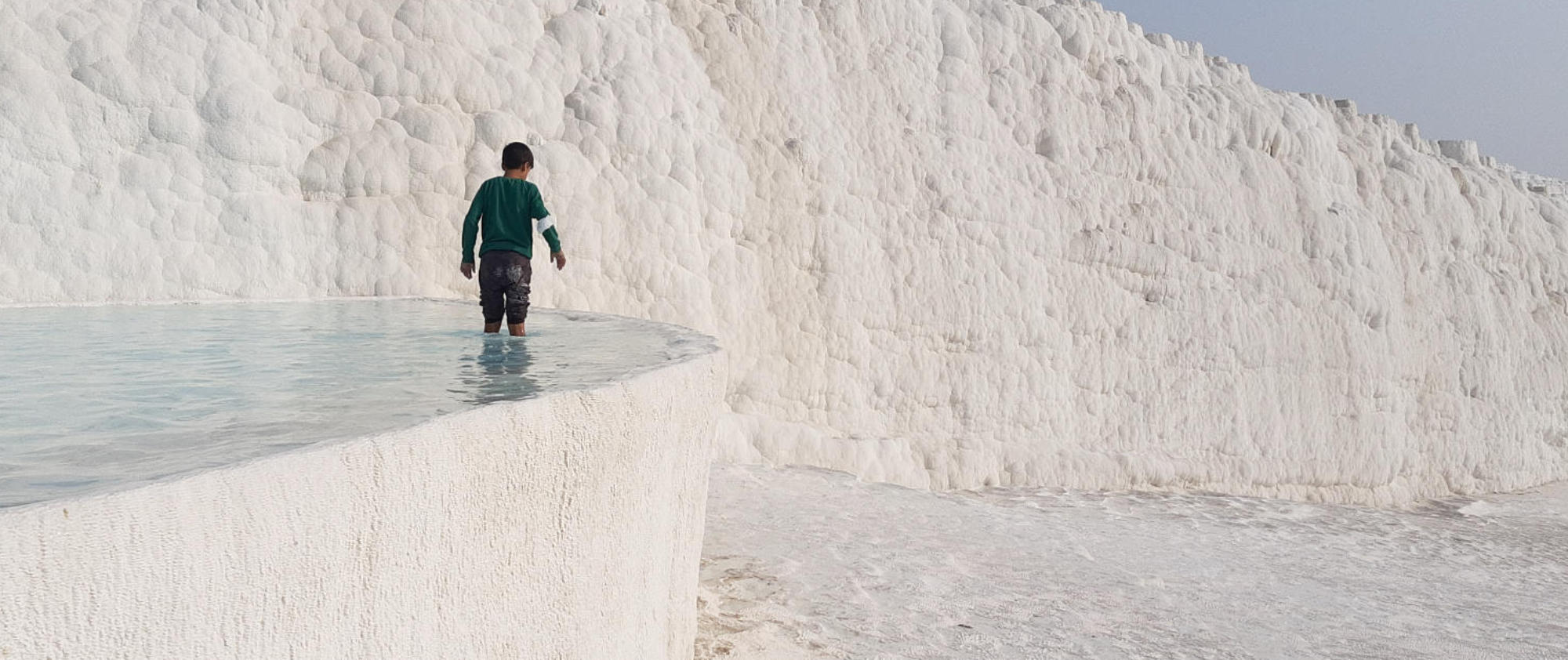
Pamukkale is home one of the oddest natural landmarks in the world. Anyone who remembers Dr. Zhivago will instantly think they landed on its fully winterised set in mid-July. For everyone else, it looks like Space Mountain in Disneyland. Suspended calcium carbonate flows out with the hot springs and over the bluff where it crystalizes, cladding a mile-wide swathe of cliffside in brilliant white, flowing icicles. As the minerals deposit, the remaining water seeps over a series of plateaus into cerulean blue ponds called travertines. The air is faintly sulphurous and while the ground beneath your bare feet looks slippery, it grips dermabrasively well. The sick and tired have been coming to these healing waters for thousands of years. Cleopatra was a fan. The Romans, who never passed up the opportunity for a soak, took one look and moved in.


HIERAPOLIS
Rising up the valley behind the travertines is Hierapolis. The broad sweep of its gentle slope gave me, for the first time, a real sense of a Roman city’s scale. It’s big for an ancient citadel. About three kilometres wide and one deep. Like all Roman urban planning, the city is laid out in parallel lines that run straight down and straight across the hill. Several streets are preserved, along with their sewers. A couple of massive buildings have been patiently restored and give a sense of scale and grandeur. With support from the Italian government, and several large companies (like Fiat), the amphitheatre has been tastefully reconstructed over the past 15 years. There was something about this smaller, bisected version of the Coliseum in Rome, that made us fall in love with it. It reminded us how little stadia have changed since their invention.
Late November days warm up appreciably and encourage balloonists and paragliders to take to the skies. Prices are very reasonable this time of year and we considered taking a flight in a Montgolfier contraption the following day. But the morning air proved cold and thick with coal smoke, throwing a damp grey blanket over the entire valley. Instead, we headed towards our next tourist event horizon, the ancient city of Ephesus.


EPHESUS

Named for a popular brand of beer, Ephesus (Efes in Turkish) is one of the Mediterranean’s most important archaeological sites. Evidence of humankind in the area dates back 6,000 years, but its heyday was under Roman rule starting in 159 BCE. After earthquakes destroyed the city twice, and worse, the harbour silted up, the site was abandoned. Rediscovered in the late 19th century by British and German archaeologists, it has undergone more or less continuous excavation and reconstruction ever since.
A SHORT TOUR
From the visitor’s centre it’s about 500 metres to the necropolis and then the road which led down to the harbour. Entering the city you pass the 24,000-seat theatre to your left, the largest in the ancient world, and arrive at the commercial agora. Re-erected columns line the main street, while dozens more lie in the centre of the marketplace, catalogued and waiting their turn. Decorative capitals sit stacked two and three deep along the back wall. Passing through the light stone arches of the Augustus Gate, the Library of Celsus towers above you on your right. With two stories of thin columns at its façade, the interior is wide, but shallow, making the building feel a little precarious and overbalanced.
As you turn around, you look up the wide, smooth flagstones that line Curetes Street, the backbone of the city. Along the way, several large stone panels of (helpfully translated) carved Latin text turn out to be some of the most boring corporate stuff you can imagine. One dealt with the allocation of funds for rebuilding parts of the town, with admonishments for handling corrupt officials. Halfway up, another of the Seven Wonders of the Ancient World, the Temple of Artemis, is little more than a foundation. A warren of unearthed catacombs. At the top of the rise is the town hall and the Odeon. There, senators made important political speeches and, in the evenings, ceded the stage for concerts and plays.
Near the library is a modern structure with an expansive white roof. Inside this exhibition hall a steel and glass staircase winds you through five lavish Roman homes. Glass floors on the walkway give you a clear view of the houses’ intricate mosaic floors and decoratively painted walls. By the time you reach the top of the hill, you have gained a sense of personal scale and some insight into the aesthetics of everyday life (for the wealthy). It was our favourite part of the visit.


PRIENE
Nasim, the owner of our hotel in Ephesus, not only plied us with homemade Cabernet, he also taught us the finer points and symbology of Turkish rug making. Then he grabbed a pen and listed seven places we should visit on our way back to Marmaris (our winter home). By this time, we were getting a little ruined out. But we headed in the direction of the first place on his list, Priene, anyway.
Set high above the Bay of Miletus, a deep-water port long since silted up, this Hellenistic era city dates back to the 4th century BC. More modest in scale than our two previous sites, Priene has seen some major efforts at restoration. Nature, as she will, keeps fighting back. Stands of pine trees now push Ionic columns around like Lincoln Logs. And while Hierapolis and Ephesus demanded 100 Turkish Lira for an entrance fee, Priene only charges 12TL. Such is the cost of UNESCO World Heritage status.
Walking up the steep hill to the agora gets your blood flowing. At the top, a cosy theatre and the partially restored Temple of Athena makes the effort worthwhile. Looking out over the broad plain towards the sea, you can imagine legions of ships sailing up the estuary to trade. Farther out, rich soils drawn down the eastern mountains by alluvial rivers, would have made farming easy. Among the pines at your feet, huge stone blocks faintly outline streets and building walls that stretch westwards, eventually disappearing into the canopy of needles. We wondered if Jeff Bezos might drop a few million to uncover the rest of this buried piece of history instead of filling his mega yacht with diesel.


Crucible
For a first venture our travels proved richer than our expectations. Our hosts have been friendly and encouraging. We’ve learned some important rules of the road, too. Like don’t stop for pedestrians at crosswalks unless you want to cause a pileup. And that, more than anywhere else we’ve been in the Mediterranean, the crucible of modern European culture rests here in Turkey. There is so much left to discover.


Great shots. Thanks you
You’re submitting these to cruising world, yes?
Thanks Mark! I guess I should be doing that 🤔!
hello again, this is Robin, we talked on the stage of the theatre at Pamukkale. hoping you two all good. have fun in Turkey. stay safe.
Hi Robin, Good to hear from you. Thanks for reading. I hope your trip is going well and you’re seeing lots of interesting places! All the best!