 Posted by
Position: 46°08’49.2″N 1°10’05.7″W

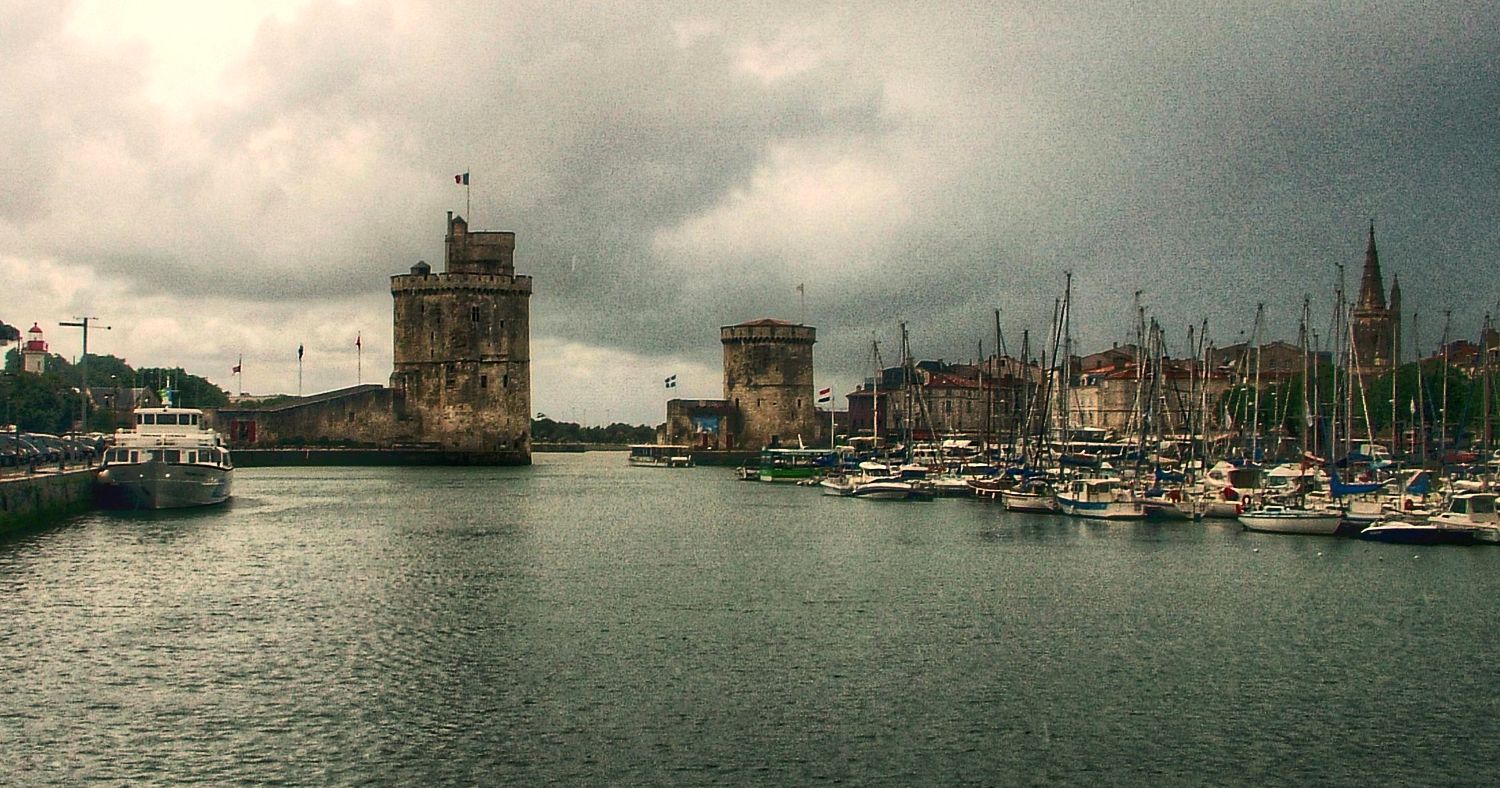
Gliding upstream past the two imposing limestone towers guarding the entrance to La Rochelle’s harbour transports you back hundreds of years. Imagine your triumphal return from a fraught campaign against the infidels of Cypress. Roses shower down on your tattered, rusted armour. The king awaits dockside to congratulate you personally. Your wife and children wave excitedly as you hold your sword aloft in salute. A fanfare of trumpets calls out and echoes off the city walls. Today is a good day to be alive and back in port, in the safe arms of your fellow Knights Templar.
Actually, the only way any of that would have happened would have been in a 1930s swashbuckler starring Basil Rathbone. A time in Hollywood when history and anachronisms blended into wholesome entertainment.
Iconoclasts
La Rochelle sits in France’s armpit. That’s an anthropomorphic geographic reference, not a social comment. If you think of Brittany as France’s outstretched arm, then La Rochelle lies just where the arm attaches to the torso. In other words, the armpit.
Back in its heyday, La Rochelle was a hotbed of iconoclasts and adventurers. As early adopters of protestant Calvinism, the Huguenots used the city as a jumping off point to escape persecution at the hands of Cardinal Richelieu, among others. Part of its rebellious nature may stem from its three hundred years under English rule (1154 – 1453). That ended after the Hundred Years’ War when the French got their mojo back thanks to Joan of Arc’s leadership (her again? – ed.).
Sailboats
Apart from its magnificent old harbour, which alone makes a visit worthwhile, La Rochelle is the epicentre of French sailing. Nearly every large French manufacturer of recreational sailboats, motor yachts, and catamarans is headquartered in the area. Global sailing brands like Dufour and its parent Fontaine Pajot are based in La Rochelle. Group Beneteau, who owns Wauquiez, Jeanneau, Lagoon, Excess, Four Winns, Prestige and a few others, is headquartered just up the road in Saint-Gilles-Croix-de-Vie. Beneteau garners about 50% of the global market for mono and multihull sailboats.
Suffice it to say, if you want a boat built, repaired, or otherwise messed about with, there’s few better places in the world than the Côte de Lumière; the coastline that stretches from Noirmoutier-en-l’Ile down to L’Aiguillon-sur-Mer and on into La Rochelle.
U-boats

In October 1941, the Germans established a huge submarine base at La Rochelle, specifically at La Pallice. The massive concrete bunkers shielded pens for the German navy’s Atlantic U-boat fleet. Today the crumbling remains of the site are deemed too dangerous to visit. If you want to see what the pens looked like in action, re-watch Das Boot or Raiders of the Lost Ark. Since both movies were in production simultaneously they shared sets and U-boat models. That was 44 years ago, when the pens were in much better shape.
Should you sail into La Rochelle you can berth either in the centre of town or do what most people do and stay in Europe’s largest single marina closer to the river mouth. Depending on your draft, your mooring will be nearer or farther from the reception pontoon. Drawing two metres and with a spring tide pending, Aleta was put where she wasn’t too likely to settle into the mud. Multi-million dollar super-sized Fontaine Pajot catamarans lined the docks. Call me a curmudgeon, but I think if your boom is three storeys off the water, it’s too high up. Nonetheless, the temptation to hijack a brand new FP44 and sail off into the sunset was tempting.
Ferries

From the marina, a fully electric ferry takes passengers downtown and runs early in the morning until midnight. With long stretches of white sand beaches, lots of romantic buildings and plenty of excellent eateries, La Rochelle packs in the tourists. Cuisine is varied, but with a heavy concentration on seafood. We ate at La Kase. Carol ordered heirloom tomato carpaccio with herb ice cream. It was as delicious as it was inventive.
Several other boats were waiting, like us, on the weather for a Biscay crossing. We shared drinks with a couple of them and for the first time in a long time it felt like we were cruising again.
Eventually, the forecast looked good enough for the 350-mile crossing to Galicia. After checking the tides and refilling our tanks, it was time to go. We had an appointment in Vigo with Emma and Jarno for a week’s time and didn’t want to be late. The mid-morning sun shone brightly and the wind on Aleta’s beam picked up steadily. Her favourite point of sail is a beam reach.


