 Posted by
Position: 31°29’18.1″N 9°46’27.8″W

Like so many young girls I fell in love with horses long before I rode one. My childhood bestie, Ginger, shared the same obsession. We spent countless hours playing with our beloved collection of plastic horses, lost in daydreams about the real ones we’d someday own.
When I was about ten, I discovered that the West Point stables were just a 15-minute walk through the woods from our house. The United States Military Academy’s mascot, the Army Mule, has been a tradition since 1899 when the school decided its team needed a symbol to rival the Navy Goat. Cherished, the mules represent not only West Point, but the entire U.S. Army. They appear at football games, parades, and other ceremonial events. The mules are trained and ridden by members of the U.S. Corps of Cadets.
I learned at least a few of the cadets spent every afternoon at the stables. I made sure to introduce myself early on and they cheerfully tolerated my eagerness to hang around. What began as offering the mules a few carrots and apples soon turned into brushing them, walking them, and sometimes sitting on them as they made a slow circuit around the paddock. I don’t recall ever being asked to shovel manure, but I’m fairly certain I would have jumped at the chance.
Gascon Ranch

I never really rode until the summer after my freshman year in high school when I got a job on a ranch in northern New Mexico. Nestled deep in the Sangre de Cristos Mountains, the southernmost reach of the Rockies, Gascon Ranch is one of the oldest in the state. It has been in the Bartley family since the 1850s. My parents got to know Jim and Editha Bartley not long after we relocated to NM, their friendship opened the door to my summer job.
Gascon was a working cattle, horse, and timber ranch. In 1962 it started welcoming guests. A handful of rustic cabins sat tucked beneath the peaks, offering a real escape for those looking to disconnect. My duties included cleaning the cabins, helping with meals, and taking on whatever odd ranch chores came my way. Many of which I could never have imagined. Milking cows was one thing, but helping with cattle branding and the delivery of breeched calves blew my barely teenaged mind. The work was the hardest I’d ever done, but the reward was worth it: I got to ride regularly.
The Bartley’s had a wide circle of fascinating and storied friends who made up most of the summer guests. Even at my young age I enjoyed and appreciated those interactions, but my favorite time was when the guests were all gone. That freed me up to tag along with Carl and John, the Bartley boys, on projects that required being on horseback, like checking fence lines and cattle herds. My learning to ride came from the boys telling me to keep up. By the end of that summer my dream of owning a horse was stronger than ever, though no closer to reality. I kept riding whenever I could, and while those chances faded over the years, my desire never did.
Mongolia
The last time I truly rode a horse was about fifteen years ago. Mike and I had taken a spur-of-the-moment trip to Mongolia and ended up on the vast steppe, miles from anywhere. After an unpleasant run-in with camels – in which I was bucked off – Mike vowed never again to mount any animal larger than himself. I had unknowingly fractured my tailbone (I just knew my butt hurt!).
Despite the pain, I leapt at the chance to mount a spirited Mongolian pony and ride across the craggy expanse with a nomad who spoke no English. Mongolian saddles haven’t changed much since medieval times. They have high wooden frames designed so riders can stand in the stirrups and free their hands for ropes and bows. I figured it couldn’t be any more painful than sitting on the floor cushions that passed for furniture in our ger (yurt).
The steppe unfolded with rugged, undulating beauty, stretching endlessly to the horizon. A perfect canvas for a ride. We’d been out for a couple of hours when a thunderstorm suddenly rolled in. My guide shouted and waved, urging me to attempt to outrun it. At one point he galloped back and handed me what looked like an old windshield wiper blade, motioning for me to use as a crop. We gave it our best, but the storm caught us anyway, drenching us to the bone. Still, I got to experience how fast those little horses can move. The rush was so great I actually forgot about the pain in my butt for a while.
Morocco

Essaouira, a small port city on Morocco’s Atlantic coast west of Marrakech, is famous for its relaxed hippie vibe, beaches, water sports and their UNESCO-listed medina. When I read it was also a prime spot for horseback riding, it went straight onto my must-visit list. I was genuinely surprised when Mike agreed to come along. Sticking to his vow, he’s turned down every horse related suggestion since Mongolia. We met our guide, Lahsen, in the nearby village of Diabat, best known for a visit made there by Jimi Hendrix in 1969. Appropriately our rendezvous spot was the iconic Jimi Hendrix café.
During our short walk to the stables, Lahsen shared his story and his lifelong love of horses. Moments later, we were fitted with helmets and matched with our mounts chosen according to experience. Mine was a mare named Morro. The Arabians immediately stood out as remarkably handsome and far beyond what one might expect for a hire like this. Known for their spirit, elegance, and endurance, it’s no wonder they dominate long-distance and competitive equestrian events.
Once mounted, Lahsen adjusted our stirrups. It was my first time in an English saddle, and I instantly noticed the closer, more responsive feel compared with a Western one. With Takos, Lahsen’s affectionate and horse-savvy dog trotting beside us, we followed a narrow trail into the forest bordering the sand dunes. The landscape is unique, the woodlands form part of the Arganeraie Biosphere Reserve, a UNESCO-recognized region distinguished by its ancient argan trees and its role as a transitional habitat between Morocco’s sweeping beaches and its inland hills.
Dunes

Ten minutes into our ride, Lahsen’s fiery stallion reared again and again, but he kept the horse in check with swift, confident movements and a few sharp words. Behind him, Mike grumbled, “I don’t like this,” loud enough for me to hear. I ignored him, hoping he’d give the ride a fair chance before dismounting. He looked especially uneasy after we were told to keep our horses apart because they tended to fight. But Lahsen stayed close, guiding him and calling encouragement.
When we reached the dunes, the horses picked up speed, eager to trot up and down the sandy humps. It felt a bit like moving through deep mud. Then, over the last rise, the terrain opened onto a vast, firm, sandy beach. Mike finally seemed at ease, happy to continue practicing his trotting. Assured he was fine, Lahsen pulled alongside me and asked, “Canter or gallop?” “Yes, and yes!”, I eagerly replied.
Perfect!
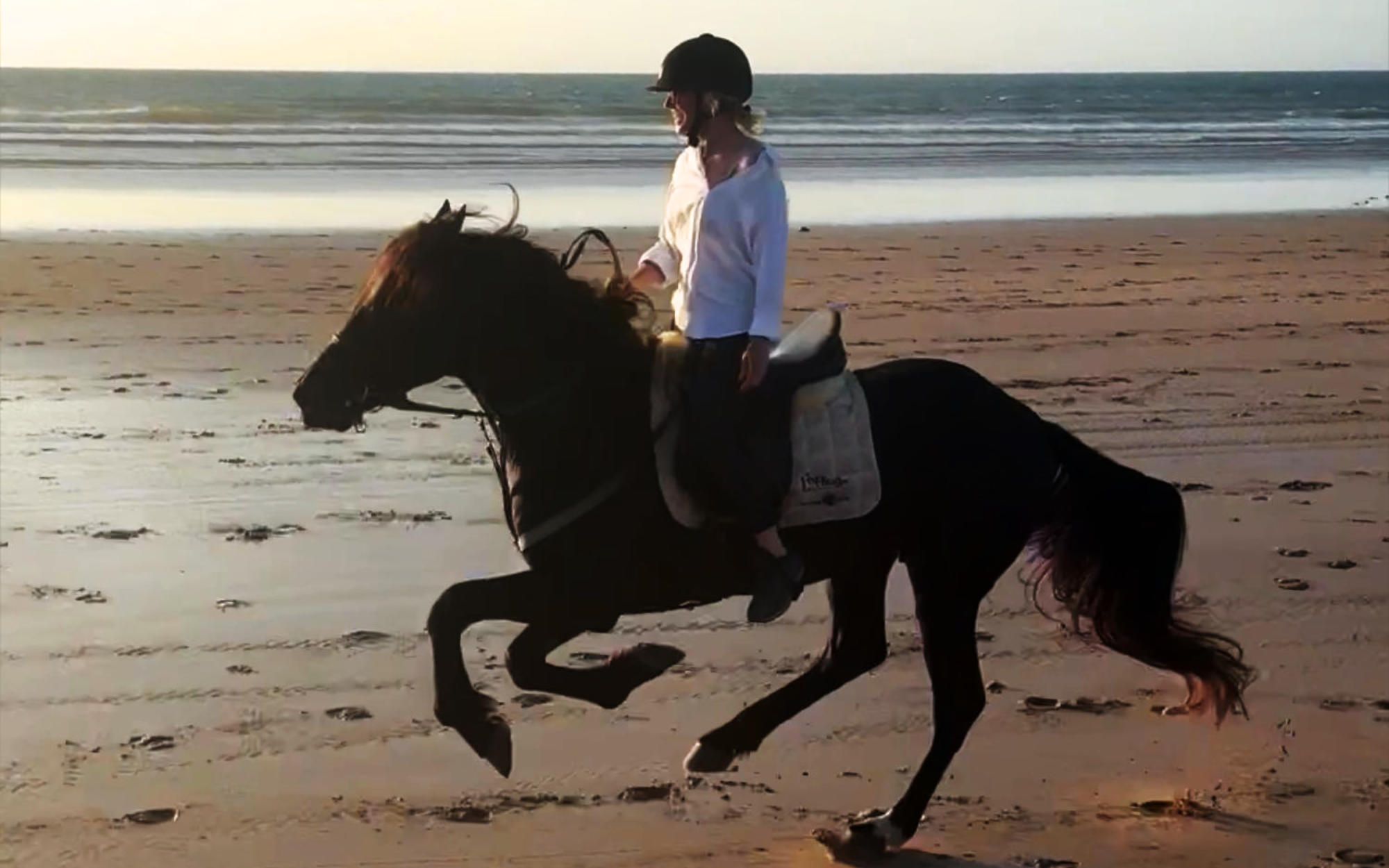
After a few warm-up canters up and down the beach, Lahsen shouted for me to gallop. I hadn’t realized he had filmed that first run, but when I slowed, he shouted “perfect!” and pocketed the phone. Then with a grin he called out, “Now we’re really going to race!” He told me to shorten my reins a bit, lean forward slightly more, and stay out of the saddle. Then he gave a holler and our horses exploded forward, two rockets side by side. There is nothing like tearing down a beach on a powerful horse, the wind whipping your face, the thundering rhythm of hooves drumming through the sand, and the sun spilling gold over the surf. I felt euphoria like the jubilation of carving fresh powder on a perfect ski run. My face hurt from smiling so much.
As the sun dipped behind the kiteboarders on the horizon we guided our horses back over the dunes toward the stables. I doubt I’ll ever own a horse, but I think Mike is ready to ride again. He might even take lessons. That puts every dream spot I’ve ever imagined galloping through officially on our travel list.


That was your FIRST time in an English saddle? I’d never have guessed. The ride looked very smooth and proficient (that coming from somebody with no experience at all, however).