 Posted by
Position: 28°23’33.5″N 13°51’23.0″W

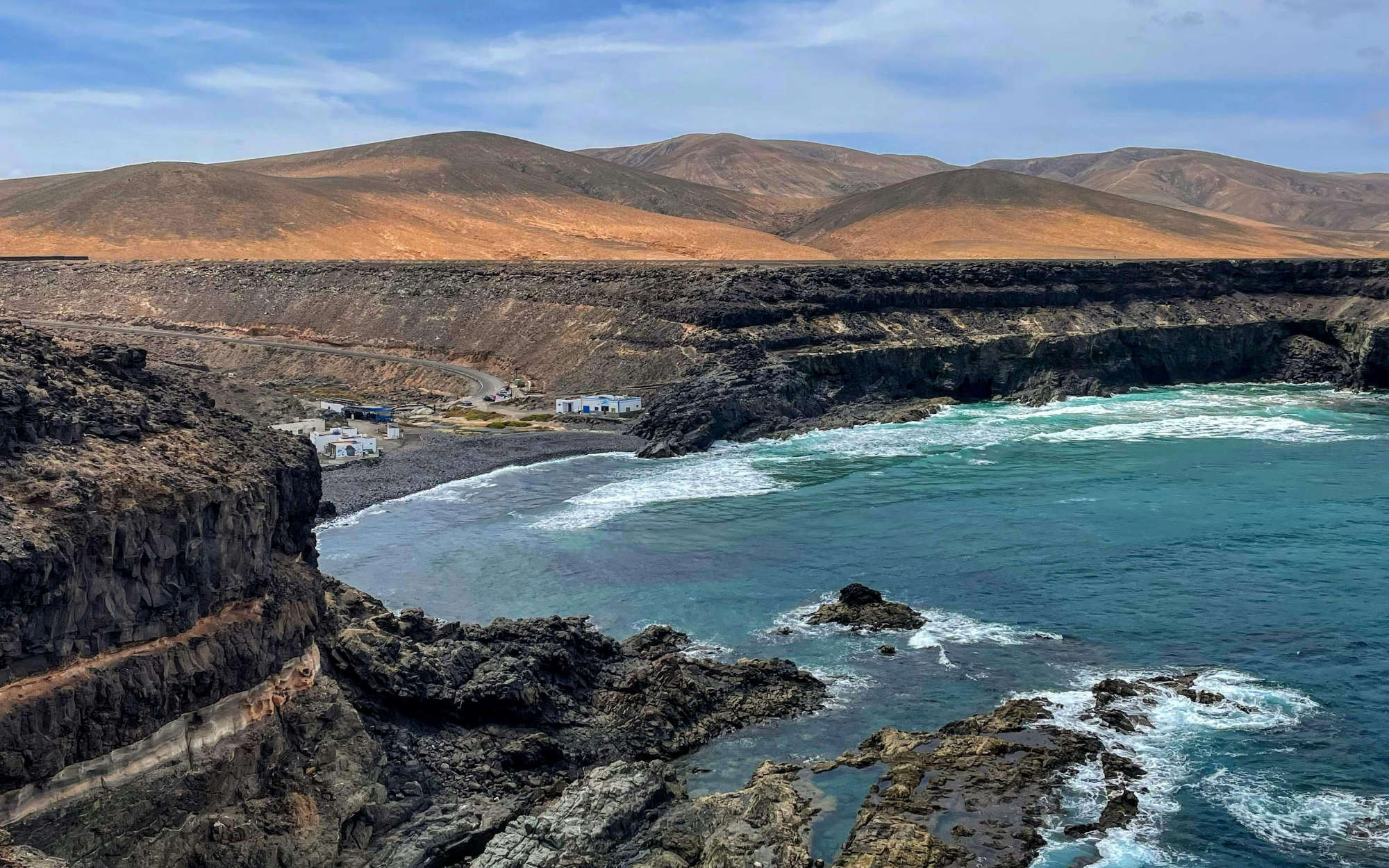
If Lanzarote is Biarritz on the Moon, then Fuerteventura is Benidorm on Mars. Sailing down the east coast of Fuerteventura the landscape is one of endless fields of barren red sands split by an occasional road. Triangular volcanoes regularly swoop up out of the ground and add a little drama to the vista. And that’s about it. Very few buildings interrupt your view. It looked like images from Perseverance or Curiosity, the Mars rovers, only less fuzzy.
With no intention of stopping any longer than one night, we steered as far south as we could comfortably reach in a day’s sail and put into Puerto del Castilo at Caleta de Fuste. We snagged the only spot on the visitor’s dock at the end of the marina and, with only a modicum of drama, tied off. Having failed to raise the marinero on the VHF, we hunted high and low for them. Eventually we figured they must have gone to lunch, giving us permission to do the same.
Tapas

Caleta de Fuste is a resort town built at least 30 years ago and in need of a refit. Worn Airbnb-able two-storied beach villas line the artfully curved streets favoured by less imaginative developers. The main harbour dates back to 1743 when a Martello tower was constructed. Today, little evidence of anything historic exists. Mostly it’s cheap cocktail bars and fast food outlets sandwiched between dank nightclubs. Plenty of dirtbag surfers and other drifters hang around lending the place some colour.
The highlight of our lunch at Tapitapas was its friendly service. Meaning the food was unremarkable. Neither good nor bad, just unremarkable. Friendly service in the dark days of November is no mean feat. Particularly in a town undoubtedly swarmed with picky eaters from Britain and Russia the rest of the year.
Our missing marinero collared us on our way back to Aleta. We immediately settled our bill in anticipation of an early start the next morning. Gran Canaria was still almost 100 nautical miles away and we had decided to break up the passage by anchoring on the south side of the island for a night. The day’s forecast called for three and four metre waves settling down overnight to a more manageable two-ish metres. The swell came from the northeast, i.e. behind us, following along with the trade winds. Once we turned the corner the island sheltered us from the waves and still allowed enough wind through the mountains for a proper sail. We made good time and dropped anchor about 10 miles from el faro de la Punta de Jandía.
Switchfoot
Early the following morning I went forward to raise the anchor. Clicking the UP footswitch yielded nothing. The DOWN switch worked just fine. Figuring it was some kind of electrical gremlin that could wait until the next day, I hauled the anchor up by hand, having almost forgotten how little fun that is. Grateful the wave forecast was accurate, we made good time in beam seas which continued settling during the day. By the time we reached Las Palmas we could have set down a gin and tonic and not worried about it spilling. Well, almost.
Trans-At

Las Palmas de Gran Canaria is the jumping off point for Trans-At(lantic) sailors. Each year the Atlantic Rally for Cruisers meets there for a launch party and boat inspections. That initiates the furious last minute preparations necessary for safely heading a thousand miles offshore with next-to-no-hope of rescue. Peak season for crossing starts in mid-November and continues through the end of January. Space in the marina is tight during that time. A snug anchorage outside along with a couple of Euro a day gives wait-listers access to the showers and other facilities. Las Palmas’ popularity means the local chandleries are stocked to the rafters with anything a boat owner could wish for. And if it’s not in stock, it can be sourced and delivered in a few days.
RTFM

Finding qualified mechanics with time on their hands is another question. There are lots of mechanics and they’re all incredibly busy. Once secure at anchor, I went below to try and figure out what was bothering the windlass. As suspected, a loose wire needed resplicing, terminating, and putting back in place. A simple job. No need for professional help. But when dealing with electrics, it never hurts to read the f**king manual (RTFM). Preferably before, not after, testing your repair. You know where this is going…
Naturally, I shorted the switch so as soon as I turned on the power to the windlass it started turning against the anchor chain which was going exactly nowhere and instantly burned out the solenoid. Fortunately, the motor was left unscathed. As soon as I looked at the windlass I knew what I’d done. RTFM-ing confirmed it. In 24 hours, the chandler’s had located a new solenoid (an OEM model, far better than the off-brand one it replaced) and I had it reinstalled. With the switches wired correctly, the anchor came up happily when we hauled it a couple of days later.
We never did take a berth in the marina. Instead, we launched Axey and motored in. The port itself is busy with lots of cargo and naval traffic heading in and out. Military helicopters spent a good deal of time flying overhead during our visit. Presumably, some kind of training was underway.
Las Palmas
As the Canaries largest city, Las Palmas makes you feel like you never left mainland Spain, right down to the well-appointed retail district, attractive bodegas and myriad tapas bars. Lunch at the Cuban/Caribbean bodega Bembé proved a grand choice. Turns out Gran Canaria has close ties with Cuba, but more on that later. Prices in the shops were no different than the mainland, although restaurants seemed a little more expensive. Given the region’s economy is based on tourism that wasn’t a surprise. The Spanish passion for faux Beaux Artes civic decorations is front and centre. It is, we decided, a pleasant enough place to wait for a weather window. Our next stop was Tenerife, another fifty nautical miles west.


Mike, thank you for another great post
How much anchor chain and rode do you carry?
And I’m confused on the rewiring job
If you were just cutting off some old wire terminating it why did it burn out so much stuff
Anyway, love your post
Mark
Thanks Mark! Good questions. First we carry 300′ of all chain 5/16″ HT rode. We have a second rode with 50′ of chain and braided rope that we’ve never used.
Second, clearly I was confused on the wiring job, too. The short was because the two switches are wired with a common live and neutral (master slave if you will). I pulled both + and – terminal wires off to inspect them and I put the neutral slave wire back on the wrong terminal with the positive. Doh!