 Posted by

Position: 45°40’45.5″N 111°02’31.4″W
Due south of Edmonton is Alberta’s largest city and its financial centre, Calgary. Most people associate Calgary with its annual rodeo, the Calgary Stampede. Held every year in July, the Stampede invites over a million visitors a year (1.4 million in 2026) to some of the best rodeo riding events in the world.
For over 100 years the rodeo has been the top event on the rodeo circuit buoyed by large prizes for participating cowfolk. Last year over $2,000,000CDN was handed out to cowpokes and rustlers from all over the world. That seems in keeping for a city with more millionaires than any other in Canada. We arrived in late August by which time the professional lassos and lariats had moved on to other events (more on that later). But instead of a thick fog of woodsmoke, we arrived to clear skies and breathable air. The wind had shifted in our favour.
Carol booked us an AirBnb at the north end of the financial district, just a few yards from the southern bank of the Bow River that flows through town. Turning right outside the front door of the building put us on Princes Island with its park. In the bright sunny weather, that’s where we started our wanderings downtown. The park is well cared for with plenty of grassy places for sitting under a shady tree. It also provides a nice detour for those taking the greenway/footpath along the river’s edge. From this bucolic idyll we turned south into the glass and steel heart of the business district. Tall skyscrapers blotted out the sun.


Terracotta
Seventeen blocks south of the river 17th street marks the southern edge of modernity. The low, brick and stone buildings contained all manner of funky coffee shops and restaurants giving off a bohemian vibe sorely lacking in the more sterile area north of it. This area is better explored on foot as traffic gets thick during the day. Seventh, eighth and ninth streets east of 4th street demarcate the city’s primo shopping district. A few Victorian terracotta facades remain and provide relief from all the mirrored plate glass.
Stopping by a local liquor store for a bottle of our new favourite tipple, Empress Indigo Gin, meant passing through a modern black and white marble-lined foyer and going up two floors. It felt a bit like being in Hong Kong. Spirits and wines were sold in separate shops. On entering the spirit side, I spied a shelf of Kentucky Bourbons and asked out loud, “Are you allowed to sell this stuff what with the tariffs and all?” The manager grumbled, “I think we should sell what we want, not what other people tell us to.” My comment had clearly struck a chord, and I learned everyone wasn’t on board the Canadian retaliatory trade train.
Across the corridor, the wine manager appeared much happier with life. Perhaps his broad selection of wines from Europe and the rest of the world keeps his spirits up.
Montana

From Calgary we continued south towards the US/Canada border. About 60 miles to the west the jagged peaks around Lake Louise emerge abruptly and spectacularly out of the prairie. Having both spent time in the area, instead of speeding off in that direction, we instead continued south towards Montana. There we would visit Carol’s sister’s family and carry on to Bozeman to rendezvous with our friends Diane and Mark and Lauren and Wade.
Once across the border, we tried finding a campsite in Glacier National Park, but without a reservation that wasn’t going to happen. Worse, local ‘bear activity’ had shut down camping in the nearby parks for anyone without an RV or other hard-sided sleeping arrangement. Glacier National Park remains one of America’s crown jewels, and it stays busy throughout the summer and early fall. That meant fewer campsites and unhelpful bears.
Lewis and Clark

Carol’s sister Keith, her husband Dan, and their son Zane live 20 minutes south of Great Falls, Montana. They’ve lived there since before Montana became a billionaire’s land grab. It is a place rich in history. Both for indigenous people and colonialists. Lewis and Clark portaged through Great Falls on June 13, 1805. They arrived expecting a short half-mile portage and instead wound up carrying their gear and equipment 20 miles overland.
Great Falls is a place of singular natural beauty and sports the wonderful Lewis and Clark National Historic Trail Interpretive Center. Both Carol and Keith were at the museum’s inauguration in May 1998, and swapped stories with the ranger in charge. The museum leads you through a history of the expedition with engaging dioramas and cultural artefacts.
If there was one historical expedition I could have joined it was Lewis and Clark’s. Crossing the American continent at a time when it was still relatively untouched by Europeans would have been remarkable. The Corps of Discovery’s challenges were relatively benign by comparison (say with Edmund Hillary’s or William Thesiger’s). Since the mission was charged with gathering information, its cause was arguably more noble than anything wrought by the decades of mountebanks, freeloaders, and genocidal maniacs that followed it for a century afterwards. On reflection, the mission also appeared well managed. In 28 months only one member of the expedition, Sergeant Charles Floyed, died. The cause was “bilious colic”, probably a ruptured appendix. That was almost as good as Ernest Shackleton’s record and far better than Robert Falcon Scott’s dismal attempt at reaching the South Pole a century later.
Western Art

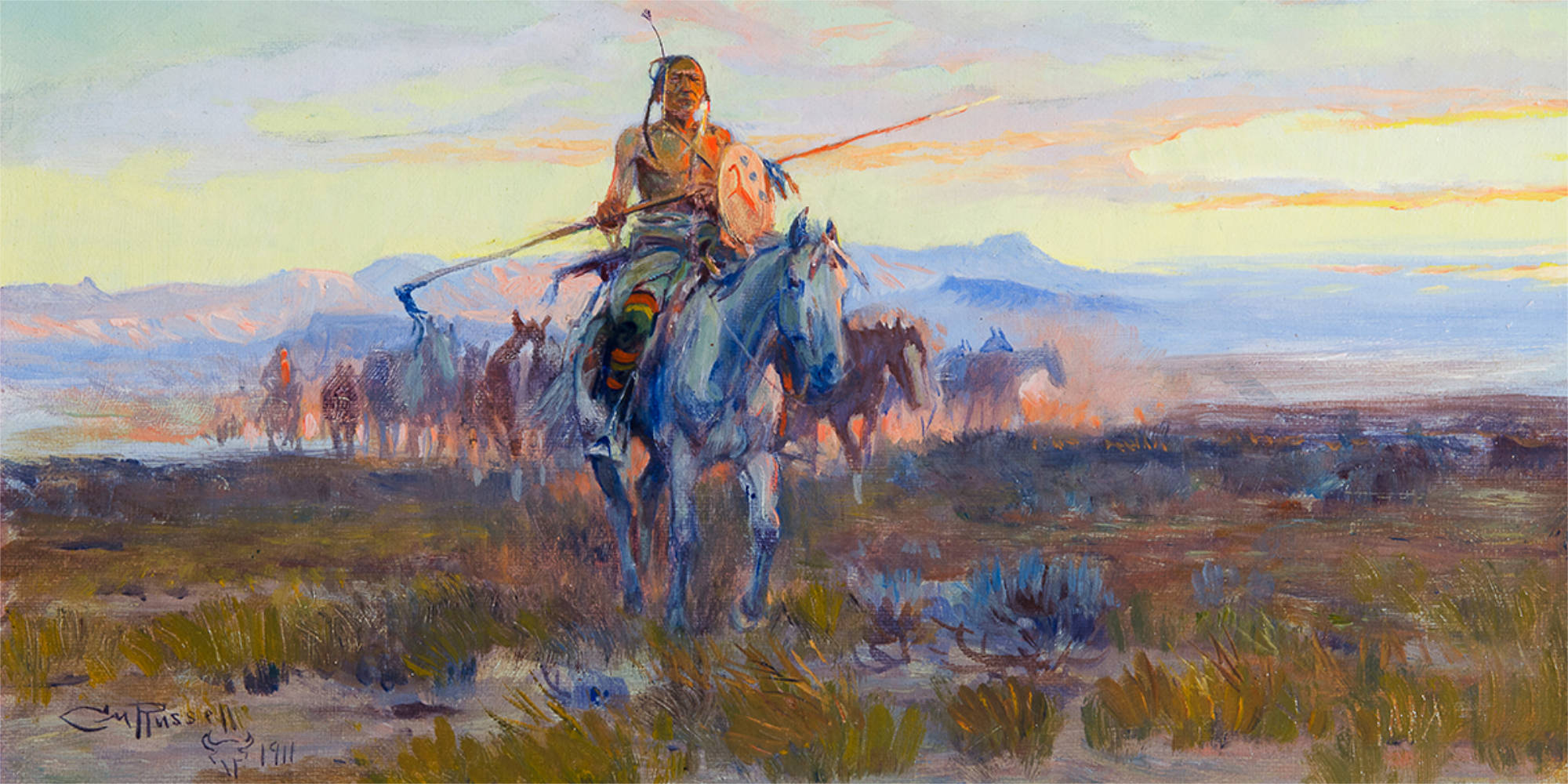
Keith also took us to the C. M. Russell Museum. Charles Marion Russell remains one of America’s great Western artists. Charlie hit his stride in his mid-teens and continued refining his art for the next 40 years. Like Frederic Remington he painted Western scenes for an audience who aspired to the romantic myth of the American West. Like Remington, Russell also sculpted in bronze.
Keith and Dan’s home near the Missouri River retains an air of homesteading. Perhaps because they built it themselves along a bend in the pretty river 30 years ago. As the river floods and ebbs, it provides endless opportunities for the world to come to their door. In heavy years no end of snags and trees pass their way, bringing critters and insects with them. In good years, the river becomes a benign opportunity for exploration by kayak. Staying with Keith and Dan we can always expect an informed and unfiltered view of local and national politics. Suffice it to say we are all on the same side of the aisle politically.
Bozeman

We were excited to get back to Bozeman after our trip there last year. The drive from Great Falls takes about three hours across country. You can, if you wish take Interstate 15 to Interstate 90, but then you’d miss the late summer yellowing of the fields and forests as crops ripen and trees take on their fall colours. Besides, the scenic route takes about the same time as the highway.
Hills line the roads in western Montana, but things really take off when you turn from Montana Route 89 onto MT86 and follow the road into the heart of the Bridger Range. Within a few miles, the road narrows and crosses Brackett Creek: a spot to avoid in heavy rains.
From our stay at Mark and Diane’s house last year, we knew Bridger Bowl ski area is only 30 minutes from Bozeman. We were getting close. A year ago, their not-quite-finished house was still in the grips of winter. In late summer, with the gardens planted and taking root, things looked amazing. Local activities filled the next few days . Mark grew up in Bozeman and gave us an insider’s tour of the town. Honestly, his descriptions of high-school hijinks sounded like something straight out of American Graffiti. From his buddy getting arrested for riding the big fibreglass horse on Main Street, to having their senior year beer keg confiscated by the police, his stories were pure Americana. I’m not sure if being the son of a sitting judge helped or hindered his pranks.
Rodeo
The west isn’t the west until you’ve been to a rodeo. Professional riders participate in local circuits for prize money. And it’s not chump change. This year’s leader, the appropriately named Stetson Wright, has landed over $400,000 in cash. Bronco busting is so popular in this neck of the woods, you can attend college on a rodeo scholarship.
Montana State University’s Bobcat Rodeo program in Bozeman is one of the country’s largest with a $1,000,000 endowment. This year the Bobcats have 63 athletes, 36 women and 27 men, participating in National Intercollegiate Rodeo Association competitions. The MSU men’s team tops the national standings, while the women’s team lags behind in 11th place. As a casual observer, I could not explain why the women aren’t doing as well as the men. From our seats in the stands, they certainly looked like they were kicking ass.
Gallatin County’s Fairgrounds are exactly what you would expect. A sprawling complex of horse barns, parking lots and two arenas, one indoor and one outdoor. Outdoors the Anderson Arena has grandstand seating for 1,500 along one side, and animal pens and an announcer’s box on the other. A big soft-dirt covered rectangle, the arena measures 150×300’.


Shaky Goats
Say what you want about rodeo, it is a visually exciting sport. Horses and their riders thundered through the gate at the east end of the arena, kicking up dust and dirt as they flew across the field. The animals may not volunteer for their roles, but they sure look like they understood what was expected of them. Calf roping was part of the men’s line up, while goat roping was women’s work. Calves shot out of the gate and ran as far as they could as fast as they could. Word had gotten around the pasture that when it’s your turn, run like hell! And a couple of the calves ran far enough they beat the cowboy’s lasso.
The goats on the other hand, were led out and tethered to a stake in the middle of the arena. It seemed a little unfair. Certainly, after a couple of times being flipped on their back and hog-tied, the goats fully understood what was coming next. The little buggers became very leery and a couple visibly shook in anticipation of the next rider bearing down on them. Aside from having the wind knocked out of them, it didn’t look like they got harmed in any way. New goats tapped in after every three riders, so I don’t think their PTSD was too severe.
Barrels
Halfway through the competition, just in time for barrel racing, a tractor dragging an arena rake smoothed over the choppy dirt in much the same way a Zamboni glazes over an ice hockey rink.
Of all the animals participating, the horses (except the bucking broncos) were clearly having the most fun. The barrel racing horses were so good, a couple of the riders looked like they were barely holding on while their horse led them around.
All that activity makes a cowboy hungry. Concessions included burgers (plain and cheese), hotdogs, chips, sodas, and beer. I guess there aren’t many vegan cowpokes. Nothing cost more than $6, this being a college event and all.
People Watching
If you’re a people watcher, low-budget rodeos can be endlessly entertaining. There were rodeo moms and dads, greying grandparents, and lots of rodeo siblings (mainly packs of adolescent girls dressed to kill in blue jeans, halter tops and the largest cowboy hats they could find). Some brims were so large I wondered how they didn’t fly away like Sally Field’s nun.
Away to the west, Montana’s broad horizon was filled with ominously dark clouds that flickered bright blue with summer lightning. In the fading sunset, we could see diaphanous sheets of rain falling over distant fields. It looked as if a slate grey net curtain had been drawn across the landscape. The front stayed where it was, however, and we never felt a drop.
Hiking
After a little negotiation on Sunday morning, we agreed on a hike to Lava Lake. This five mile out and back starts down at the Gallatin River in the Lee Metcalf Wilderness and heads uphill for 2,000 feet towards Table Mountain. The climb is steady on a well-maintained trail running alongside Cascade Creek. Between the trees, rushing water and conversation, the walk passed quickly. Lava Lake is a thing of beauty and warm enough in late summer to encourage the hardier among us (i.e. Diane and Mark) to strip down and get in. Despite the morning’s clouds clearing out and making way for blue skies, I did not join them. It didn’t feel warm enough that I felt like jumping in without a change of skivvies.


Floating
The Madison River rises deep in the heart of the Gallatin Mountains and has a reputation for some of the world’s best fly fishing. Hebgen Dam, completed in 1915, regulates the flow of the Madison and serves only to maintain a reservoir. In 1959 a 7.5 magnitude earthquake rolled through the area and water flowed over the earthen dam forming a new, natural dam and lake. The quake remains the fourth strongest in US history.
80 million tons of earth flowed downhill at 100 miles per hour, killing 28 campers in its path. Crews repaired the cracks in the dam in a matter of weeks after the quake. Thanks to the dam’s regulated release of water, the level of the Madison can be finely controlled. On warm, sunny days, its banks teem with fly fisherfolks in search of an elusive brown, rainbow, or cutthroat trout. The river is shallow and the water warmer than you might expect coming off the mountains as it does. That makes tubing and river rafting popular pastimes.
Dumped
Tubing when Mark was a lad meant finding a truck-sized rubber inner tube, inflating it and heading downstream. These days it’s easier to hire tubes from a company that will put you in at California Corner and fish you out at Black’s Ford about five miles downriver. Then they’ll drive you back to your car. All very civilized. Carol tried staying as dry as should could to keep warm. Her plan worked well until 200 yards from the finish when her tube went up and over a slick rock that unceremoniously dumped her fully into the river. She soon surfaced, coughing and sputtering and we all spent a couple of minutes fishing around for her hat that had floated on ahead. Fortunately, we had towels and a change of clothes in a dry bag, and she didn’t slip into hypothermia or unconsciousness.


Super-Gee
Bozeman’s gentrification has yielded an active and engaging arts and foodie scene that serves as a great complement to the culinary and entertainment skills of our hosts and friends. At our advanced years, alignment on such things has become increasingly important. Speaking of entertaining, Mark is schussing into retirement like a Super-G racer navigating the Hahnenkamm. He has picked up the guitar and while he modestly defers requests to perform, we admired his diligence at practicing for at least 30 minutes a day. We anticipate great things.
Apart from dining like kings and queens at home, we explored a few venues on our walking tours through town. Lunch at Nina’s Tacos threatened to turn our afternoon sloppy from too many margaritas. Restraint was called for and hard to muster. The food and drinks were worth the detour. Trapped in a modern ghetto, the atmosphere, all azures and teals, was sufficiently quirky it made us momentarily forget where we were. Fun fact, kitty corner from the restaurant stood Mark’s dad’s former law offices. Another lawyer is housed there now. That building retains elements of the historical art deco that pops up around the city.
Off Leash
 A walk to Misco Mill brings one dangerously close to the brewing district. Sobriety isn’t something you have to endure for long in Bozeman. An old grain elevator and mill was repurposed as an art gallery, pizza bar, and maker’s venue. Photogenic in its own right, the space exuded creativity in a satisfyingly creaky wooden building. A couple of blocks away you’ll find Mountains Walking Brewery and Bozeman Brewing. The BNSF railroad sits a stone’s throw from both watering holes. If good beer isn’t your thing, then stop at Roly-Poly for some damn fine coffee. Closer to downtown, Little Star Diner remains a favourite for eclectic food and wine. In warmer weather, the patio on top is the place to sit.
Whatever your desires, Bozeman remains a good walking city, no matter what time of year you’re there. On the eastern edge of town, Peets Hill/Burke Park offers 60 acres of cycling, walking and running trails. The main, shared trail runs along the spine of a low ridge for almost 1.5 miles. Dogs are allowed off leash making the park very popular with the woofy crowd. From my casual observations, this is where people congregate. Everyone seemed to know everyone.
Views to the south and west are filled with the Gallatin Mountains and valleys. Turn around and you’ll see the Bridger Range to the north and east. Sunsets are gorgeous and worth bringing a thermos and blanket for. The ridge is high and steep enough that winter sledding reaches breakneck speeds. At the north end of the park you’ll find the Bozeman Public Library and Joe Barrington’s Trickster, an excellent ‘found object’ sculpture of a raven.
Trivial Pursuits
Few things make or break relationships like pub trivia nights. Pub trivia ranges from the mundane to the arcane, reaching those extremes in one round of questions. There’s no hiding your ignorance, either. Own it or risk the opprobrium of your teammates. Undaunted, we struck out en masse for It Will Always Be That Way, a 60s themed bar with fittings straight out of your Grandparent’s ranch house. You’ll even find a lava lamp or two. Trivia contests every Tuesday evening help keep cash flowing during the quieter nights of the week. As a bunch of smarty-pants with broad and eclectic interests, we felt confident. But when questions turned to video gaming and hip-hop, our ignorance ran deep. It showed. We placed second and won $10.


