 Posted by

Position: 28°28’00.5″N 16°14’40.2″W
 Cyril Northcote Parkinson (no relation) first described ‘Parkinson’s Law’ in the November 19th, 1955, edition of The Economist. Briefly, Parkinson’s Law states that, “work expands so as to fill the time available for its completion.” By example he described that “an elderly lady of leisure can spend the entire day in writing and despatching a postcard to her niece at Bognor Regis. An hour will be spent in finding the postcard, another in hunting for spectacles, half-an-hour in a search for the address, an hour and a quarter in composition, and twenty minutes in deciding whether or not to take an umbrella when going to the pillar-box in the next street. The total effort which would occupy a busy man for three minutes all told may in this fashion leave another person prostrate after a day of doubt, anxiety and toil.”
Thus, there is no relation between productivity and the number of staff employed. Wags will tell you, if you wait until the last minute, then the job will only take a minute to do. Issac Asimov proposed that, “In ten hours a day, you have time to fall twice as far behind your commitments as in five hours a day.”
CYS
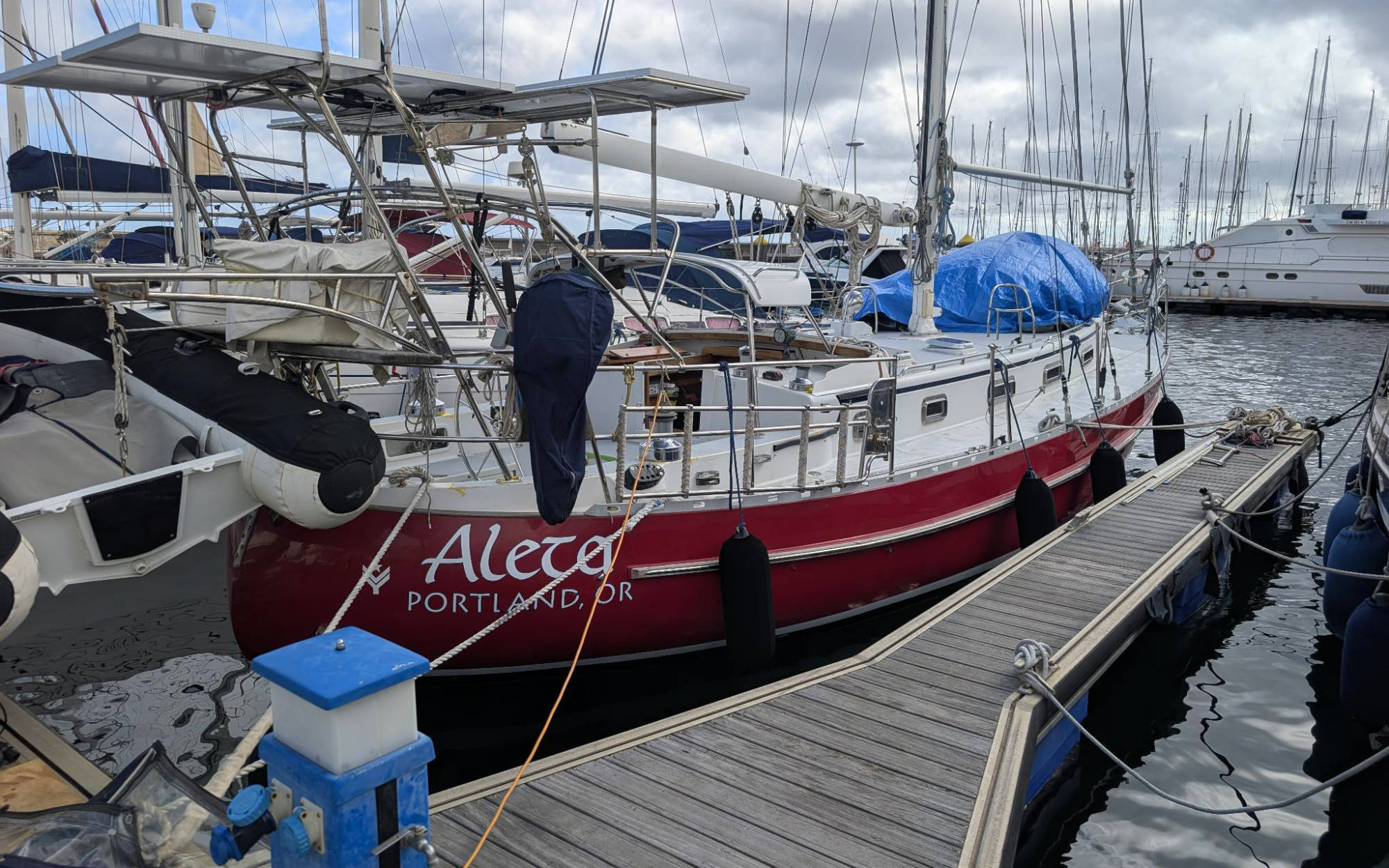
 When we left Tenerife last January, we put Aleta in the capable hands of Joey at Canary Yacht Services for several repair jobs. Needless to say, Aleta’s still not quite ready. Now in Joey’s defence, not all of this is due to dithering and indecision. Far from it. It is as much to do with Aleta being a foreign boat in a foreign land and the general dearth of spare parts for an 18-year-old boat. Not to mention several years of deferred maintenance.
In the generation that has passed since Aleta’s keel was laid down, the popularity of many of her components has waned to the point of obsolescence. Not because they were poorly designed. Rather, the sailboat market consolidated and shrunk and many of the component manufacturers that got their start in the heyday of the 1980s fell from favour. Like many private equity ‘roll-up’ targets, the small companies started aging out of production and either quit or died. Production boats moved to Europe where ISO process engineers optimized tooling and manufacturing to the point that all new boats kind of look the same. Laying up a solid fibreglass hull by hand is a skill as rare today as navigating with a sextant.
Making a profit in modern manufacturing requires volume production. That means eliminating as many competitors as one can and fitting as many products into a vanilla envelope as possible. Variation is the enemy of cashflow. More SKUs mean more inventory and more carrying costs. All that variable stuff is a drag on the balance sheet. Supporting older products is therefore expensive. Usually that means raising the prices of service components to levels of sheer silliness. Add international shipping costs to the equation and you quickly wonder if anything on the boat is worth repairing?
Parts Are Parts
 Waiting for parts is a part of boat life. It is a refrain you’ll hear in marinas all over the world. Ask any sailor, ‘How long are you staying?’ If they reply, ‘Oh, we’re waiting for parts’, then you instantly realize they have no idea when, or even if, they’ll leave the dock again.
All is not lost. Just as when we replaced Aleta’s rod rigging with swaged, many decisions now have a third way, a more modern option. Instead of expensive racing rigging (rods) and weaker traditional swaged wire, we opted for compacted strand wire. That gave us more strength than rod for only slightly more weight at half the cost. Cha-ching! When our batteries came due for replacement, we opted for LiFePO4 (lithium iron phosphate) batteries for their superior energy density, long life, and general reluctance to spontaneously burst into flames. We also upgraded our solar panels for pennies on the dollar (compared with 10-15 years ago).
Not Fully Arsed
Nevertheless, years of half-assed work meant that our chief engineer and guy-who-wants-to-do-it-right (Joey), found that almost every job had a rich history of bodging and skimming behind it. Like an archaeologist, he’s been digging into miles of inadequate wiring and layers of crappily applied bottom paint to get to a solid, useable base.
None of this is helped that Aleta is our home. Like any home, she’s filled with stuff that we don’t really need or use. That restricts access and makes storing important stuff challenging. Almost as soon as we touched down, Carol broke out several large rubbish bags and started piling stuff into them. Books, clothes, pots, pans, adaptors, and zip ties were all tossed. We set the bags out by the marina’s rubbish bins for general rummaging by other cruisers and locals. Within 36 hours our basura was transformed into someone else’s treasure. The clothes we stuffed into one of several clothes and shoe recycling bins dotted around the city.
Now that our bosun, Tai, has arrived, we are waiting only on the finishing of Aleta’s topsides with Awlgrip anti-skid and the final commissioning of our water maker before we set sail again. Something we hope to accomplish within the next week. Assuming the parts arrive…
Share


