 Posted by

Position: Kneading over a hot stove
A recent post on pudding.cool discussed essential words. The gist of the article (forwarded by Lauren, a self-described word nerd) was an examination of words taught to English language learners and how they have changed over the past 70 years. The original list published in 1953 had about 2,300 words that covered roughly 90% of general English usage. The 2023 update dropped 600 words and added 1,100, the rest remained as they were. As the post says, words like telegraph were dropped and computer added.
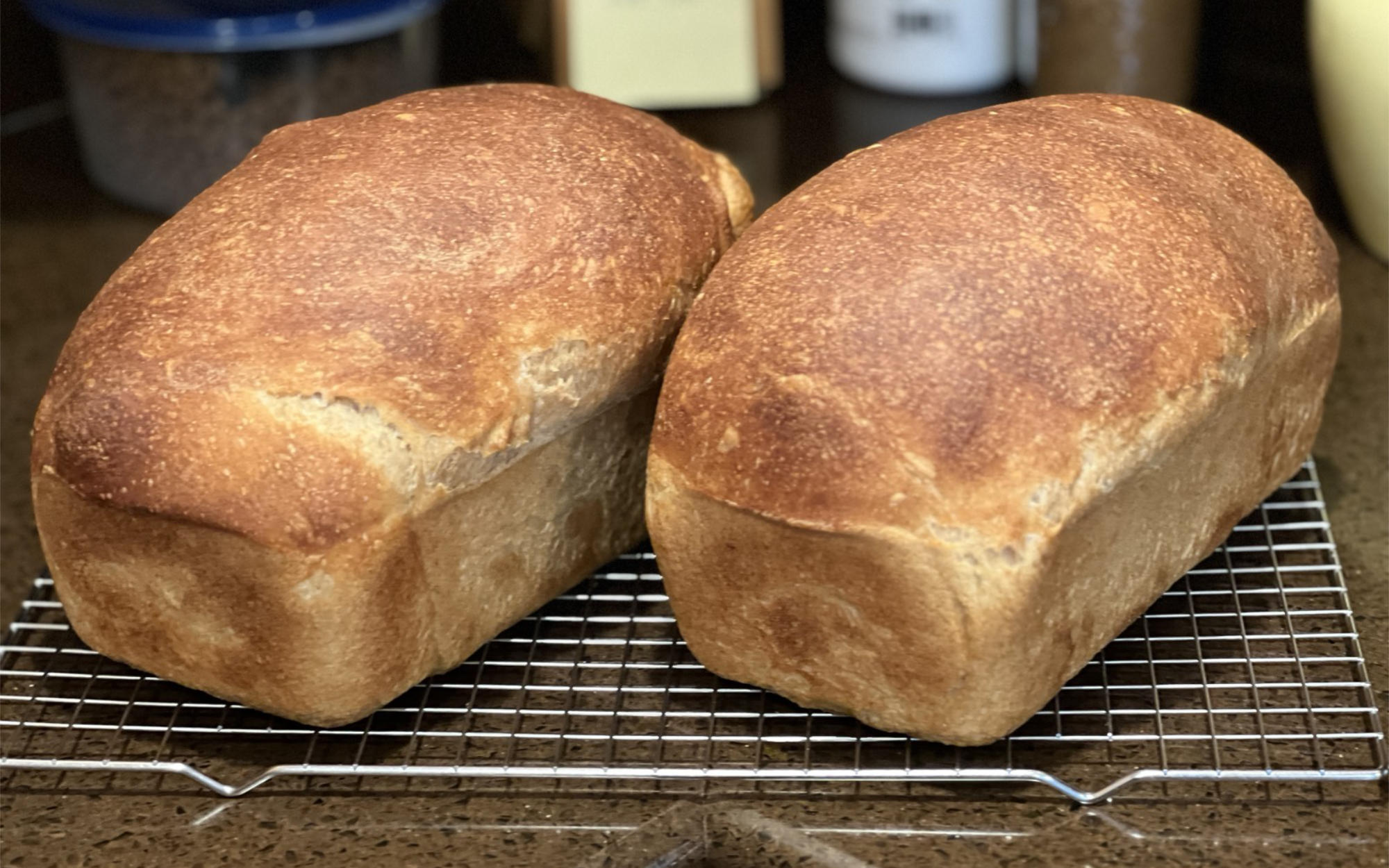
The list is split into categories. Growth occurred in psychology and money and sports, while objects, emotion, body, and food all saw declines. Dog stayed, but goat and donkey were tossed out. Bread remains on both lists, but flour, wheat, bake and harvest got dropped. Rather than analyse the implications of these trends, I simply want to acknowledge the hard work and dedication of my friend Wade in making the best damn loaf of bread he can.
At a time when highly processed food of all kinds has become a bogeyman, Wade has spent the past six years nurturing his sourdough starter and continually perfecting his bread making skills. When asked, he’ll modestly point at Ken Forkish’s books as his guide and mentor. Forkish’s Evolutions in Bread rarely stays put on the shelf. Rather, its well-thumbed pages are pored over and serve as continual inspiration for Wade’s alter ego, The Master Baker.
Round Cut or Square Shaped
 Wade wasn’t always a baker. In the past he used to generate monumental Excel spreadsheets with all the ease of a daring young man on a financial trapeze. But his and his wife Lauren’s dedication to healthy living fired his imagination. Making bread seemed a natural outcome of reducing processed foods of all kinds to an absolute minimum. Once you’ve mastered the minutiae of Excel’s LOOKUP function, cracking open a bread making book and diving in with both hands must have felt like child’s play.
Not that I would dream of saying Wade had gotten skilled at cooking the books. Far from it. Rather it is the precision and attention to detail needed for successful baking that I am talking about here. Baking, after all, is a type of alchemy. It is science that you eat. Specifically, two sciences, chemistry and biology. Successfully straddling the boundary between the two takes time and dedication.
Every science is imperfect and typically runs through a well-known series of steps. Observation, “This bread I bought isn’t very good and it was very expensive.” Question, “Can I make bread better than the stuff I buy in the store?” Hypothesis, “With guidance, I’m sure that I can make better bread.” Experiments are conducted, “I’m going to do what Ken Forkish tells me and see what happens.” And finally, analysis, “This bread IS better than the stuff I could buy in the store.” From which a conclusion can be formed, “Baking bread at home can yield better results than buying bread from the store.” As an independent observer, I can attest to the immutability of the conclusion. Moreover, Wade has proven that his science is both sound and reproducible.


Which is Which?
Which is chemistry and which is biology, you ask?
Chemistry? Chemistry is the discipline that brings order to the natural chaos that is biology. Baking, like all chemical reactions, blends together compounds in specific amounts that generate a (predictable) reaction. Ions and electrons bind and break to varying degrees depending on which chemicals are employed and the environment in which they are used. Chemistry is a process discipline. As a noob, when following a trusted recipe for baking do not deviate. If you trust the recipe, then you trust that the experimentation and kinks have been worked out. If you follow the recipe, then you should get a good result. The margins of error in baking, in my experience, are narrow.
Sourdough starter is all about biology. This is a living entity that needs care and feeding if it is to survive. There are legends of sourdough starter whose DNA reaches back to the Klondike Gold Rush. Back then, ‘sourdoughs’ (i.e. experienced prospectors and ‘stampeders’) lived off bread and flapjacks made from sourdough starter rather than perishable yeasts (also a living entity). The care and feeding of sourdough is nothing short of a metaphor for the entire bread making process. It is an act of love. And that, dear reader, is the mystical ingredient in Wade’s bread. Love is what makes it so damn good. Not only does he care and feed the sourdough and keep it alive, but he also turns that sourdough into bread that feeds his family and friends and helps keep them alive, too.
Ancient Grains
 Humans have been making bread for thousands of years. It is, pardon the pun, ingrained in our culture. “Give us this day our daily bread.” We don’t say, give us our daily pomegranate, or our daily Jujube. Our daily bread is a devotional construct and, for those believers among you, evidence of God’s love for his children. Bakers therefore touch the divine every time they knead their dough.
Don’t believe me? There is a wonderful documentary from National Geographic called, “World Eats Bread”. Watch the first episode, Sourdough in San Francisco, and you’ll get a sense of what I mean. The film tells the stories of several Bay Area bread makers and their challenges at making a living baking bread. Their dedication, long hours, and limited returns, can only be reconciled as an act of love and generosity for their communities – a pure form of manifest divinity. Blessed are the bread makers! Wade – long may you bake!


