 Posted by
There’s not much history on the sleepy settlement of Tarpum Bay. We know that the impressive white and blue-trimmed church overlooking the harbor was built in 1849 and appears to have been in business ever since. Other buildings date from the turn of the 20th century, so it’s safe to assume people have been hanging out here for well over 150 years. It’s easy to see why.
Sitting about a third of the way up the island of Eleuthera as you head north, Tarpum Bay lies on a knee of coastline that makes for a natural shelter from the southerly winds. Hills, such as they are, run the length of the island and do a decent job buffeting winds from the Atlantic side. Our Waterways Guide said that anchoring in the Bay is poor, with rock and hard sand. Since those kinds of comments keep the riff-raff away that was good enough for us to check things out. Our blunderbuss of a hook hacks through most of what the Bahamas has to throw at it and so it did here. Libra, a sailboat sporting naked Swiss from Basel, was the only other vessel around. They’d beaten us to the perfect spot, so we anchored in the second most perfect spot off their stern quarter.
Tarpum’s beach isn’t the white powdery sand so often found around the islands, it’s a little more interesting. Strewn with tiny broken shells and shards of shiny pink conch rubbed smooth by the tides, the soft sand lies just below the water. We pulled Nell, our erstwhile dinghy, up the beach near the working fish dock, one of the last on the island. Our objective was a bit of exercise, a bit of provisioning and a little exploration of what makes this place tick.
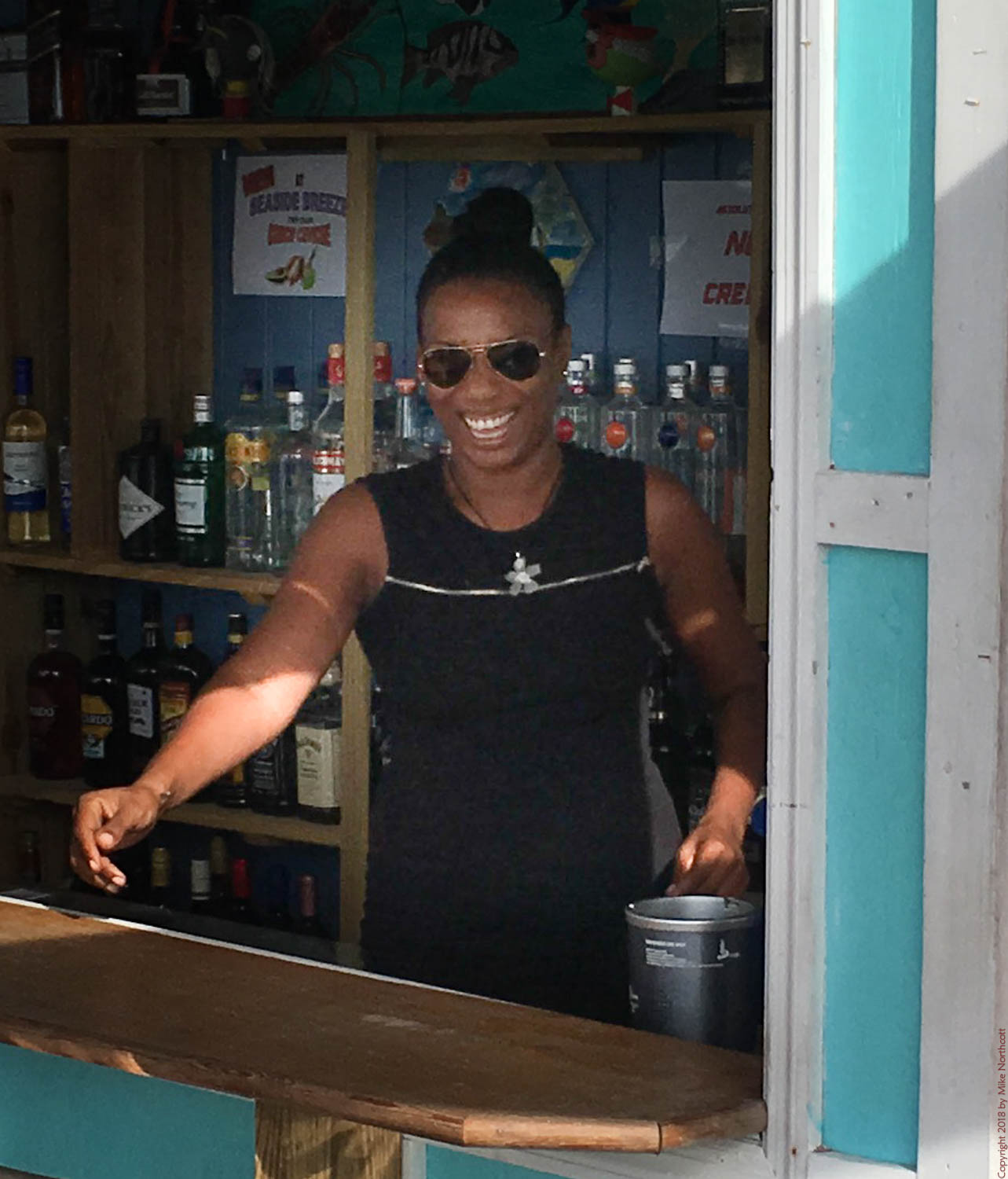
Walking along the front, we waved at the lady tending bar at the Seaside Breeze restaurant, saying we’d return in a bit and carried on. At the corner, we stepped into Carey’s general store for a look around. Tidy and stocked with most everything we had on our list we made notes and again promised to return. Carey’s is attached to a full hardware store, if only we needed a shiny new green wheelbarrow.
Across from the store is the Tarpum Bay Primary School, home of the Tarpons. We smiled and waved at the youngsters in their blue shorts and white t-shirts all nicely lined up to go inside after games. Up a short hill we passed an empty stone keep with crenellations and a tower; clearly someone’s castle was once their home.
Lord Street parallels the front and is a mix of barren house foundations and homes with front yards filled with dilapidated trucks or stacks of old washing machines, sat next to tidy English-style seaside bungalows. There’s no obvious rhyme or reason for the condition of the properties, but I’m guessing that hurricanes, as much as demographics, have played a big role in shaping the town.
Farther down we’re joined on our walk by a small, blonde wirehaired terrier with rheumy eyes and a pronounced limp. We call him Little Sparky in honor of Big Sparky, a dog we once met in Mongolia. He followed us for several blocks hoping for a handout or at least a petting, but he was scruffy enough for us to be wary of fleas. Pausing for a few fresh vegetables at a small supermarket, we decided that with the afternoon wearing thin, we’d better head to the dock and buy some fish before we lost the chance.
Between the fisherfolk, two women and two men, there wasn’t much choice: a grouper, a porgy, and a lion fish. We settled on the grouper. While the younger man fileted it for us, one of the women talked a length about Google’s inability to answer questions in the form of full sentences, saying that it did better with a couple of words. It was a canny observation and she’s right, Google’s natural language processing needs work. Once the scraps of our fish had been cast to the cheeky Black Headed Gulls, we headed back to the Seaside Breeze for a swift beer before we finished our shopping.
A large, pendulous cloud had been menacing for the past 30 minutes and it finally reached us as we sat at the outside bar. Rain poured down, filling the decorative canvas awnings and soaking everything. Twenty minutes later the sun came out, along with the humidity and mosquitoes.
Erica, a striking woman of 43 (by her admission), who could pass for 10 years younger, talked us into the drink special of the day, three Sands beers for $9. We started chatting and she mentioned that she served the best conch salad on Eleuthera. At least, she said, no one has complained, yet! Having left her private banking career, Erica’s goal now is the perfect Bahamian ceviche, complete with fresh limes, pineapple and avocado. The only problem is the ingredients take somewhere between a human gestation of 9 months for the avocados and elephant’s 18 months for the pineapples to grow. So she’s settled on imported ingredients for now. You should try the conch salad. It’s really very good, Erica said. Sure! We’ll give a try.
Her chef was already busy making a salad for another customer which gave us a chance to watch his process. His skills belied his young years. He minced the conch and other ingredients quickly, then piled everything into a dish lined with pineapple and garnished with a slice of orange. It looked much better than that sounds. Erica mopped up the rain as we tucked into the fresh conch with tidbits of pineapple, avocado, apple, and onion that sweetened the tart lime. As we ate, we listened as she discussed local politics with another customer, himself a tall, slim gentleman wearing a bright orange Nike t-shirt and an olive drab cap with the word ‘HASH’ stitched across the front of it.
Turns out politics in the Bahamas, just like the USofA, is all local. The government was busy raising taxes, but the revenue was going to Nassau, not the outlying islands, whose needs were just as great. Erica and her interlocutor agreed that paying taxes was okay so long as the benefits accrued locally. Plus ça change…
By now we were convinced this was not only the best conch we’d had, fresh, fried, or otherwise, but one of the best salads ever. No complaints? Erica asked. No complaints! we replied.
Turns out the world is small, Erica’s son is studying at the University of Utah and spending the summer playing for the Cowlitz Black Bears, a West Coast collegiate baseball team located just north of Portland. Mom and son are optimistic about bigger things baseball-wise.
With that we paid our meagre bill. Then with hearts full of hope for a reenergized Tarpum Bay community, starting with the Seaside Breeze as a worthy draw for tourists and cruisers alike, we finished our shopping and headed back to Aleta. As we motored out, we looked back at the town and reflected that, although we’d had the place almost to ourselves, wouldn’t it be great if the Bay had been full of cruisers spending their money, too?


