 Posted by
 With 325 million-odd people (or 325 million odd people) in the United States, we’ve been wondering in the past couple of weeks where everyone is. Making our way across the country, stopping in some of the most famous natural landmarks in the world, we’ve managed to consistently avoid crowds of people. I’m not quite sure how. Granted, at our first stop, Steamboat Rock State Park in Washington, we grabbed the last available campsite, but from there it seems like there’s been a bank error in our favor.
In Idaho we pulled over at the Sam Owen Campground high in the pan handle and bagged a prime site on the shores of Lake Pend Oreille. In Glacier National Park, well known for its crowds, we pulled into Avalanche campground and had our choice of spots. Yes, some of the other campgrounds were full, but there was plenty of room available, especially if you were willing to go ‘primitive’ and off the beaten track a bit.
Devil’s Tower National Monument in Wyoming is mostly famous for inspiring Richard Dreyfuss’ mania in Close Encounters of the Third Kind, and as such draws crowds from all over the world. As spectacular as this 867’-tall butte is, we waited only a few minutes to get in and find parking.
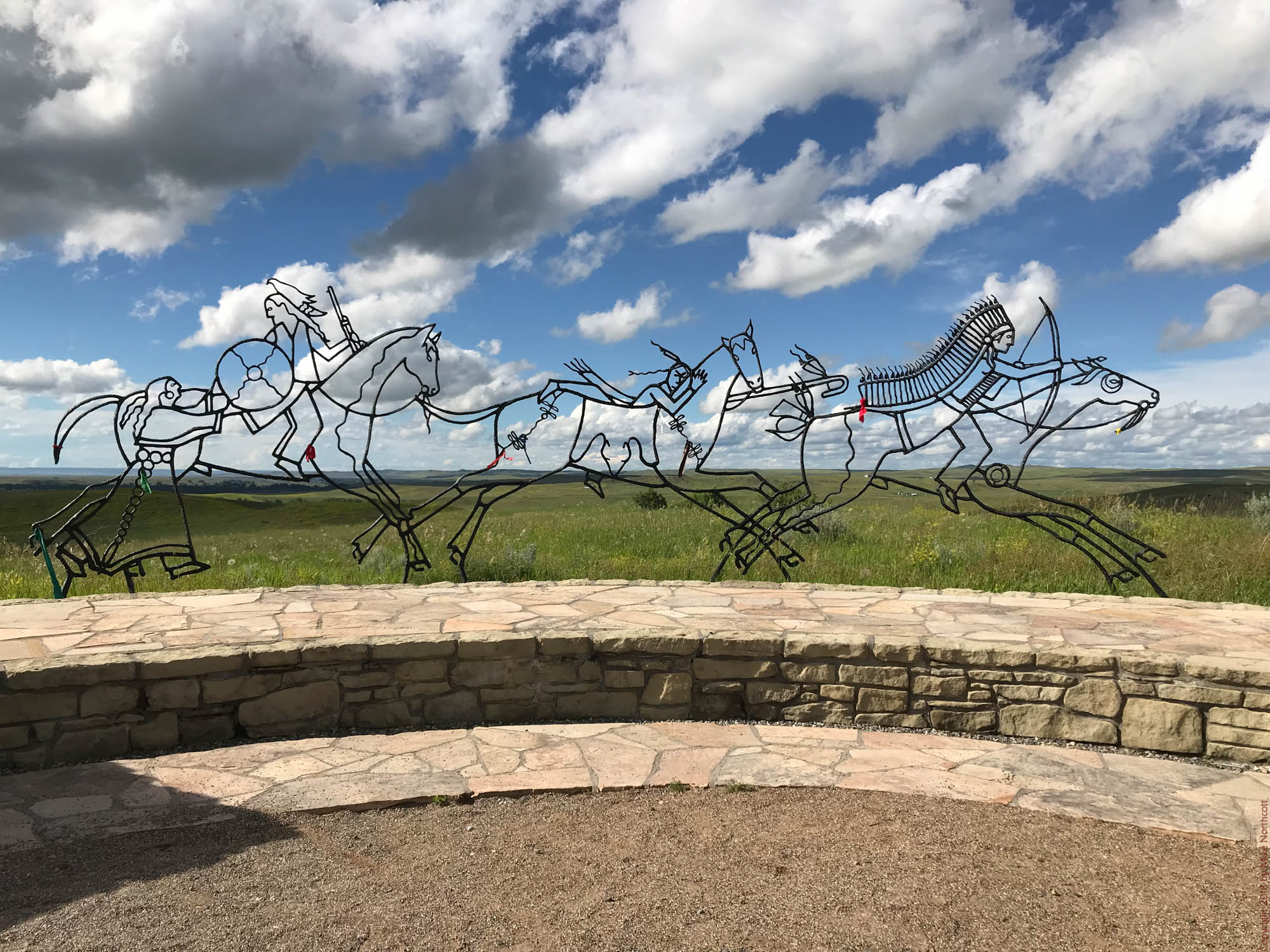
Not far away is Little Bighorn, the site of America’s indigenous people’s last victory and Custer’s last stand. The skirmish wasn’t quite as I remembered it, but it’s been 40 years since I read Bury My Heart at Wounded Knee and I’m a little rusty on the Plains wars. Like almost every other battle site I’ve visited, Little Bighorn is both beautiful, nestled in rolling hills overlooking a wide valley that stretches into the distance, but also somber, with a weirdly spiritual vibe. Even though we arrived mid-afternoon, the parking lot was only half full.
History as it’s taught almost never gives a real sense of location. We’re told how the events unfolded, but too often how the roles of terrain and local knowledge affect the outcome gets lost. Basic stratagems, like taking the high ground, are supposed to work in a combatant’s favor. But what happens when the high ground is accessible only by foot, with a steep climb of 300’? Nothing goes to plan, as veterans of Pointe du Hoc, the Devil’s Den, and, in this case, Reno’s battalion would tell you. Seeing it for yourself gives you a perspective that all the books or films in the world can’t.
Mount Rushmore was even more poorly attended. Perhaps everyone else had read the same history I had and discovered its sculptor, Gutzon Borglum, was an active supporter of the Ku Klux Klan, something the visitor’s center has carefully elided. However, I suspect the wet and foggy weather played a bigger role in damping the crowds.
 And so it went on, through the Badlands of South Dakota, the glacial lakes of Upper Michigan, and even Canada, where we had no problem finding places to pitch our tent. Perhaps it’s the increasing urbanization of modern society, or our mass addiction to the internet (most of the places we visited had little or no signal to connect), or that heading out and sleeping under (nylon) canvas and swatting bugs is viewed as an atavistic folly for the clearly demented. Whatever the reason, we were loving our semi-privacy beneath the stars.
Should we be worried about the future of America’s natural spaces? Legions of extraction businesses, including cattle ranchers, oil barons, and timber merchants have shared the benefits of government-managed natural resources with sportspeople for the last century and a half. American wilderness has once again become wilder, with bears and wolves returning to their natural territories.
Upsetting the balance between citizens and business that’s evolved in the past 100 years could mean the loss of habitat, harvestable resources, and billions of dollars in tourism. But if the people aren’t out there enjoying it, well, we can’t reasonably expect the bears to successfully defend themselves against an army of corporate lawyers. Can we? So get off your butt. Go camp in a state or national park. I bet you’ll find an experience that’s irreplaceable – one that as taxpayers we can all share in as a mutual benefit.


Never could get into camping. Which I feel is a character flaw.
Yes, most probably! [insert smiley emoji]