 Posted by
Position: 48°34’04.8″N 123°28’11.3″W

There were two last stops on our Alaska inside passage itinerary. The first stop was Wrangell. Founded by the Russians in 1811 and later named for Ferdinand von Wrangel, chief manager and governor of the Russian-American Company from 1829-1835, Wrangell is one of the oldest non-native settlements in Alaska. That’s not to say the Tlingits weren’t around. They were. Just that the town was not established in the way that Sitka had a native settlement pre-dating the European invasion.
Wrangel ordered a stockade built on the site in 1834. In 1839 the Hudson’s Bay Company leased the fort and began usurping the Tlingit trading routes into the interior. The Tlingits protested. But two outbreaks of smallpox in 1836 and 1840 killed off half the native population (who had not acquired immunity, despite Dr. Jenner’s discovery of a smallpox vaccine derived from cowpox in 1796) and the protests gave way to more pressing matters. By 1849 all the local sea otters and beavers had been turned into hats or coats, and the Hudson’s Bay Company abandoned the fort. Once the Alaska purchase was completed, the town fell out of British hands and into American ones.
Finger
One tasty historical tidbit about Wrangell involved a Tlingit man, a quartermaster’s wife’s ring finger, and retribution by both sides in the ensuing dispute. In 1869, the army corps held a Christmas party at Fort Wrangell and invited local tribespeople. During an altercation between Mrs. Jacob Muller and the Stikine Indian, Lowan, he, for reasons lost to time, bit off Mrs. Muller’s third finger on her right hand.
A melee ensued and soldiers attending shot and killed Lowan and severely injured his brother. Lowan’s father, Shx’atoo (Schtd-doo), following Tlingit laws on retribution, marched into the fort the following morning and shot Leon Smith, a trading partner, fourteen times. Demanding that Shx’atoo give himself up, the Army bombarded the local Tlingit compound, killing at least five people. Two days later, Shx’atoo surrendered and was hanged by court martial on December 29. He stated before his death, his revenge was against the fort, not Smith in particular. Perhaps an early example of the differences between giving the finger and taking the finger.
Dewey
All that history aside, modern Wrangell appeared before us bright and sunny. Having been through the standard economic transition of Otters > Salmon > Logging > Tourism, Wrangell greeted us with a dockside bevy of excursions and flightseeing options. Going low budget, we opted instead for exercise. Two days on board had girded our loins and we were ready for a hike. Seeking the nearest walk up a hill with alternative routes back to the ship proved less crowded than expected. The climb up Dewey Hill is well trodden and these days bolstered by wooden steps and platforms for the elderly and infirm from visiting cruise ships. The walk down the backside of the hill was free of both tourists and bugs. The long slope limits standing water and the volcanic soil is slightly more acidic, limiting larval growth. Whatever the reason, the lack of biteyness was appreciated.
A long loop back into town inevitably led us to the other big low-cost attraction, petroglyphs on the beach. A glyph is any symbolic figure that is usually engraved or inscribed. In typography it is a representation of a character. So, petro (stone) + glyph (engraved symbol) and beach says it all. I am fond of petroglyphs, particularly since they can last for thousands of years. They always inspire in me the desire to pick up a rock and scratch something into another rock and hope that hundreds of years later someone will pick it up and wonder about its provenance.


Chish and Fips
Now hungry, and still being cheap, we opted for fish and chips in the Golden Lion Pub on board the Queen Elizabeth. The F&C did not disappoint, and we got to see a little World Cup action to boot.
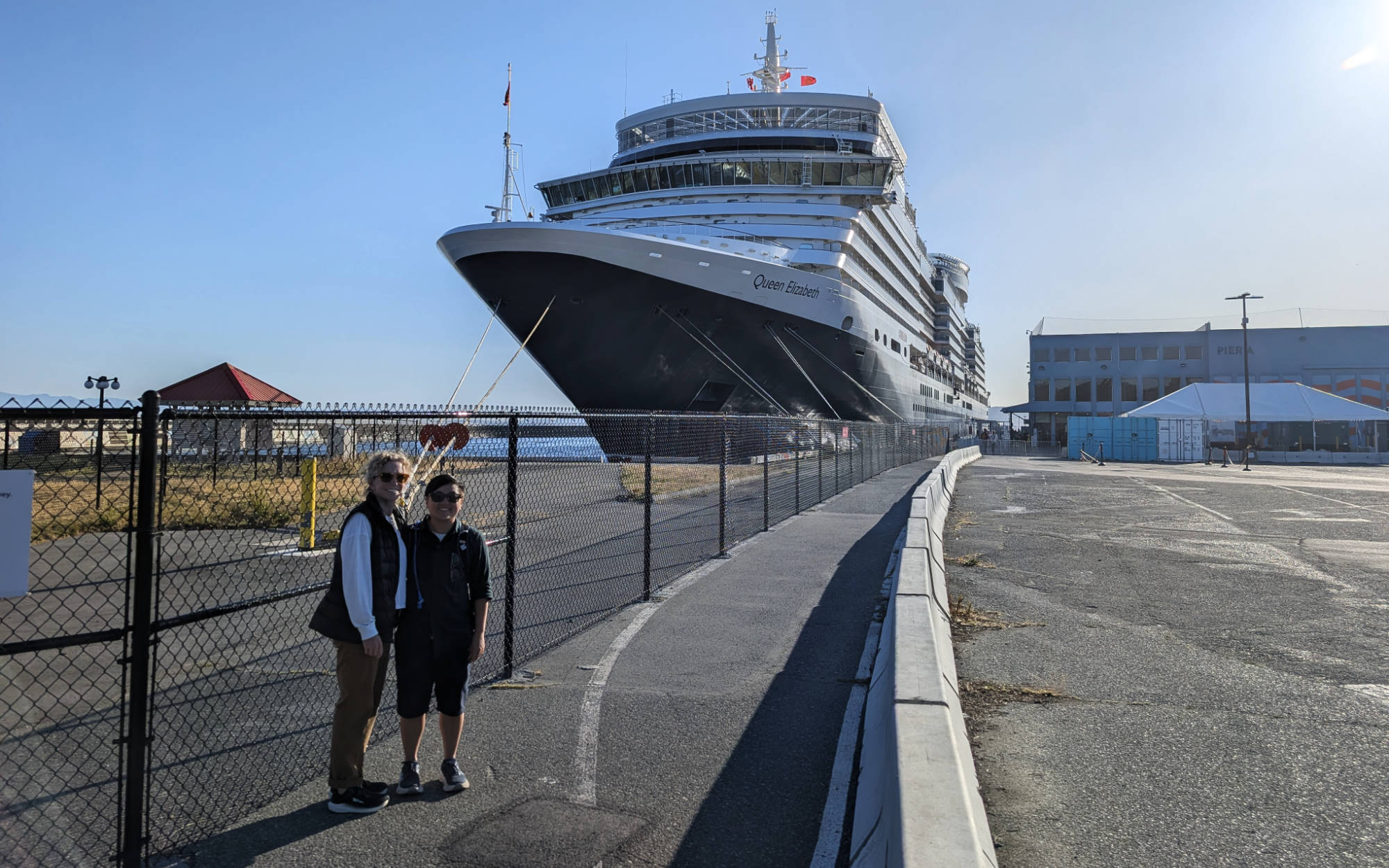
Heading south, the QE was due for another day at sea before arriving at her penultimate port of call, Victoria, British Columbia. To keep us entertained we dressed for the evening’s Red and Gold Gala. More experienced cruisers had saved up their tuxedoes and ball gowns for the occasion. Dancing into the wee hours was expected. In fact, we met a small group of keen ballroom dancers who more than generously offered to help anyone with their moves.
After taking one ballroom (waltz) dancing lesson, we realized that the only way to master the moves is through endless repetition. The waltz is sold as a simple 1-2-3 steps, but there’s always more to it. There’s a pas-de-deux and a reversal that’s not part of the primary billing for the dance, but makes you look like a putz if you don’t get it right. That is about the sum of my knowledge of ballroom dancing. I fear I may not live long enough to repeat the moves to the point where I can do them without counting. But I’m willing to try. Tai led our team on the dance floor and looked very sharp in their blue suit and tie.
Victoria
Victoria, the eternal city. (Sorry, that’s Rome – ed.) As many times as I’ve visited Victoria, I had never visited Butchart Gardens. Botanical Gardens are, I think, a bit of a standing joke for well-travelled tourists. But despite their ubiquity, they offer a slice of plant life that may be difficult to appreciate in other ways. Masses of local flora jammed into a small space give the visitor solace and communion with nature.
Robert Butchart built a fortune making Portland cement in Ontario. Drawn by the rich limestone deposits on the west coast of Canada, Robert and his wife Jennie upped stakes and moved to Vancouver Island in 1904. There they built a house next to Robert’s pet limestone quarry. In 1909 the quarry was exhausted. Jennie set about turning it into the, now famous, sunken gardens. Building the gardens became her life work. In the end 55 acres of land was given over to the enterprise. Today it is designated as a National Historic Site of Canada.
Personally, I’m a fan of roses. The dedicated rose gardens left no rose un-sung. Winding through the fragrant blossoms with hundreds of other sweaty tourists in no way diminished their sweet smell. At the back end of the gardens a small cove, Butchart Cove, has eight mooring balls, free to use for 24 hours. File that away in the Aleta log.
Photos
Perhaps the best way to describe the gardens is to let the photos speak for themselves:


After a quick tour of the Royal British Columbia Museum and dinner at the harbour, that was it. Overnight the QE slowly made her way down Puget Sound back to Seattle. Tom kindly picked us up at the dock and our Inside Passage adventure was done. Our Alaskan land adventure was about to begin. That’s coming up next. Stay tuned!


My one and only visit to Buchard Gardens was in the fall! Fewer tourists , it was PNW misting, and beautiful fall reds, oranges and yellows.