 Posted by
Position: 57°03’09.4″N 135°20’13.8″W
Icy Strait Point survives on cruise ships. The little hamlet sits at the crossroads of salmon migration in and out of Icy Strait. For years its economy was built around a salmon cannery. When that finally closed, like so many small towns, Icy Strait Point reinvented itself by focussing on tourism. Ships stop here to give their passengers a bit of shore leave after a couple of days at sea scouting for glaciers.
Full credit to the townsfolk for putting on a good show. Things to do include one of the world’s longest zip lines. You can ride a pointless telekabine (6-person ski lift) that takes you from the visitor’s centre a half mile along the seafront to the chairlift for the zip lines. Any time we see a ski lift we feel obliged to board it and see where it goes. Based on how long it took for people to climb into the telekabine (without ski gear), we can safely say that Venn diagram of cruisers and skiers barely overlaps. The classic skier’s no-no of fewer than six people per kabine was roundly ignored. Nervous hesitancy by the uninitiated before boarding extended wait times and was telling enough.

Nevertheless, the cannery has a new lease of life as a mini-mall and tchotchke emporium. Some of the old machinery exists for the edification and distraction of visitors. From my cursory examination, the entire set-up looked more like a finger-removing apparatus and not something you’d want your canned salmon anywhere near. Most of the tricky work, cleaning and preparing the fish was done by Chinese women, who lived in the shanties nearby. Back in the 1920s and 1930s the work was probably as brutal as the can’s graphic artworks were engaging. Long hours fiddling with fish with extremely sharp tools seems to invite worker’s compensation – if such a thing existed back then. I’m sure things haven’t changed much in the intervening years. Note: these photos are from Alaska Itinerary. Check out their site for more information on Icy Strait Point.


Hoohah
Tai had pre-booked our kayaking adventure in nearby Hoonah (which I insisted on pronouncing Hoo-hah). Hoonah is a legit fishing village with its own marina. Dave and his family run Fairweather Kayak Tours. Dave acts as lead guide while his wife and son follow along in their power/rescue boat. As a recovering professional fisherman and erstwhile Oregonian, Dave had plenty of stories to tell, including one about a determined young woman who signed on as crew with eight other crusty men – none of whom felt they should give her a break any more than any other fishing noob. Apparently, the challenges of relieving yourself in a force 9 gale doesn’t bias towards any gender norms. It’s a pain in the arse for anyone on board. One only has to cast modesty aside and get on with it.
The salmon had yet to begin their migration, which meant the whales weren’t hanging around the strait. Instead we went in search of bears. Grizzlies in particular. The grizzlies around the islands have a bit of polar bear in them. That means instead of running you down and eating you like a polar bear would, they first do a bluff charge like a grizzly. Depending on your reaction, the bear will then decide to eat your or not.
According to Dave, it doesn’t matter which charge, bluff or full-on, the bear chooses, you’ll still want to change your underwear sooner rather than later. We also learned that in local culture, you are a raven or an eagle. Eagles and ravens are two of the most important moieties in Tlingit culture. Eagles can’t marry eagles and ravens can’t marry ravens. When someone dies, the other clan will bury them and together they will celebrate the life of the one that passed. The celebrations can go on for weeks.
Grizzly Bear

We were fortunate and found a yellow grizzly, a sow, hanging out on the beach. She was young, about three years old and alone. That meant we could get fairly close and as long as we didn’t disturb her, we could watch her lounging around and eating reeds. From the chase boat with a long lens, it looks like we’re right on the beach with her, but in fact we kept a good couple of hundred yards away in the hope that would be enough of a headstart if she came in after us.
One of the local curiosities was a fishing boat that had sunk in the harbour due to an excess of snowfall. Last winter over seven feet of snow fell in one night. That was enough weight to sink the boat. It hadn’t occurred to me that that could be an issue. Given where we sail, the equivalent amount of guano would be impressively stinky and undoubtedly more valuable than snow.
Sitka

Sitka was one of the highlights of the cruise for me. It has a sufficient combination of history, culture, and creepy graveyards to make a place interesting. For history, the area was settled millennia ago by Tlingits. They foraged happily for centuries, until one day the Russians turned up in search of sea otters, the raw material for those arch Russian hats with earflaps than only weaklings and foreigners turn down in winter.
Sea otters we learned have over a million hairs per square inch on their furry little bodies. Their fur hangs on them loosely, allowing them to form pockets under their arms where they store stones when diving for crabs and urchins. Back on the surface, they’ll lie on their back and crack open their bounty with the stone. Biologists get excited about animals that use tools, but they never talk about animals that use their coat pockets to store their tools. Marsupials notwithstanding.
The Russians Are Coming!

Alexander Baranov arrived in Sitka in 1802 as the representative of the Russian-American Company chartered by the Russian emperor Paul I. The original settlement was soon destroyed by Tlingit warriors. Baranov left and returned two years later with a large troop of soldiers. After several days of bombardment, the Tlingit abandoned their fort and retreated. The Russians moved in and established a permanent presence. Sitka grew to become the largest city in the region and the de facto capital of Russian America. Baranov stayed on as governor until his death in 1818.
Baranov understood the benefits of making peace with the local tribespeople and encouraged inter-marriage. Children of those marriages, known as Creoles, often lived in the twilight of both cultures. Under Russian American Company rules, however, they enjoyed certain privileges like Russian citizenship and exemption from certain taxes. They also received education that allowed many to serve the company as navigators, traders, interpreters, and cartographers. Tlingit society is strictly matrilineal. Identity, clan membership and moiety are all inherited through the mother. Thus, children born of a Russian father and Tlingit mother enjoyed all the traditions of Tlingit society as well as the benefits of Russian citizenship.
Holy Sheetʼká
Under Russian occupation Sitka was called New Archangel (Ново-Архангельск, or Novo-Arkhangelsk). The name Sitka comes from the Tlingit, Shee Atʼiká meaning ‘People from the edge of Shee’. The original was contracted to Sheetʼká and from there Sitka.
The Russians Are Leaving!
After sixty years or so, the Russians had decimated the population of sea otters and maintaining their base in Sitka became increasingly unprofitable. Thanks to the Crimean War, the Russians had a more favourable view of the Americans than the British. When Alexander II decided to sell up, he went straight to the Americans, thumbing his nose at British Canada. The Alaska Purchase, or Seward’s Folly, was signed on March 30, 1867, and went into effect on October 18 that year. For the bargain price of $7.2 million (about $132 million in today’s money, or the price of a single F-35 fighter), America acquired all of Russia’s land in North America. Soon after the purchase, almost all the Russians left Alaska. Many returned a century and a half later as tourists.


Walkabout
With so much history in Sitka still available it is worth taking a walk around. From where the shuttle bus drops you, it’s a short walk to the Sitka National Historic Park. According to the National Park Service, the park “preserves the site of a battle between invading Russian traders and Indigenous Kiks.ádi Tlingit. Totem poles from Tlingit and Haida areas line the park’s scenic coastal trail, and the restored Russian Bishop’s House is a rare reminder of Russia’s colonial legacy in North America.” Also in the park is a totem pole carving workshop. A couple of artists were sitting chatting, but no wood chips flew as we walked past. Like most NPS museums, this one did not disappoint. Plenty of facts and folklore gave context to the indigenous culture and traditions, along with a history of the invasion.
At the end of the park trail, across a busy road, is the Alaska Raptor Center. Dedicated to the care and rehabilitation of injured, wild birds, the centre treats about 200 birds a year. While they concentrate on raptors, they’ll take care of any injured bird. All with a view to releasing them back into the wild. Some birds never fully recover and stay on as the centre’s Avian Ambassadors. They help educate the public about the importance of protecting natural habitats, as well as raptor biology and conservation. Most interesting was their indoor rehab facility. Big enough for a large bird to take flight and get their wings flapping again, it contains a small lake and a simulated upland rise.


Heading back to town we split up. I poked my head into the Bishop’s House and learned more about the Russian occupation and fur trade. From there I walked down to the Russian Orthodox Cathedral of St. Michael the Archangel. I find Russian Orthodoxy particularly gloomy and opted not to go in. Instead, I walked up to the site of the first Russian blockhouse. At the foot of which is a stone marker put there by the Americans for the purposes of accurately mapping the town after its purchase.


Graven Images

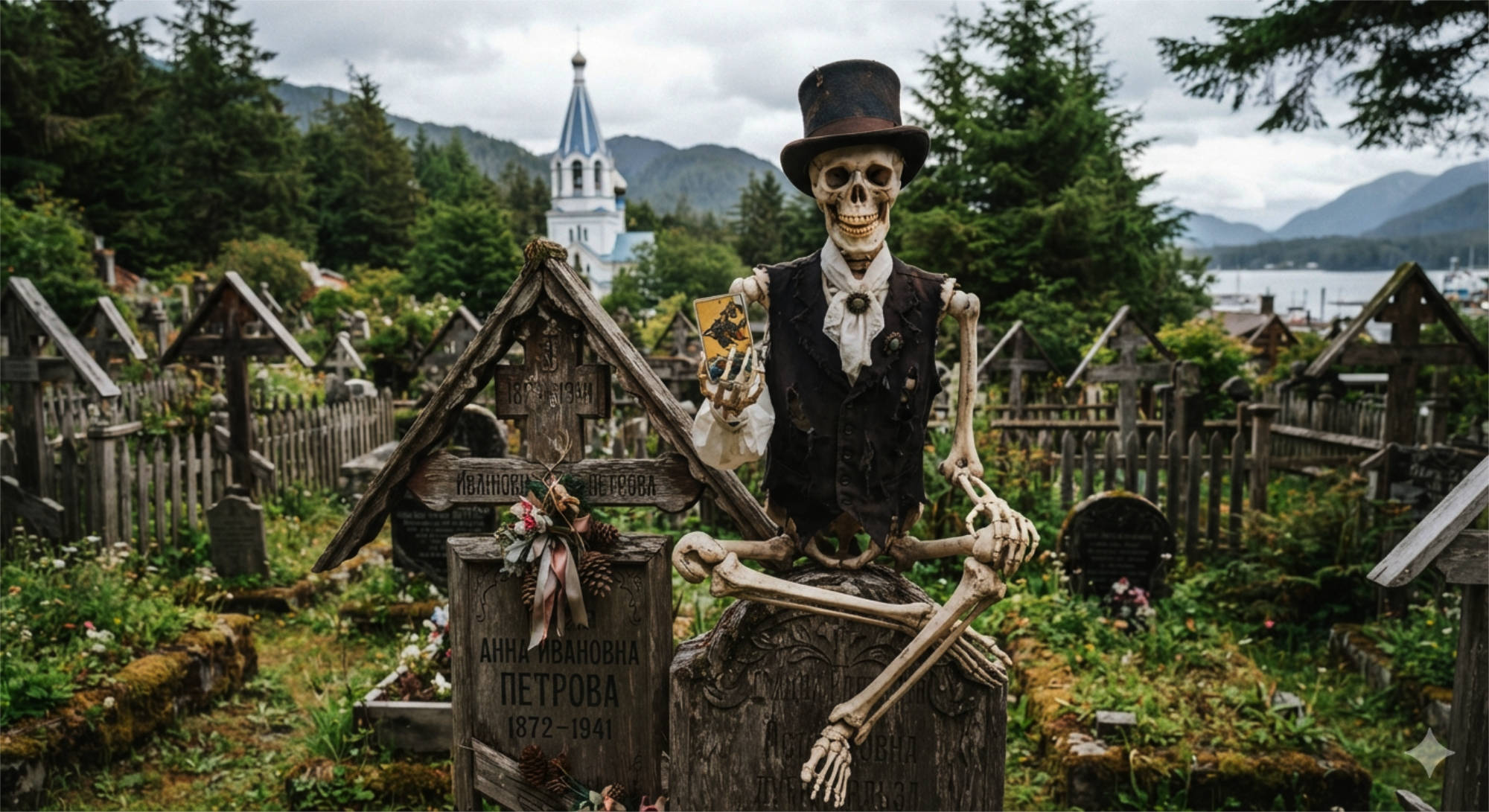
Out of curiosity I made my way around the corner to the Sitka Russian Orthodox Cemetery. I’ve seen many graveyards in my life, but this had to be the most Hollywood Gothic one ever. The graves are surrounded by a grove of large, mature trees. Besides Sitka Spruce and Western Hemlock, there were Red Alder and Black Cottonwood.
The sun was nearly blotted out under the dense, dank canopy. The ancient roots had heaved the headstones hither and thither in the undergrowth. The scene was delightfully creepy. Each path through the hummocks revealed more graves, tilted and twisted and some completely knocked down. I half expected I’d bump into a skeleton wearing a top hat and sitting astride one of the larger gravestones ready to tell me my fate. Sadly, he must have been at the pub. Have you seen a skeleton drink? They are very messy. Or, so I’m told. During our visit to Antakya we found this mosaic that seems apropos.


Handover Fist
After a latte in the local bookstore and coffee shop, I rendezvoused with Carol and Tai and together we explored the Baranof Castle historical site. The last stop on my list. Originally called Castle Hill, this was where in 1867 Alaska was officially transferred from Russia to America. Although the Russians had sold Alaska for a song, they still won the historical battle of which official had the best name. Captain Aleksei Alekseyevich Pishchurov, IMHO, narrowly beat out General Lovell H. Rousseau for best name at a territorial handover. General Jefferson Davis, also present, didn’t come close.
The hill afforded us a grand view of the harbour in the dimming light. From there we hopped on a free shuttle bus for the six-mile ride back to the ship.


I bet the Russians wish they now had that Alaskan oil, fisheries and…, even if they had to refund the ‘song’ with interest.
Thanks Brad! And yet, the purchase was very controversial at the time. But in the end an opportunity to buy millions of acres of land and poke Britain in the eye was too good a deal to pass up!
If you’ve ever read Janet Evonovich’s books about of Stephanie Plum, Bounty Hunter, it will cure you from calling it hoo-ha. 😂
Did you take that photo of the otter with his (her) bouty? It’s adorbs.
Thanks Erin! I didn’t take the photo of the otter, but did see many through my binoculars. And they are all very adorable.
Thank for another great post
Thanks Mark! Trust all is well!