 Posted by
Position: 60°00’22.3″N 139°31’32.6″W
From Juneau Captain Ward turned the ship back towards the ocean for a couple of “days at sea”. Days at sea is cruise-speak for periods that do not include tying up and allowing the punters time on dry land. Having cut my milk teeth on trans-Atlantic crossings, when every day is a day at sea, these are my favourite times aboard ship. Having opted out of pricey internet access, our ability to communicate with the rest of the world was limited to times when we had clear line of sight to a cell tower.
In the Alaskan archipelago, that happens whenever the ship moors up and there are trinkets to buy. The rest of the time, assuming you forgot your satphone, you’re offline. For those of us who spent their formative years without smartphones, this is seemingly less of a burden than for the present generation. The ship had an internal network that provided, among other services, a daily newspaper in four editions, US, British, German, and Australian. Each about eight pages long, half of which covered sports, it meant that you could get a global news round up before your latte went cold.
Discovery
 The principal objectives for our two sea days were Glacier Bay and the Hubbard Glacier. George Vancouver visited Glacier Bay in 1794 aboard the Discovery. Captain George would have seen peak glacier. At the time of his visit, the whole of the bay was choked with ice. Ever since then the glaciers have been in retreat. 100 years later, John Muir (later of Sierra Club fame) found the ice had retreated almost all the way up the bay, a distance of 48 miles. Today 80% of Glacier Bay’s visitors arrive on cruise ships. A few deep-pocketed guests pay a small fortune to board a small power boat for up-close viewing. If they play their cards just right, they might see the Margerie Glacier calving into the bay without getting swamped or crushed by ice.
Three National Park Service rangers boarded the ship in the early hours of the morning and made presentations and guided us throughout the day. Among other things we learned iceberg terminology. A growler is an iceberg less than a metre tall and less that five metres long. A bergy bit is 1 – 4 metres high and 5 – 14 metres long. Then you go up in order from small, medium, large and very large bergs. All the rangers commented on how much ice was in the water.
Calvin and Jimmy
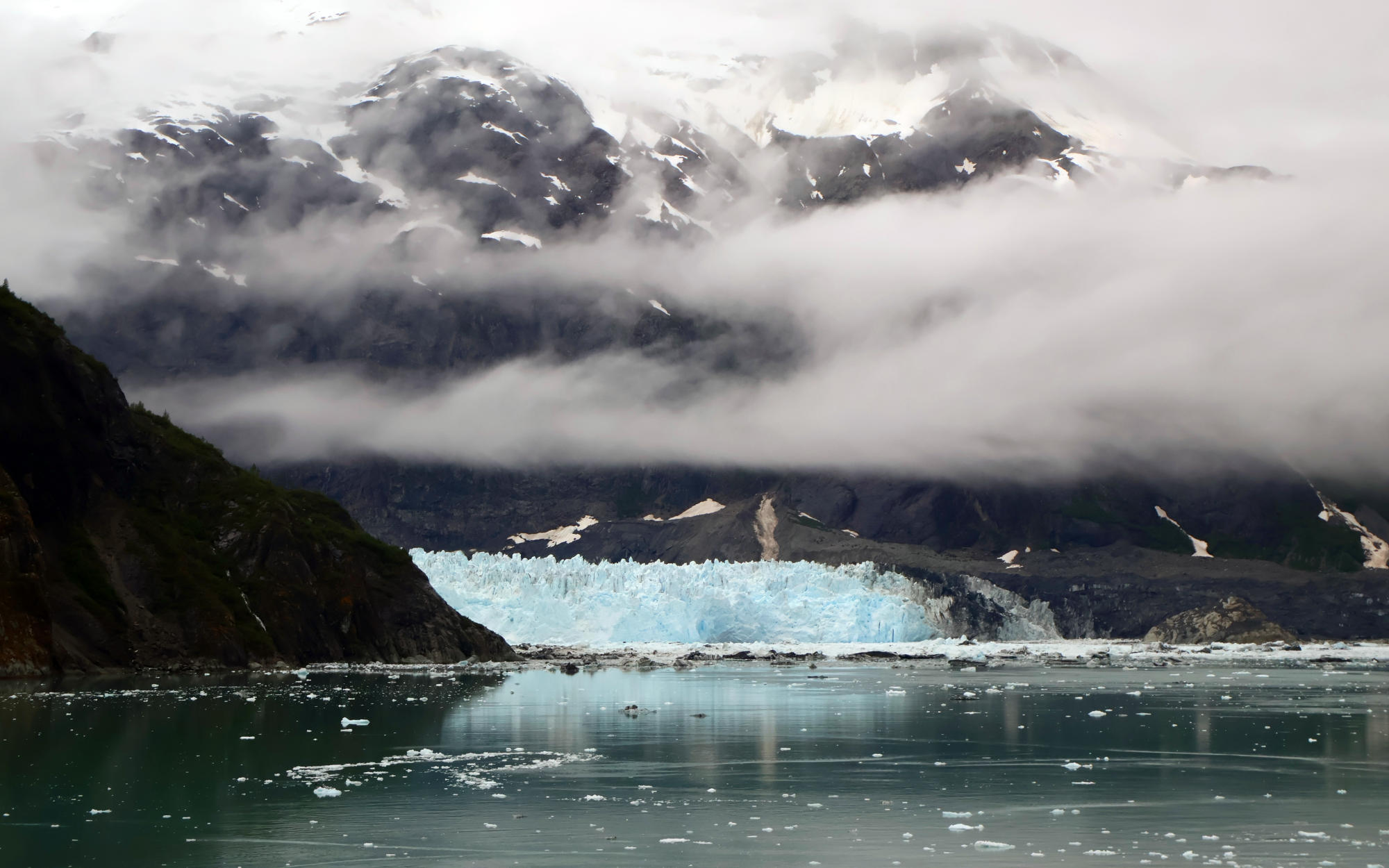
The day had been misty, damp and cool. Seeing the glacier from the bow of the ship was never guaranteed. But as we poked along through the bergy bits and growlers, the skies brightened and the fog lifted just enough for a good, albeit long distance view of the glacier. With a decent pair of binoculars (ones that cost about as much as a powerboat excursion) you can get close enough to get a good sense of what a tidewater glacier is all about.
The deeply fissured and dense blue wall of frozen water pushes tonnes of rocks and dirt ahead of itself before breaking up in the salty waters of the bay. Glacier Bay National Park and Preserve covers an area of 3,223,384 acres (13,044.57 km2) and was established in 1925 by Calvin Coolidge. The park was expanded by 523,000 acres by Jimmy Carter in 1978. There are no roads to the park and if you’re not on a cruise ship, you’ll need to charter a boat or an airplane to see it.
A lone sailboat hung out in the bay and made us wonder if we weren’t crazy enough for the adventure they were having. As we left, the little monohull fell in behind the Queen’s wake, no doubt to miss the bergy bits.


Old Mother Hubbard
 The following day we sailed into the Gulf of Alaska and pointed north for Yakutat and Disenchantment Bays. Outside the bays, a moderate swell (1-2 metres) kicked up and was noticed only by passengers with sensitive stomachs and/or bad hips. The Hubbard Glacier sits in the armpit of Alaska’s southern coast where every weather pattern bundles up and relieves itself. Despite his best efforts to get us within viewing distance of the Glacier, the weather remained stubbornly socked in, preventing us from seeing the terminal ice. This photo is what we had hoped to see.
At a reception later that night, the captain passed his thanks to his co-captain for gently suggesting, “That’s close enough.”, and, by implication, keeping the ship afloat. Those who spent the big bucks for the powerboat excursion managed to get close enough to see the glacier’s face. Fun fact, it takes about 400 years for ice to traverse the 76-mile-long glacier. That means the ice falling into the bay is about 400 years old.
Gin and Tonic
 There is something to be said about making a gin and tonic with ice formed from snow that fell during the early reign of King Charles I; before his beheading by Cromwell’s Parliamentarians in 1649. (And thus, giving us the immortal line from 1066 and All That, “…it is very memorable that he (Charles I) walked and talked Half an hour after his Head was cut off.”) (that quote is missing a full stop and a comma, surely – ed.)
Back on board there was no shortage of things to keep us occupied, including lectures, World Cup football and laundry. Free laundry facilities were available on each deck. As sailors, we never pass up a free load of laundry and threw ourselves into our mid-cruise cleaning with gusto. At almost 300m long, walking the deck soon adds up to serious miles. Three complete loops of deck 3 added up to 0.9 of a mile. Combined with many trips back and forth to the laundry room it meant we still got our daily ration of exercise in. Back in the Gulf the swell kicked up and rocked us very gently to sleep.


The wispy skies in so many of your photos provided such a wonderful ethereal quality to my experience of them. I’m delighted for you – and now me.
Thanks Brad! I was happy someone else was driving!