 Posted by
Position: 45°49’54.6″N 122°23’19.9″W
There comes a point in the aging process when you might feel you’re running short on time. The time when the endless future of your 20s gives way to the inevitability of destiny. This feeling is underpinned in part by the health of our peers and in part the loss of our parents. (Our generation held onto our parents far longer than even they expected.) Perhaps this is why retirees frequently observe, “”I don’t know how I ever had time to work!”
The challenge ahead is manifold. Think about all the things on your bucket list for a start. That the list never seems to get shorter is itself an indicator. In addition to my bucket list, there are bags of ‘things I think I must do’ that I’ve carried around for years. Things like read those books I skipped in high school that, on reflection, I feel I ought to have read. It doesn’t help that I think I must carry the load for all the other men who have given up reading. I don’t know why I say that. All my male friends are, to a man, readers.
Don’t fret too much. Modern libraries and telecommunication devices are there to compress the time you have left, at the expense of boredom, creativity, and long-term retention. As a distance athlete, my relationship with spending long periods of time bored out of my mind while training has evolved over the years. Whether running or cycling, training periods can run for hours. Cycling, especially, lends itself to hours-long training sessions in ways running does not. A fellow 100-mile bike rider once told me, “There’s nothing I have done on a bicycle that beat me up as badly as running.” Grinding out miles for five or six hours is something cyclists in training call a long Saturday ride.
Boredom

I spent my first couple of years cycling mulling things over in my head. It gets lonely up there. After a while, I felt I’d done enough self-reflection and needed something more socially engaging. What I experienced was a common side effect of boredom. Boredom occurs when you have nothing else to occupy your imagination. For many people it can be a slightly depressing and disorienting experience. Spend too long being bored and it can lead you to psychosis. Or, in the case of long-distance cycling, substantial weight loss. Mitigating these risks was the persistent ‘runner’s high’ of intense aerobic exercise. In other words, it felt good being bored as long as I worked my heart and lungs intensely enough.
More experienced cyclists recommended I listen to something with only one earbud (in the right ear – the one next to the curb). Keeping my left ear free to listen for traffic and possible commands from the local constabulary. Turns out after 10,000 miles, most of my rides were guided by my Default Mode Network. That meant I could track a podcast and keep out of the way of the traffic. It gave me a misguided idea that I was making both my brain and body fitter. And all I needed was a smartphone with some flanged, noise excluding earbuds.
Audiobooks
Thanks to our library’s network of reciprocal agreements, thousands of audiobooks are available with a few keystrokes. I’ll be the first to admit that I don’t retain as much when reading from a digital screen or listening to audiobooks. With a few decades of practice, my retention with digital devices has improved, but it’s still not as good as turning a paper page. There’s something about the physicality of reading a printed, bound book that isn’t replicable digitally. Probably a result of how I was taught to read. All these carefully aligned electrons mean that I can listen to books anywhere, anytime I want to. Boredom is a thing of the past! I can whittle down that long list of books and claim I’ve read those forsaken classics, even when I’ve retained only as much as I might have as a hormonal teenager.
Yet, because we humans can honestly only do one thing consciously at a time, listening to a book is nevertheless distracting. That means a walk in the woods near Moulton Falls might be remembered as a walk through Wan Chai or Kowloon. (It happens that my last ‘read’ was a memoir that took place partly in Hong Kong in 1959[1].) That distraction makes exercise pass more quickly – just as a good conversation makes time pass more quickly – but at the cost of living in the moment.
Digital Dieting
There is a great deal to be said for shutting off your devices and letting your mind wander. Letting yourself get a little bored. You retain more of your experiences and make them more readily accessible to short-term memory. An undistracted mind is better at ruminating and seeing problems from different angles. Digital dieting is all the rage these days and I’m all for it. Each morning, I am grateful I don’t have to deal with Facebook, Twitter-X, TikTok or any of the other time-wasting and enraging social media sites. Almost everyone I know and love is on Signal (the messaging app) and can contact me at will. And if we’re not connected, now you know how to find me.
Photos
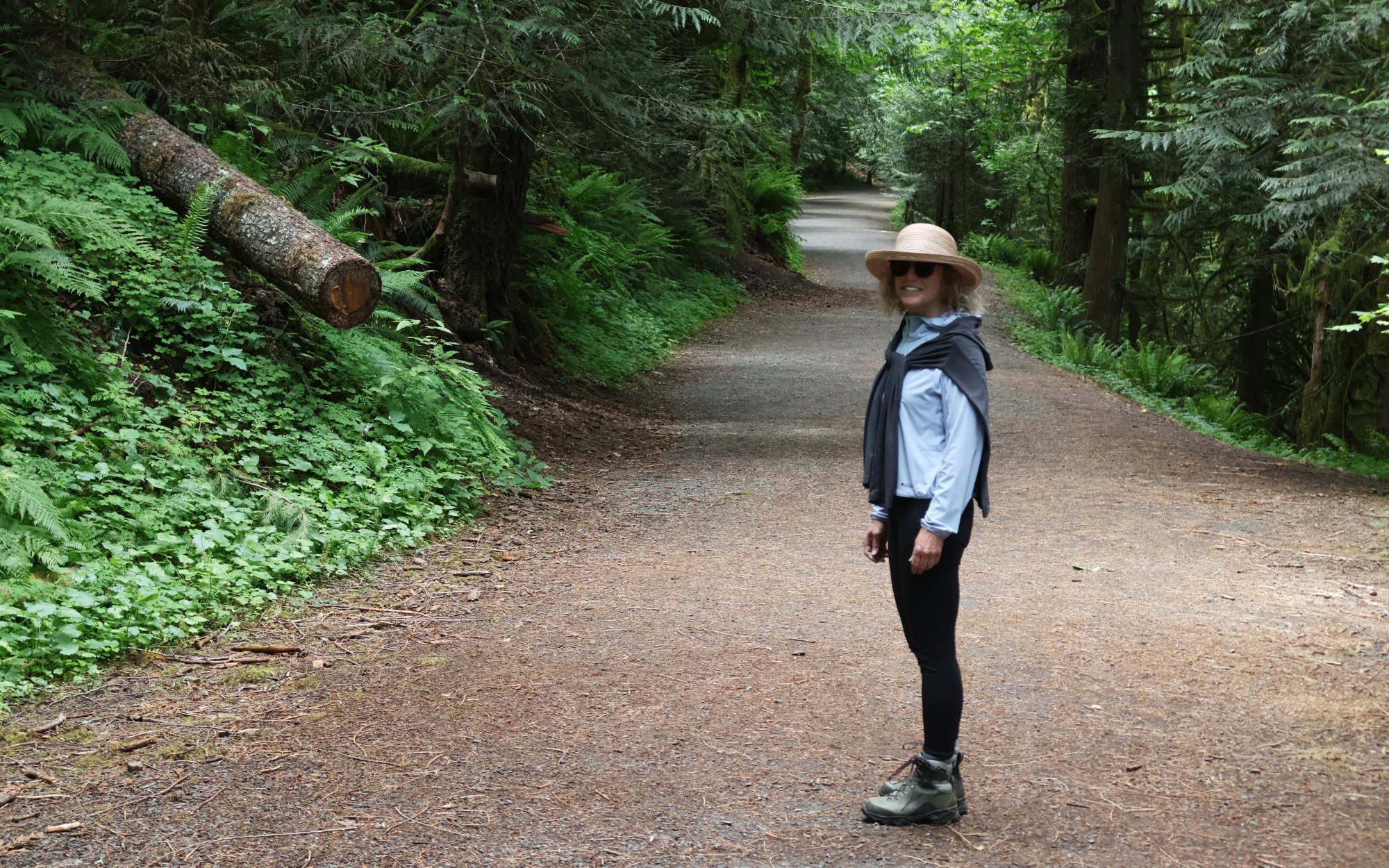
Here are some photos from our walk along the Moulton Falls Trail. It follows the east fork of the Lewis River near Battle Ground, Washington. This is a wonderful spot in the foothills of the Cascade Mountains. Bring your mountain bike if you have one. Trails lead everywhere. The day we walked there, listening to our novels, bright green leaves spread raucously as they do in late spring. Wildflowers and blossoms still clung to the bushes and low meadows. Rain the day before had filled the hillside’s natural cisterns and rivulets of water fell through the rocks in a zen-like garden setting. Appropriately, my book also spent a good deal of time in Yokosuka, Japan.


[1] I heartily recommend Please Enjoy Your Happiness, by Paul Brinkley‑Rogers


I really like photo #2!
Thanks Erin! It’s a lovely place!
Beautiful photos reminding us of the few years we lived in the magnificent green of the Pacific Northwest!
Thanks Judy! It’s still beautiful up here!
Mike, your points triggered this reflection.
It is said that the best teaching is helping others discover what they already know to be true (as in when they reflexively respond, “That’s right.”). This in turn suggests that good learning is our discovering what we already know to be true (as in our realizing, “Yes, that makes sense and/or feels right.”) Feeding ourselves with opportunities to notice/learn makes us ‘self-taught learners’.
Mike, the reading, listening, viewing, and other forms of doing that you’ve described is about feeding ourselves with opportunities to discover and align with what is true for us. And then, it is up to each of us, in all our moments of living, to notice, focus, consider, discover and learn — and appreciate life and ourselves that much more.
Thanks Brad! Well said! The road to self-enlightenment runs alongside the paths of self-discovery and learning. At some point don’t they all meet in the woods?