 Posted by
Position: 63°40’16.3″N 149°34’45.1″W

Today President William McKinley is mostly famous for getting assassinated and having a mountain named (and renamed) after him. He was a noted booster of protective tariffs and believed protectionism would bring prosperity. Thus, he was as far from a free trade Republican (like Eisenhower, Reagan, and the Bushes) as the current White House incumbent.
With some curiosity we made our way from Fairbanks down to Denali National Park, home of the highest mountain in the country. We wanted to know which name the locals used for the mountain after the Cheeto in Chief’s critically important 2025 executive order renaming it. Denali was first renamed for McKinley back in 1917. In 1975 Alaska petitioned the U.S. Federal Government to change the mountain’s name back to Denali, the same year the state officially reverted to its original Koyukon name. Ohioans blocked the measure and it wasn’t until 2015, under the Obama administration, Denali became the official federal name as well.
You say potato…

Now knowing this history, we shouldn’t have been surprised that everyone in Alaska still calls the mountain Denali. I suspect New Yorkers of all political stripes will refer to Lake Ontario by that name for generations to come. After all, no one likes to be told what to do by the feds.
A cold rain fell steadily as we entered Denali National Park, turning the road wet and silvery under the grey clouds. On our way through Healy, I pointed out the Stampede Trail to Carol. That was the track Christopher McCandless took when he went into the wild and starved to death in an abandoned Fairbanks school bus. Having replenished our supply of water and Mountain House freeze dried meals, we had no such ambitions. Our main concern at the time was not being eaten by bears.
The trip to Brooks Falls was still a week away and our fear of bears still based on a nearly complete lack of first-hand experience. I say, “nearly complete”, but Carol and her first husband, Mark, encountered a grizzly in Glacier National Park many years ago. They had hiked up a trail and, unknowingly, inserted themselves between a sow and her cub. All parties were surprised by the encounter, but Carol and Mark escaped intact. Rangers closed the trail as soon as they reported in.
Grizzlies don’t like surprises. Therefore, one of the best things you can do on trail is make noise. Talking loudly, singing, and carrying warning bells are all effective means of telling a grizz you’re on your way. Having bought a couple of bear bells in Fairbanks, I was determined to use them. Their gentle tinkling seemed too quiet to be of much use, but after three nights in the park, we didn’t see a single bear. Perhaps they worked after all. To boost our confidence, I strapped on a can of bear spray and had it ready at my hip. Just in case waving our arms and jingling our bells didn’t scare the bears.
Teklanika Camp
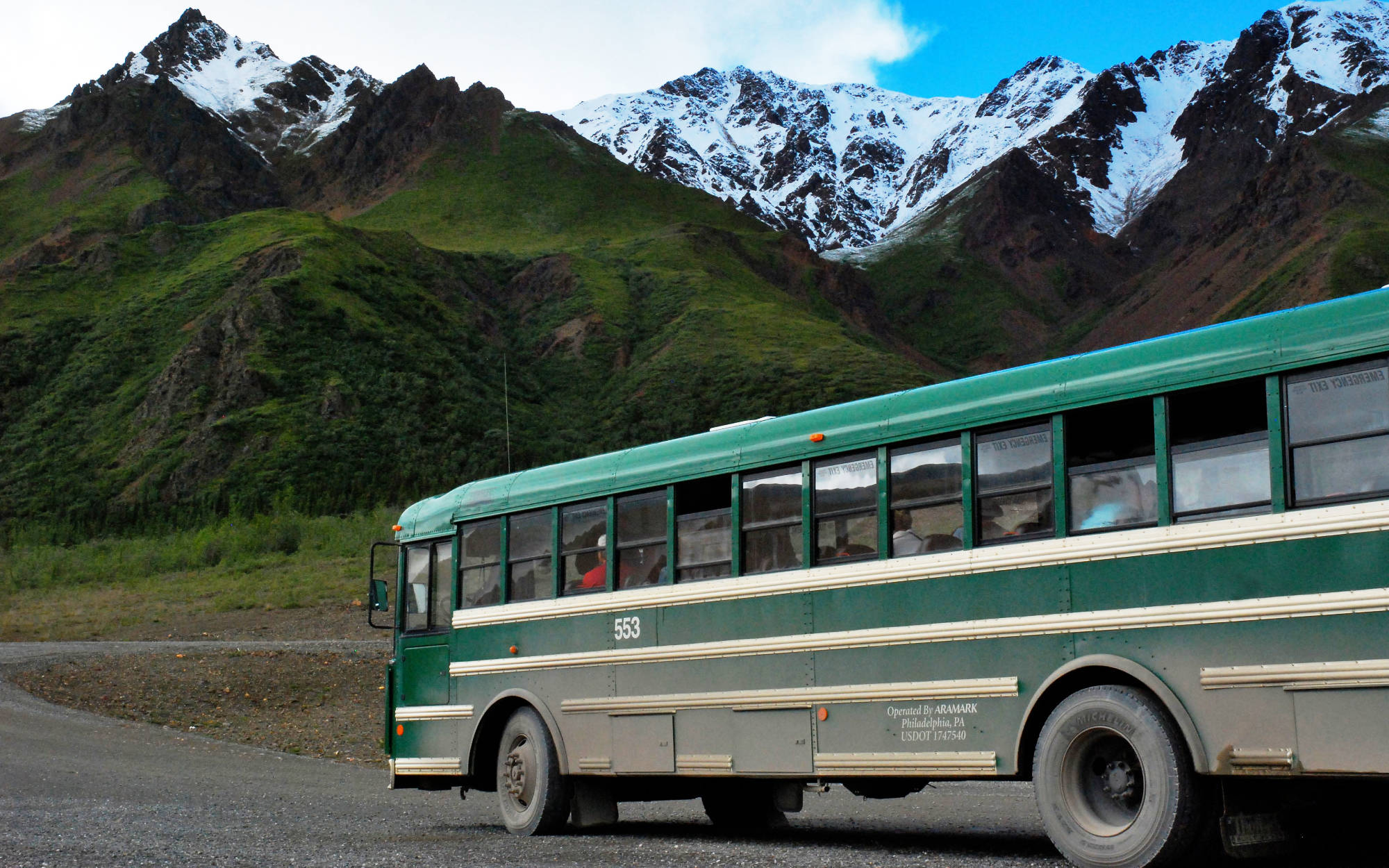
After some detailed research we opted for Teklanika campground, about 28 miles from the park entrance. Tek, as it’s known, requires a three-night minimum stay. Once you’re there, you agree not to drive your car in or out. This helps preserve the illusion of wilderness camping and minimise pollution. The illusion is mitigated by bus services that run up and down the park’s only road ferrying cruise ship passengers and campers in search of wildlife.
The main thoroughfare to Denali mountain, Park Road, passes along a significant, and slow-moving landslide about 15 miles further up the road from Tek. For the past three years, the road has been closed at its midpoint and the National Park Service has been working on a comprehensive fix for the problem. In other words, a stop just past East Fork Bridge (crossing the east fork of the Toklat River) was as far as the bus would take us.
At a park service hut, a long set of steps leads down to the riverbed. There we were free to explore the rocky glacial wash of the river’s many arms. The going was easy as the stones are small and tumbled smooth. We walked as far as we could until we couldn’t cross the fast-flowing river safely.


Spray

At the top of the stairs, a young ranger gave us some helpful advice about using bear spray. Spray it at the ground in front of the bear, not directly at the bear itself. Used correctly, he said, you can incapacitate a bear for 45 minutes. That sounded optimistic for any animal weighing 1,000 pounds. You should also stand upwind of the spray, assuming that’s possible.
At the end of our hike, we stood on the bridge and watched a large elk walk upstream along the path we had just taken. From a distance we could see other hikers admiring the beast. With its large antlers it would have towered over me. Elk can be aggressive and account for five times as many injuries as grizzlies. You can, in theory, use bear spray to deter an elk, but make sure you aim higher.
Rain fell that night and we realised our 10-year-old tent was no longer waterproof. Not catastrophically, just annoyingly. With temperatures dropping into the 30s(F) at night we bundled up in our woolly hats and spooned furiously to keep warm. Our earlier choice of Coleman sleeping bags turned out singularly poor for the conditions.
Hiking
Denali has very few marked trails. Mostly, you are encouraged to wander through the undergrowth and cut your own path. For lubbers that means either turning on your smartphone’s GPS tracker or orienteering. For our second day’s hike we opted for Tattler Creek, one of the few marked trails just off the main road. The trail isn’t maintained. Rather you follow an instinctive path up along the clear stream waters, pushing through green alders and dwarf birches.
We lost the trail a couple of times and hacked through the undergrowth, our bells jingling all the while. What scat we came across looked like mountain sheep’s, not bear’s. Clambering up a short escarpment provided us a view up and down the valley and several paths to choose from. For another mile we followed our noses and wished we’d brought a machete. The weather held off for the rest of the day. Finally, back at camp we lit a fire to shoo the mosquitoes and black flies away. Above, in the treetops, a pair of noisy ravens did their best to keep a hawk out of their territory. Their squawks and caws carried on for an hour. Despite the chilly conditions, we slept soundly.


