 Posted by
Position: 28°15’10.6″N 16°37’32.3″W
Winters in the Canaries are generally mild. From November onward the trade winds settle in and blow a steady 20-30 knots out of the northeast by late January. Sea temperatures hover around 20C all year round, keeping things warmer in the winter and cooler in the summer. Steady breezes and warm weather make for great sailing. So, when my daughter Katie asked if she and her husband Aron could come to Tenerife and sail with us for a few days in mid-December, we said, “of course!” Knowing full well the weather might or might not cooperate.
Storms

The Atlantic hasn’t been happy this year. Since the middle of August, storm after storm has battered the northern ocean. Much of the energy slams into the British Isles and Ireland or blows directly into the Bay of Biscay. A dock neighbour in Lanzarote said he had left the UK in mid-November. In other words, very, very late in the season. Off the north coast of Spain, he battled four and five metre waves and his engine packed up. Eventually, he limped into a local harbour at night under jib alone. There he jury-rigged things well enough to get him as far as the Canaries. With a trans-Atlantic crossing in his sights, however, he decided to fly in his personal mechanic and his assistant for an engine and generator overhaul. It was undoubtedly the most efficient way of getting the work done.
For our part, after a couple of weeks crossing between three big islands, we felt a little more confident with what to expect from the weather. Naturally, the weekend Katie and Aron arrived the forecast was predicting the worst storm in a decade. And it did not disappoint. High winds mean high seas. Not knowing how seaworthy the kids were and with no desire to sail in big seas, we opted to leave Aleta where she was and instead explore the island by car and foot.
Windward

The storm bore straight down from the north, so of course our first foray was to the exposed northern side of the island. Jagged spires of rock stretch up and tower over the cliffs and thin stretches of beach. Veils of grey rain were visible for miles out at sea. Making their way slowly towards land, the clouds shifted and merged as they bumped against the steep cliffs. Rain lashed down in bursts, but not enough that it spoiled the walk.
Breathlessly, we climbed the near-vertical streets of Taganana until things finally flattened out. The trail stretched ahead of us curving around the hills. The tarmac soon ran out and the trail turned into red soil and rocks, drawing us forward with sweeping views of the coast in both directions. When they came, the rains blew in horizontally and whenever we could we sheltered behind the trunk of a nearby palm tree.
Then, abruptly, the trail ended at a wash out. With no safe way around and posted warnings of further rock falls, we reluctantly turned back. For Aleta’s full-time crew, used to sauntering along flat beachfronts, the hills proved challenging. I awoke with sore calves. Katie and Aron on the other hand are young and mad keen on hiking and climbing and were barely getting warmed up.
The storm reached its height that night. On Aleta gusts peaked at 40 knots in her relatively protected marina. Elsewhere on the island winds hit 70 and 80 knots taking down trees and electrical power. Snow blanketed Tenerife’s highest elevations.


Los Gigantes

The following day the sun shone brightly between scudding clouds. The sea state had dropped from four metres to three and remained unattractive. Pointing our rental car west-southwest towards the cliffs of Los Gigantes we wound up at Bar Cafetería Mirador de Archipenque, overlooking Puerto de Santiago. Given the island is riven with challenging hiking trails, you can choose your microclimate and always find a good walk with stunning views.
Heading uphill, we made our way around a series of walled gardens chock full of banana trees. Tenerife grows about 150,000 metric tonnes of bananas and plantains annually. You’d think that the entire place would be covered in banana plantations, but the mountain is so vast it dwarfs almost everything in its shadow. At our turnaround point at the top of a ridge, we could see straight down 500m to the ocean and across to the round island of La Gomera.


Teide
Pico del Teide looms over Tenerife. It is by far the highest peak in the Canaries, and the highest point above sea level among all the islands of the Atlantic. From the sea floor to the tippity-top it measures 7,500m (24,600’). From sea level it is only 3,718m (12,198’), making a day’s bicycle ride up and down a possibility. Based on our firsthand observations, keen cyclists come from all over Europe and knock out an ascent of the world’s third tallest volcano on a regular basis.
Having cycled up both Mount Hood (3,429m) and Mount Ranier (4,390m), I looked up at the flared verges of Mount Teide and admired the smooth roads leading to the top. I wished, momentarily, I had both a suitable bike and the stamina for such a ride. Ten years ago, I might have challenged Aron to an ascent. Ten years ago, he probably would have accepted.
Snow!

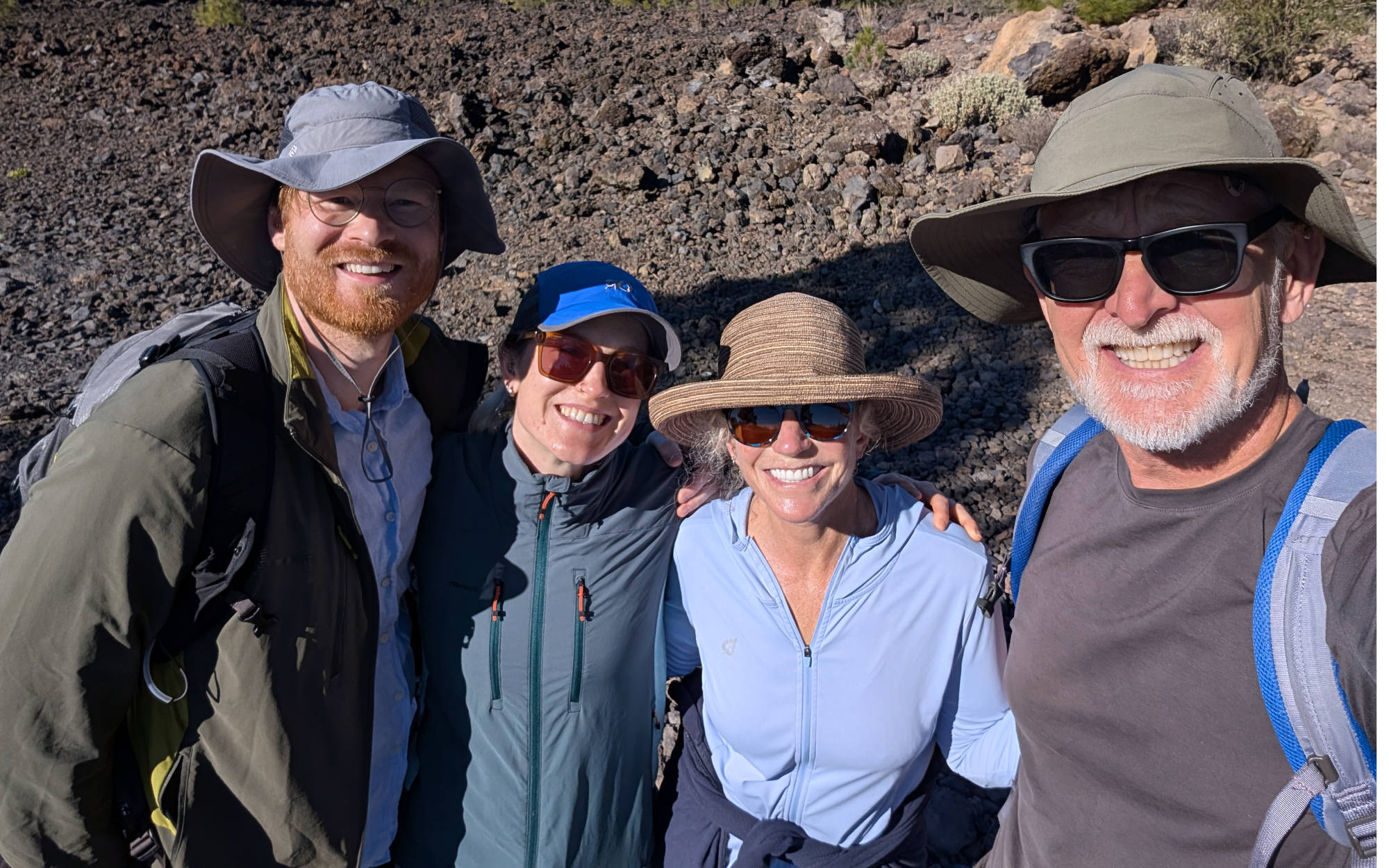
For our last adventure, Aron took the advice of a friend and we located a hike about halfway up the mountainside. Sitting a couple of hundred metres below the treeline, the Sendero del Chinyero makes a long loop around a couple of small cinder cones. Mostly flat, the hike takes you through pine forests and broad lava fields.
The Chinyero volcano is either off limits to hikers, or it isn’t. Seeing people on the ridgeline contradicted what the national park signs told us (which was to keep off). Since we couldn’t reach a consensus, we opted to stick to the footpath. At the end of the hike Katie spotted a cat in a tree. As we got closer, we saw a young couple standing around and occasionally looking up at the cat. Turns out it was theirs and this was the cat’s favourite thing to do after a walk in the woods.
Back in the car, I drove uphill towards Teide National Park to see how far the road would lead us. Snow had closed most of the roads crossing towards the north side of the island, but after two days the sun had cleared the roads along the south side of Teide’s summit. Dozens of families had driven up for a rare chance to play in the snow. The police, in a Grinch-like manoeuvre, pulled over anyone who had put a snowman on the bonnet of their car. The scenery was amazing and more than made up for the interminably long drive back down to the motorway.


Next time
After a few short days, Katie and Aron boarded their flight back to the UK to begin their Christmas preparations in earnest. We will save the sailing for their next visit but remain very grateful for their energy and passion for hiking, exploring and seeking out the best craft beers wherever they go.


Great info to update your sailing and land exploration!! We are going to Sicily in a couple of weeks. It sounds like all is well with you guys and boat! Your house here is still being cleaned and remodeled as is Huffs. Miss having you guys here!
Thanks Steve! Have a great time in Sicily! We’re hoping to get down to Albuquerque in April and see you guys. We’ll let you know when our plans firm up!