 Posted by
Position: 58°33’17.7″N 155°47’28.0″W

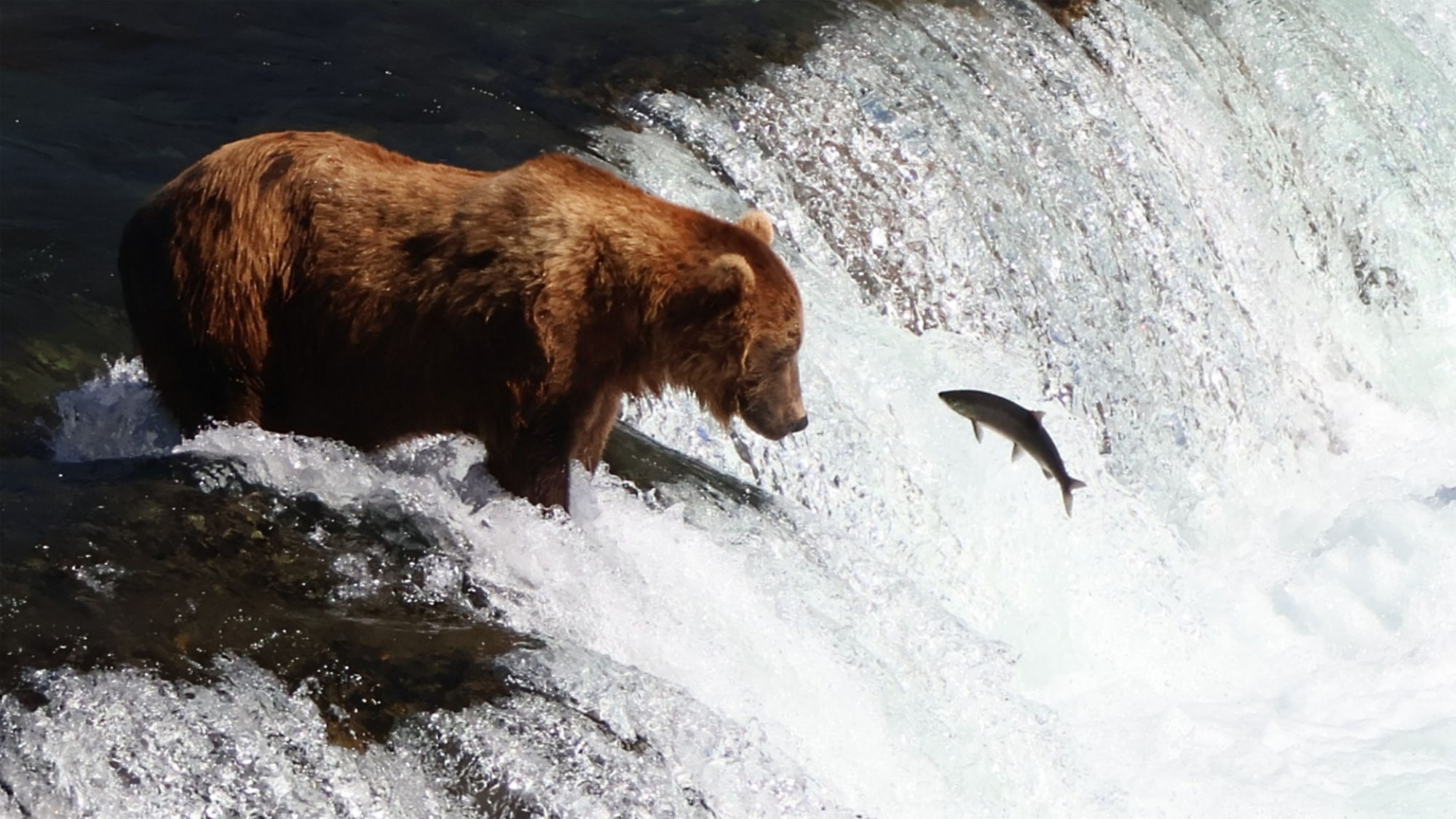
The morning of our big bear adventure rose sunny, cool and calm. Carol, on a mission to experience as much of Alaska as money would allow, had booked us a couple of seats on a Bald Mountain Air Service flight to Katmai National Park to watch the bears catch salmon. Watching the National Park Service’s bearcam gives you a sense of the action. If you’re a gambler, you can follow Fat Bear Week and find out which bears are in the running this year. Armed with that knowledge, you can then blow your life savings by betting on one of the many prediction markets that manage the odds for punters. For our part, we just wanted to see wild bears as closely as possible without getting eaten.
On the dock, the pilot, Gary, asked me if I wanted to sit in the copilot seat. I jumped at the chance, knowing Carol would be envious. I made a mental note to make sure she sat up front for the return leg. Our fellow passengers included two Czech couples who we thought sounded Russian. But what did we know?
Flying Otters

When it’s on the water, a float plane is a little like a boat. Mooring lines need cleating and uncleating and an anchor is useful when there’s no dock to tie off to. Our runway was a lake parallel to Homer’s tarmacked airport. After a short taxi we turned and accelerated. Within a few hundred yards we were airborne. The unpressurized DHC-3 Otter was very loud and noisy and headphones are a necessity for communicating. By the time we reached 12,000 feet in altitude the cabin temperature had dropped significantly, but we could see along the Cook Inlet all the way up to Anchorage.
Sitting in the co-pilot’s seat I decided Gary was probably a couple of years older than me; and probably just a couple of years older than the plane. Looking up any airplane’s history just requires knowing its tail number. N413JP was riveted together by de Havilland Canada in 1958. Bright orange with red lettering, the plane had been repainted in the past five years. I looked up what a 70-year-old de Havilland Otter goes for. I was surprised. A decent one costs around $1.5 – $1.7 million. Originally, they cost about $140,000. That’s about $1.4 – $1.5 million today. 0% depreciation over the past 68 years is a good deal. DHC-3 Otters are solidly built and, when well-maintained, the airframe should last forever.
Don’t Feed the Bears

Brooks Falls is the only place in the world that the typically solitary coastal brown bears come together. But when the salmon come in droves and there’s enough for all, you can afford to cozy up. As a result of all the bearnomie, the bears are also much more chill around humans. In Denali we were warned to keep 275m from the bears, at Brooks Falls the safe distance was deemed only 50m. The young ranger admonished us not to apply that rule anywhere else in the world. A naturally well-fed bear is a happy bear. Bears fed by humans generally wind-up dead. Something in human food instantly turns them into sociopaths and they have to be put down. Sad but true.
A few bear facts (from the NPS):
- Alaska has between 32,000 and 43,000 brown and grizzly bears
- At birth cubs weigh about a pound. An adult can weigh between 700 and 1,000 pounds.
- Brown bears feed mainly on salmon and will eat 90 pounds of salmon a day to gain 3-6 pounds of fat daily.
- Brown bears vary in colour, from blonde to dark brown.
- A brown bear can run at up to 35mph in short bursts.
- Females live into their mid-twenties, and males into their late teens or early twenties.
Watching the bears fish from the safety of the viewing platform was incredibly relaxing. (To be clear, I was on the viewing platform and the bears were in the water.) The river burbled in the background and only the occasional bear grunt broke the stillness. Very ASMR if you’re into that kind of thing. Lots of folks come to fly fish the Brooks River. Standing in icy waters a hundred yards from grizzlies may not be everyone’s cup of cocoa, but it sure looked fun. Encouragingly, several women were also fly fishing, and one was a guide and instructor.
Don’t Get Eaten by a Bear
Getting eaten by a grizzly bear takes effort. Since 2000 19 people have died from brown/grizzly (ursus arctos) attacks in Alaska. That’s less than one a year. For comparison, two to three people are crushed by vending machines each year in the United States. That makes the office break room far more dangerous than hiking through the brush in bear country.
To inspire (read: scare the bejeepers out of) us, we watched Werner Herzog’s documentary, Grizzly Man. Visiting Brooks Falls gave us a much better sense of how and why Timothy Treadwell became so comfortable around wild bears. As long as everyone has enough to eat, things stay fairly relaxed. But a hungry bear is an unpredictable bear and best avoided. We always carried bells (to warn the bears we were around and not surprise them) and bear spray (to discourage a bear charge). Properly deployed, bear spray will disorient a bear for up to 45 minutes. But if a bear charges you and you survive (or don’t), the likelihood is a posse will track the bear down and euthanise it as a precaution.
Back Home(r)

Unsurprisingly, our flight back followed the same route we flew in on. Late afternoon on a sunny day meant more wind and thermals swirling over the tall mountains, hence a little more turbulence. That settled down over the waters of Cook Inlet. With Carol up front and me sitting just behind her on the port side, I had a clear view of the Pitot tube outside my porthole. Based on 18th century technology, the Pitot tube is a doohickey that with some additional gear measures airspeed. (Of course I had to look that up.)
After a smooth landing on the lake, we drove down Homer’s famous spit looking for a snack, or at least a pint. In the height of summer, the city gets jammed with tourists taking advantage of the short summer. RVs lined the street on both sides. The spit has only one road out and back. Since it was too early for dinner we headed to Grace Ridge Brewing for a pint. There we reflected on the many wonders of nature and how lucky we have been to experience a few of those wonders – like bears in the wild.


