 Posted by
Position: 32°07’40.7″N 118°46’17.5″E

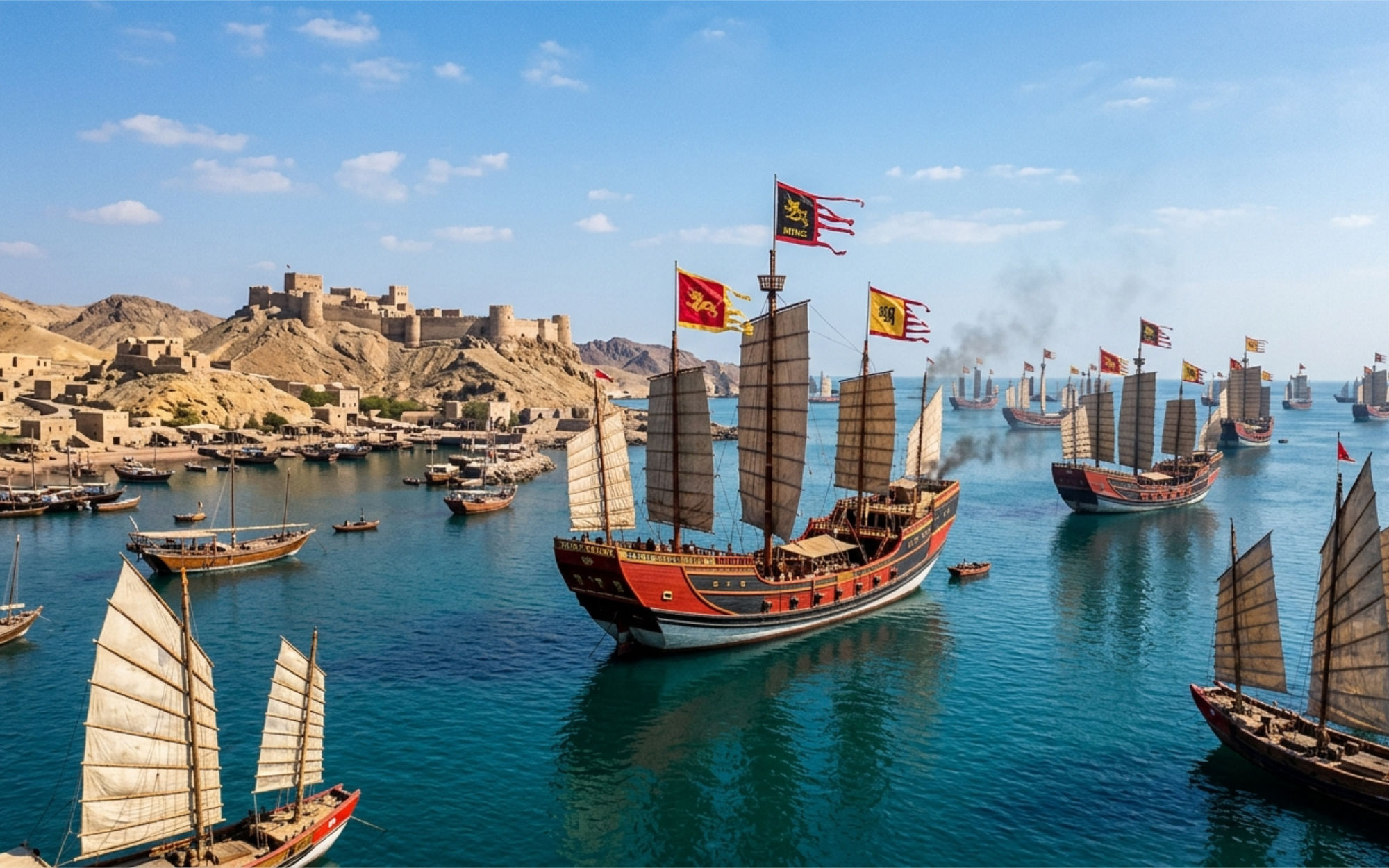
Continuing our occasional series on famous sea captains, this week it seems appropriate to delve into a little about Zheng He, China’s Ming dynasty-era admiral and adventurer. Zheng is often regarded as China’s greatest admiral. Beginning in 1407, Zheng led a total of seven voyages in large treasure ships over 100m in length, twice the size of European ships at the time. Each voyage set out to explore the ‘Western (Indian) Oceans’ and firmly establish China’s foothold in regional trade.
The fleets consisted of 300 or more ships and 27,000 people. In addition to huge treasure ships, the fleet used smaller, specialized vessels for horses, supplies, and troop transportation. Fresh water tankers carried enough for the fleet to spend an entire month at sea. Warships helped defend against pirate attacks, a common occurrence through the Straits of Indonesia. To avoid scurvy, the tanker ships grew sprouted mung and soybeans in hydroponic trays. Dry beans contain no vitamin C, while 100 grams of sprouts will yield between 15% and 80% of your required daily amount. Green tea and brown rice carried in vast quantities provided antioxidants and vitamin B1.
Big Bamboo

Uniquely, the treasure ships featured watertight bulkheads modeled after the internal structure of bamboo. The junk rig had several advantages over the more familiar square rig used on European ships. Chinese ships used fully battened lug sails giving them a distinct advantage in handling. Sailors didn’t have to go aloft to take in or let out sails and the rig gave the ships better windward performance.
It was an armada that sought trade and diplomacy, not dominance over the Indian Ocean. In exchange for Chinese silks, gold, silver and porcelain, Zheng brought back ostriches, zebras, camels, giraffes and ivory. All this 80 years before Vasco de Gama rounded Cape Horn from Portugal. Much like today, the Yongle Emperor’s focus was on establishing control over distant trading routes and establishing a China-centric geopolitical order. So many linguists and interpreters were acquired during the voyages that a language institute was established in Nanjing. Navigation was enabled by maritime compass, celestial observation and star charts accurate to within 4.5 miles, along with speed and time calculations. On each voyage detailed navigation scrolls were created and updated with the assistance of local mariners.
Beginnings
Zheng He’s beginnings were modest. Born Ma He into a Muslim family around 1371 in Yunnan province, his family claimed descent from an early Mongol governor of Yunnan as well as from King Muhammad of Bukhara (Uzbekistan). Ma was captured and castrated at about 10 years old when China reconquered Yunnan from the Mongols.
Ma joined the army as an orderly. In 1390 the army Ma served in was placed under the command of Zhu Di, the Prince of Yan, and he distinguished himself as a junior officer with skills in war and diplomacy. In 1399 Zhu revolted against the Jianwen Emperor and launched a civil war. After three years of fighting, Zhu prevailed and ascended to the throne as the Yongle Emperor in 1402. Having gained the trust of the emperor in battle, Zhu Di bestowed the surname Zheng on Ma He in 1404 in recognition of his service during the civil war and for his distinction in battle defending the Zhengcunba district near Beijing. Bestowing a surname was one of the highest imperial honours of the Ming Dynasty.
First Voyage
In 1405, a grand fleet was readied and orders to lead 27,000 troops to the Western Ocean issued. Zheng was appointed as Grand Director and later Chief Envoy during his sea voyages. The size of the fleet was unprecedented. However, the ships followed a well trodden route. On the fleet’s return journey, it engaged and defeated the pirate fleet of Chen Zuyi in the battle of Palembang, South Sumatra. That opened the trading route through the Strait of Malacca and was the first step in making Malacca an international trading hub. The fleet returned to Nanjing in October 1407. Almost immediately it set sail again, this time reaching as far as Calicut, in southern India.

Tributaries
The fourth voyage, beginning in 1413, sailed as far as Hormuz. The fifth voyage reached East Africa including Dhofar (Oman), Lasa and Aden. By now the China-led tributary system around the Indian Ocean was well established. Like the Hanseatic League in the Baltic, Zheng He’s network dominated maritime trade. Unlike the Hanseatic League, Zheng’s system was state sponsored and focused on prestige more than profit. It was also much shorter lived. When Zheng’s continuous adventuring and presence in the region came to an end with his death in 1433 the system began falling apart.
Under the Xuande Emperor (1425-1435) Zheng made one more voyage. But the new emperor decided the tribute system was too expensive and ultimately unnecessary. From that point, China entered a period of isolation and Zheng He was almost entirely forgotten. It wasn’t until the early 20th century Chinese scholars rediscovered Zheng’s maritime record and reinterpreted him as a grand symbol of China’s maritime prowess. His legacy was used to counter Eurocentric narratives of exploration. Later, in 2013, Zheng’s legacy was incorporated into the Chinese government’s Belt and Road Initiative with a “maritime silk road” extending all the way into the Mediterranean Sea.
Zheng He probably died on his last voyage and was likely buried at sea. He is quoted as saying: “We have traversed more than 100,000 li (a Chinese Mile) of immense water spaces and have beheld in the ocean huge waves like mountains rising in the sky, and we have set eyes on barbarian regions far away hidden in a blue transparency of light vapors, while our sails, loftily unfurled like clouds day and night, continued their course [as rapidly] as a star, traversing those savage waves as if we were treading a public thoroughfare…”
More:
- Zheng He’s voyages to the west oceans
- Zheng He’s sailing to the West Ocean
- Zheng He – Encyclopedia Brittanica


That was an awesome post, Mike!
Thanks Michael! One for the history fans!